
Some of the best future customers for your painting company may come from people you have already served.
A happy customer already knows the quality of your work. They have experienced your communication, watched your crew work around their home, seen how you protect their property, and gone through the entire project from estimate to final walkthrough.
Most importantly, they already trust you.
So when a friend, neighbor, coworker, or family member asks:
“We're looking for someone to paint our house. Do you know anybody?”
your customer's recommendation can immediately put your painting company in a much stronger position than a business the homeowner has never heard of.
This is not a small opportunity.
Block Renovation's 2025 homeowner research found that among respondents who had completed a major renovation, 52% found their contractor through a referral from a friend or neighbor, compared with 19% through Google searches and 9% through online platforms. The research focused on U.S. homeowners who had completed or were planning renovations of at least $10,000.
The problem is that many painting contractors leave referrals completely to chance.
They finish the project, collect payment, thank the homeowner, and hope that six months from now the customer remembers the company name when a neighbor needs a painter.
A referral program creates a repeatable system instead.
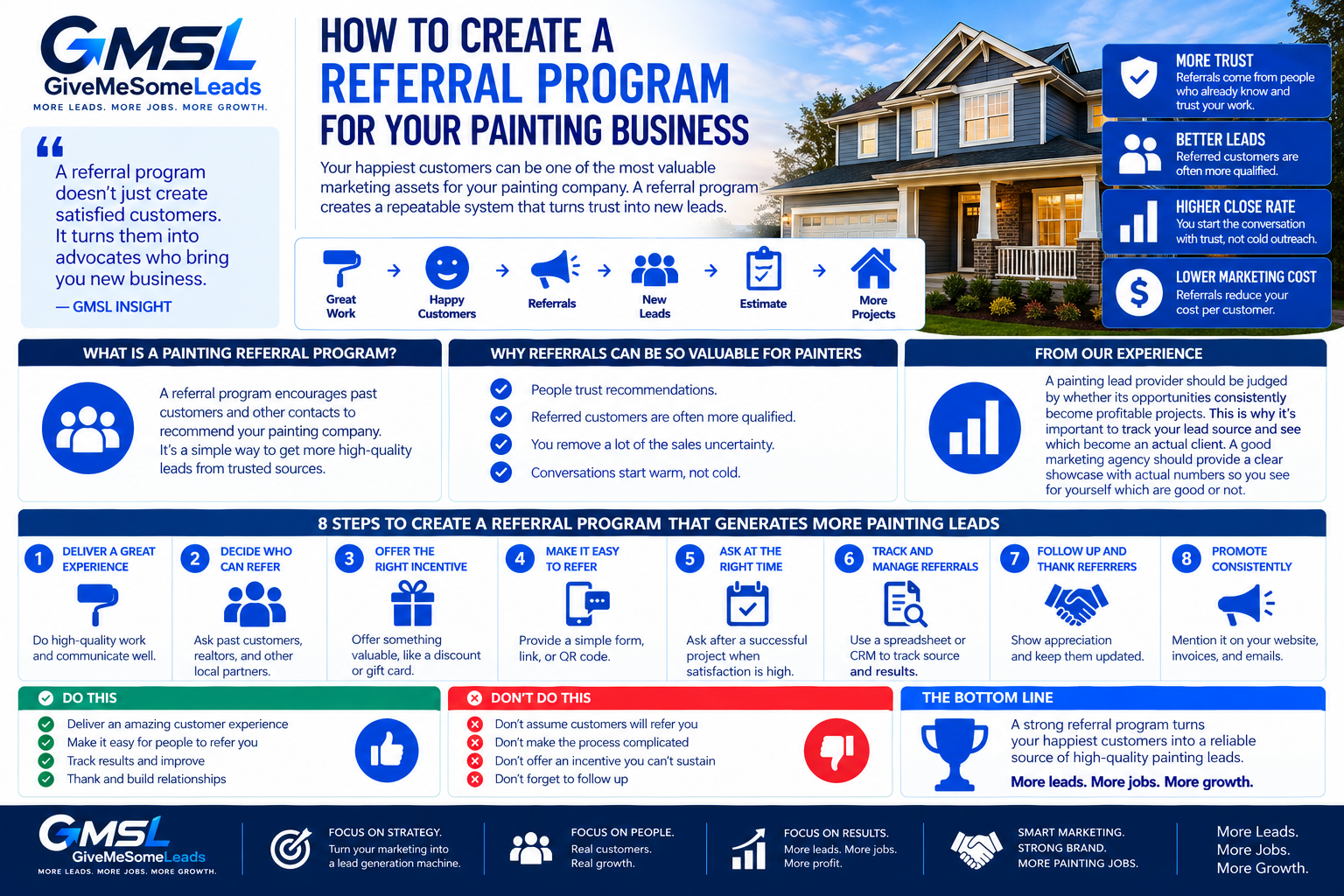
The best referral programs are usually not complicated. They combine an excellent customer experience with good timing, a simple way to make the introduction, consistent follow up, proper tracking, and appreciation for the customers and professional partners who send opportunities your way.
A referral program does not create satisfied customers. It turns the satisfaction and trust you have already earned into more opportunities for your painting company.
What Is a Painting Referral Program?
A painting referral program is a system designed to encourage past customers, current customers, and sometimes professional partners to recommend your company to people who need painting services.
The basic customer journey might look like this:
Great Painting Project → Happy Customer → Referral Request → Recommendation → New Homeowner → Estimate → Painting Project
Some referral programs provide a financial reward. Others offer a future painting credit, gift card, small thank you gift, or no incentive at all.
The incentive is not the foundation of the program.
The foundation is making referrals easy, memorable, trackable, and worth giving.
If someone already loves your company but cannot remember your name, does not know how to refer somebody, or is never reminded that referrals are appreciated, potential opportunities can disappear.
Why Referrals Can Be So Valuable for Painting Contractors
Painting is a trust driven purchase.
Homeowners are not simply buying paint and labor. They may be hiring a crew that will spend several days inside their home, work around expensive furniture and personal belongings, prepare delicate surfaces, use ladders around the property, and potentially require access while the homeowner is working or away.
Trust matters long before the first gallon of paint is opened.
Houzz surveyed 2,866 registered users for research published in 2025 and found that 64% of homeowners included recommendations or references among the top three factors influencing who they hire for a home improvement project. Experience with a similar project scope followed at 47%, while pricing that fit the homeowner's budget was cited by 39%.
A referral can therefore solve one of the hardest parts of contractor marketing before your estimator even arrives.
Instead of starting the conversation completely cold, the homeowner might already have heard:
“They were extremely clean.”
“They showed up when they said they would.”
“They painted our entire exterior and did an excellent job.”
“We would definitely hire them again.”
Your sales process still matters, but you are beginning with borrowed trust from someone the homeowner already knows.
Start With a Customer Experience Worth Referring
No referral incentive can compensate for mediocre service.
Before creating a large “Refer a Friend and Get $100” promotion, make sure your painting company is actually creating experiences customers feel comfortable attaching their name to.
That means answering calls, arriving when promised, communicating schedule changes, protecting the property, maintaining a clean jobsite, performing proper preparation, treating homeowners respectfully, solving problems professionally, and completing a final walkthrough before considering the project finished.
The finished paint job is obviously important, but customers remember the entire experience.
Houzz's homeowner research also found that 55% of respondents experienced some type of challenge once a home improvement project was underway. Among those reporting challenges, schedule changes and staying on schedule were the most common issue, while timely and accurate communication was another major concern.
For painters, that matters because referral potential is not created only by straight cut lines or smooth walls.
It is also created by being the contractor who makes the project easy to live through.
Imagine two painting companies produce similarly good finished results.
Painter A delivers beautiful work but repeatedly arrives late, does not communicate scheduling changes, leaves materials around the house, and makes the homeowner chase them for updates.
Painter B sends scheduling updates, protects the floors and furniture carefully, keeps the work area organized, communicates when something changes, cleans at the end of each day, and finishes with a professional walkthrough.
Which painting company is the homeowner more comfortable recommending to their neighbor?
Probably Painter B.
A referral means your customer is putting some of their reputation behind your company.
Good workmanship creates satisfaction. A professional customer experience makes people more comfortable recommending you.
Decide Who Can Participate
Your referral system does not have to be limited to past homeowners.
Different groups can generate different types of opportunities.
Past Customers
Past customers are usually the most obvious source because they have already experienced your work.
Current Customers
A customer may begin recommending your company while the project is still underway, especially when neighbors see exterior painting, cabinet transformations, or visible improvements.
Repeat Customers
Someone who has hired you several times can become an especially strong advocate because their recommendation is supported by repeated experience.
Realtors
Realtors regularly work with homeowners preparing properties for sale, buyers improving recently purchased homes, and investors maintaining properties.
Interior Designers
Painting and decorating naturally overlap, particularly with interior repaints, cabinets, feature walls, and major room transformations.
Flooring Contractors
Painting often happens immediately before or after flooring installation.
Remodelers and General Contractors
Painting is commonly one of the final stages of renovation and remodeling work.
Property Managers
Property managers may have recurring painting needs across rental units, multifamily properties, offices, or other managed properties.
You do not necessarily need the same referral program for every audience.
A simple homeowner referral reward and a professional relationship with a property manager should not automatically be treated the same way.
Keep the Referral Offer Simple
If a customer needs to read several paragraphs of conditions to understand your referral program, it is probably too complicated.
A simple customer offer might be:
Refer someone who hires us for a qualifying painting project and receive a $100 thank you reward after their project is completed and paid.
The customer immediately understands the basic arrangement.
They know what they need to do, what needs to happen for the referral to qualify, what they receive, and when the reward is issued.
You can still have reasonable terms covering service areas, minimum project values, duplicate leads, existing customers, and other conditions.
Just do not make customers study a legal document to recommend their painter.
Reward is issued after the referred project is completed and paid.
Decide Whether You Actually Need an Incentive
Not every referral needs a financial reward.
Customers regularly recommend businesses simply because they had a great experience and want to help someone they know.
Your program could use:
- No financial incentive.
- A gift card.
- A future painting credit.
- A small thank you gift.
- A charitable contribution.
- A cash or equivalent referral reward.
Test what works for your customers and your business economics.
A larger reward does not automatically create a better referral program.
In fact, making the reward too aggressive can sometimes shift the feeling from “I know a great painter” to “I am trying to make money by selling my friend something.”
You generally want the recommendation to feel natural.
Before creating an expensive incentive, start by consistently asking satisfied customers for referrals.
You may discover that the biggest problem was never the size of the reward.
You simply were not asking.
Make the Reward Fit Your Customer Acquisition Economics
If you decide to offer an incentive, compare the cost against what you normally spend to acquire a customer.
Suppose your average painting project is $7,500 and your company normally spends approximately $600 in marketing to acquire a new customer.
Paying a $100 referral reward after a referred homeowner becomes a paying customer could potentially be extremely reasonable.
Those numbers are illustrative.
Your actual decision should consider your average project value, gross margin, customer acquisition cost, close rate, referral reward, and the type of projects the program generates.
Do not simply ask:
“Is $100 expensive?”
Ask:
“What would acquiring this same customer through another marketing channel normally cost us?”
That is a much more useful business question.
Reward Results Instead of Random Contact Information
Someone providing a phone number is not necessarily the same as generating a valuable referral.
Consider issuing rewards only when a referral meets clearly defined requirements and becomes a paying customer.
Your process could look like:
Referral Received → Qualified Opportunity → Estimate → Project Sold → Project Completed → Reward Issued
This helps protect the program from fake information, duplicate leads, people outside your service area, requests for services you do not offer, or homeowners who were already communicating with your company.
Clearly explain the rules before the referral happens.
You want customers to feel rewarded, not surprised by conditions they were never told about.
Ask for Referrals at the Right Moment
Timing matters.
One of the strongest moments to mention referrals is immediately after the customer has expressed genuine satisfaction.
Imagine finishing the final walkthrough.
The homeowner looks around and says:
“This looks amazing. It feels like a completely different house.”
That is a natural moment to say:
“We're really glad you're happy with everything. A lot of our business comes from customers recommending us, so if you know anyone who needs painting, we'd really appreciate you passing our information along.”
If your company offers a referral reward, mention it briefly.
Then move on.
Do not turn a positive final walkthrough into a ten minute sales presentation.
The homeowner should leave the conversation thinking about how happy they are with the painting project, not feeling like your salesperson suddenly appeared at the end.
Keep the referral request brief and natural, then let the positive project experience remain the focus.
Combine Referrals With Your Review Process
The end of a successful painting project can become one of your most important marketing moments.
Instead of treating project completion as simply:
Finish → Invoice → Leave
create a better process.
Confirm the homeowner is satisfied. Complete the final walkthrough. Request a Google review. Ask permission to use project photos where appropriate. Mention your referral program. Send a thank you message. Then keep the customer inside your long term follow up system.
One successful project can potentially generate:
Revenue + Google Review + Referral + Project Photos + Repeat Customer
That is much more valuable than viewing the transaction only as the revenue from one painting job.
Every completed project can strengthen several parts of your marketing system at the same time. Reviews improve reputation, photos strengthen your website and Google Business Profile, referrals create new opportunities, and follow up keeps your company memorable.
Make Referring Someone Extremely Easy
Do not simply tell customers:
“Tell people about us.”
Give them something easy to share.
A referral could happen through your website, a simple referral form, text message, QR code, digital contact card, business card, or simply by having the new homeowner contact you and mention the customer's name.
For example, your completion message could include:
Know someone who needs painting? Feel free to send them our website or contact information. If they reach out, just have them mention your name so we know who referred them.
Simple.
The customer should not need to create an account, remember a complicated referral code, complete five form fields, and then explain the process to their friend.
Every unnecessary step between “I know someone who needs painting” and “I referred them” creates another opportunity for the referral to disappear.
📊 Click the diagram to view a larger version. After opening it, turn your phone sideways for the best viewing experience.
Create a Referral Page on Your Website
If referrals are an important part of your growth strategy, consider creating a simple referral page on your website.
A clean URL such as:
/referrals/
can give customers one place to understand the program and submit an introduction.
The page does not need to be complicated.
Explain how the program works, who qualifies, what the reward is if you offer one, when the reward is issued, and how the referral should contact your company.
If you use a referral form, collect only the information you genuinely need.
That might include the referring customer's name, the potential customer's name, contact information, painting service, and location.
Keep friction low.
Consider giving customers the option to share your contact information directly with their friend instead of requiring them to submit someone else's personal information.
The goal is to make the introduction convenient while respecting how people prefer to be contacted.
Promote the Program After Successful Projects
A referral program customers forget about will not generate much business.
Mention it naturally at appropriate moments, including completion emails, thank you texts, final invoices, occasional customer newsletters, leave behind materials, or future follow up messages.
You do not need to constantly remind someone:
“REFER PEOPLE TO US.”
That becomes annoying quickly.
You simply want your painting company to remain easy to remember when the moment arrives.
Six months after you finish their project, a homeowner may be standing in their neighbor's kitchen when someone says:
“We need to repaint this entire place. Who did yours?”
That is the moment your program needs to be remembered.
Stay in Touch With Past Customers
Referral opportunities do not always happen immediately after a painting project.
Someone could recommend you two weeks later.
Or two years later.
If your previous customer remembers the experience but cannot remember your company name, you can lose the opportunity.
Stay visible occasionally through useful communication such as seasonal painting tips, exterior maintenance information, company updates, new services, helpful homeowner content, project anniversaries, or occasional holiday messages.
Keep the communication useful and reasonable.
You are maintaining familiarity.
You are not trying to convince someone to repaint their house every month.
Turn Neighborhood Painting Projects Into Referral Opportunities
Painting has a natural neighborhood advantage.
When your company repaints a home's exterior, nearby homeowners can physically see the transformation happening.
They see the preparation.
They see the crew.
They see the colors changing.
Then they see the finished house.
That can create conversations without any advertising message at all.
Imagine your customer tells a neighbor:
“GiveMeSomeLeads Painting did ours. They were excellent.”
The neighbor does not only have the recommendation.
They can literally look across the street and see the finished project.
Where permitted and with the homeowner's permission, a professional yard sign can reinforce the connection between your company and the visible transformation.
Your crews can also remain aware of neighbors who approach the jobsite with questions.
Do not become aggressive or turn the street into a sales operation.
Simply make it easy for interested homeowners to learn who completed the work.
A strong exterior project can create a natural:
Neighbor → Neighbor → Neighbor
effect.
This can be especially useful in neighborhoods where homes were built during similar periods and therefore may need exterior maintenance or repainting around similar times.
Build a Separate Professional Referral Network
Do not limit your referral strategy to homeowners.
Painting naturally overlaps with many other home improvement services.
Build genuine relationships with Realtors, general contractors, interior designers, flooring contractors, drywall companies, property managers, paint stores, home inspectors, restoration companies, and other professionals who regularly encounter customers needing painting.
The strategy should not be:
“How can I get leads from these people?”
Think:
“How can we become useful to each other's customers?”
A flooring contractor might refer a homeowner who wants painting completed before the new floors are installed.
Several months later, one of your painting customers asks whether you know a reliable flooring company.
You send the opportunity back.
Now both businesses are more valuable to their customers.
The strongest professional referral relationships are partnerships, not lead extraction strategies.
Respond Quickly When Someone Refers You
A referred homeowner often arrives with context that an ordinary advertising lead does not have.
They may say:
“Sarah gave me your number. You painted their house last summer.”
That sentence is valuable.
Someone has already transferred part of their trust in Sarah to your painting company.
Do not waste it by taking three days to respond.
Jobber's 2026 Home Service Trends Report, based on a survey of more than 1,000 U.S. home service business owners, reports that more than 70% of customers expect a same day response, with more than half expecting a response within an hour.
You do not need to promise that every inquiry will receive an immediate estimate.
You need a reliable process.
A referral should enter your CRM, trigger an appropriate response, be qualified, move toward an estimate when appropriate, receive a proposal, and receive consistent follow up.
The referring customer did their part.
Your sales system now needs to do yours.
Create Referral as an important lead category inside your CRM and consider triggering a notification when one arrives.
A recommendation from a great customer should not sit unnoticed beside spam form submissions for two days.
Thank the Person Who Referred You
Acknowledging the introduction is one of the easiest parts of a referral system, yet it is frequently forgotten.
When appropriate, send a simple message:
“Thanks for connecting us with Mike. We really appreciate you thinking of us.”
You do not have to wait until the job sells to appreciate the introduction.
If the customer later qualifies for a referral reward, deliver it according to the terms you promised.
Do not create a program advertising a $100 reward and then force your customer to contact you three times asking where it is.
That destroys the goodwill you were trying to create.
The reward should feel like appreciation, not an unpaid invoice.
Track Exactly Where Referrals Come From
Do not record every referral inside your CRM as:
Source: Referral
That tells you almost nothing.
Track the actual source.
For example:
- John Smith, Past Customer
- Sarah Jones, Realtor
- ABC Flooring
- Downtown Paint Store
- Previous Customer, Neighborhood Referral
Then follow each opportunity through the sales process:
Referral Source → Lead → Qualified Lead → Estimate → Customer → Revenue → Profit
Over time, patterns begin to appear.
You might discover that one Realtor has sent nine inquiries but only one qualified project.
Meanwhile, one past customer referred three homeowners and all three became profitable customers.
Those are very different relationships.
Tracking lets you see the difference.
Calculate the Real ROI of Your Referral Program
Imagine your referral program produces 25 opportunities during the year.
Twenty are qualified.
Fifteen schedule estimates.
Eight become customers.
Average project value is $6,000.
That produces $48,000 in revenue.
If every successful referral receives a $100 reward, you issued $800 in referral rewards.
Those numbers are illustrative and obviously do not include labor, materials, overhead, administrative expenses, or every other business cost.
But they demonstrate why you should measure the economics rather than simply count referrals.
Your dashboard should not stop at:
25 Referrals
Continue through:
Qualified Referrals → Estimates → Customers → Revenue → Gross Profit
Then compare the program with other customer acquisition channels.
A referral program should be treated like a marketing channel. Track what you invest, what opportunities it generates, how many become customers, and what those customers are actually worth.
Recognize Your Strongest Referral Sources
Some customers and professional partners will naturally become stronger advocates than others.
You may discover that one homeowner has referred four neighbors.
One Realtor may consistently connect you with new homeowners.
One property manager may introduce your company to another property manager.
One flooring company may regularly recommend your painters after installation projects.
Do not treat those relationships like random contacts inside a spreadsheet.
Stay in touch.
Say thank you.
Provide excellent communication when they send someone.
Refer appropriate business back to professional partners.
Remember who has supported your company.
The goal is not favoritism.
It is recognizing relationships that create genuine value for both sides.
Do Not Depend Entirely on Referrals
Referrals can be extremely powerful.
They can also be difficult to control month to month.
Your painting company could receive twelve referrals this month and three the next.
That does not mean the program failed.
It means referrals are influenced by when customers happen to encounter someone who needs painting.
This is why GiveMeSomeLeads does not believe contractors should build their entire customer acquisition strategy around a single channel, even when that channel performs extremely well.
Jobber's 2026 Home Service Trends Report found that 59% of home service professionals identified referrals and repeat work among their top sources of leads. At the same time, Jobber reports that its top performing businesses typically use three to five lead sources, reinforcing the value of combining trusted referrals with additional customer acquisition channels.
A stronger painting marketing system can combine referrals with Google Ads, Local SEO, Google Business Profile optimization, your website, reviews, professional partnerships, past customer marketing, project photos, and other channels.
Each one can support the others.
Someone might first hear about your painting company from their neighbor, search your business on Google, read your reviews, visit your website, look through before and after projects, and finally request an estimate.
Another homeowner might discover you through Google Ads, hire your company, leave a review, and eventually refer two neighbors.
That is how marketing channels compound.
Referrals should strengthen your customer acquisition system, not become the only thing holding it together.
Real Life Example: One Painting Project Creates Several Opportunities
Imagine your company completes a $9,000 exterior repaint.
The homeowner is extremely happy during the final walkthrough.
Your team confirms satisfaction, asks for a Google review, requests permission to use professional project photos, mentions the referral program, and sends a thank you message containing your contact information.
The customer leaves a strong Google review.
Your company adds the exterior transformation to the project gallery and Google Business Profile.
Three months later, the homeowner's neighbor asks:
“Who painted your house?”
Your customer sends them your information.
The neighbor visits your website.
They see the original project.
They read the review written by the person who referred them.
Then they request an estimate.
Your company eventually sells a $7,500 exterior repaint.
The original project has now contributed to:
Original Revenue → Google Review → Project Photos → Referral → Second Customer
The values are illustrative.
The system is what matters.
You did not simply finish a house and leave.
You created marketing assets and relationships that continued producing value after the original invoice was paid.
The lifetime value of a great painting customer is not necessarily limited to the project they personally purchase. Reviews, referrals, repeat work, project photos, and neighborhood visibility can continue creating value long after the original job is finished.
A Simple Painting Referral Program
You do not need complicated software or a massive rewards platform to start.
Create a painting experience people genuinely feel comfortable recommending.
Use your final walkthrough to make sure the homeowner is happy before asking them to promote your company.
Mention referrals naturally after a successful project.
Give customers a website link, phone number, referral page, or another simple way to connect someone with your company.
Record who generated every referral inside your CRM.
Contact referred homeowners quickly and professionally.
Qualify the opportunity, schedule the estimate, provide the proposal, and follow up.
If your program includes a reward, issue it according to the terms you promised.
Acknowledge the customer or professional partner who made the introduction.
Remain memorable so customers can still recommend you months or years later. Then repeat the process after every successful painting project.
Then repeat the process after every successful painting project.
Common Painting Referral Program Mistakes
One of the biggest mistakes is creating the reward before creating an experience worth recommending.
A $100 gift card will not make someone enthusiastically recommend a painting company that arrived late, damaged their property, communicated poorly, and left them unhappy.
Other common mistakes include making the program unnecessarily complicated, never actually asking satisfied customers for referrals, asking before the customer is happy, making introductions difficult, rewarding random unqualified names, forgetting promised rewards, failing to thank customers, ignoring professional referral relationships, responding slowly to referred leads, and tracking every opportunity under one generic Referral source.
Another mistake is depending entirely on word of mouth.
Referral marketing works best when it connects with everything else you are building.
Your website helps referred homeowners verify your company. Google reviews reinforce the recommendation. Your Google Business Profile helps them find you. Before and after photos prove the quality of your work. Local SEO brings in homeowners who have never heard about you before. Google Ads can create demand while the referral pipeline is slower. Tracking shows which channels actually become estimates, customers, revenue, and profit.
The objective is not to choose between referrals and digital marketing.
It is to build a customer acquisition system where both make each other stronger.
Frequently Asked Questions
How do I start a referral program for my painting company?
How much should painters offer for referrals?
Should I pay for every painting lead someone refers?
When should I ask customers for referrals?
Do I need to offer money for referrals?
Can painters create referral partnerships with other businesses?
Should I ask for a review and referral at the same time?
How do I track painting referrals?
Are referral programs better than paid advertising?
Final GMSL Insight
A strong painting referral program is not really about handing out rewards.
It is about creating an experience customers want to talk about, asking at the right moment, making the introduction easy, responding professionally, tracking where opportunities come from, and staying connected with the people who already trust your company.
Homeowners already recommend contractors to friends, neighbors, and family.
Your job is to make sure your painting company is worth recommending and easy to remember when that conversation happens.
Then track what those recommendations actually produce.
Not just referrals.
Qualified leads. Estimates. Customers. Revenue. Profit.
That is when word of mouth becomes a real customer acquisition system.
As you’ve seen, referrals can be one of the most valuable sources of leads, especially when you’re just getting started. You may not have the budget to invest heavily in ads or other forms of marketing, so investing your time in building relationships with people can help kick-start your business. Referrals can continue to provide value over the long term, and as your business grows, you can add other marketing channels to build a complete lead generation system that creates even more value for your business.
Ready to Build a Stronger Painting Referral and Lead Generation System?
GiveMeSomeLeads helps painting contractors combine customer referrals, professional partnerships, Google reviews, Local SEO, project content, paid acquisition, and revenue tracking into one measurable customer acquisition system.