
Some of your best painting leads may already be walking into the same stores where you buy your paint.
Think about it.
A homeowner walks into a local paint store and says:
Who gets recommended?
Usually, it is not the contractor with the fanciest Facebook ad. It is often the painter the store employees know, trust, and see regularly.
Paint stores are in a powerful position because they interact with both professional painters and homeowners who are already thinking about painting projects. A homeowner may come in for samples, paint colors, primer, exterior coatings, cabinet paint, or advice. During that conversation, they may realize the project is bigger than they expected.
That is where the opportunity begins.
For a painting company, the goal is not to walk into every paint store and ask for leads. The goal is to become the painter local paint store employees feel comfortable recommending.
From our experience, referral partnerships work best when you stop asking, how can this person send me leads, and start asking, how can I become the contractor they are confident putting their reputation behind?
Do not treat paint stores like lead machines. Treat them like local relationships that need trust, consistency, and real professionalism.
The best referral partner is not always the person with the biggest audience. It is often the person your ideal customers already ask for advice.
A homeowner walks into a paint store planning to repaint the outside of their home.
After talking with the employee about surface preparation, primer, ladders, weather, and product options, they realize the project may be too much to handle alone.
They ask:
If your company is known, professional, and easy to recommend, that employee may mention your name.
That one conversation can become a real estimate opportunity.
Why Paint Stores Can Generate Excellent Painting Leads
Paint stores regularly interact with two important groups.
Professional painters and property owners planning painting projects.
That makes them different from many other referral sources.
A homeowner inside a paint store is usually not just casually scrolling online. They may already be choosing colors, buying samples, comparing finishes, dealing with peeling paint, planning an exterior repaint, refinishing cabinets, preparing a rental property, or starting a project they thought they could handle themselves.
During that process, they may realize the work is more complicated than expected.
That is when they ask for help.
A recommendation from a trusted employee can carry a lot of weight because it happens naturally during the buying process. The homeowner is already thinking about painting. They already trust the store for advice. If the employee recommends a painter, that recommendation feels practical and timely.
This is why paint store referrals can be high quality.
The customer is often closer to action than someone who randomly saw an ad.
Look for referral partners who meet homeowners at the moment they are already thinking about the project.
Paint store leads can be strong because the homeowner may already be planning the work before they ever ask for a painter.
A painting company gets 40 leads from a general online campaign and closes 6 customers.
The same company gets 10 referrals from a local paint store and closes 5 customers.
The online campaign produced more leads, but the paint store referrals closed at a much higher rate.
The numbers are only an example, but the lesson matters. Lead quality can matter more than lead volume.
Choose the Right Paint Stores
Do not try to build relationships with every paint supplier within 100 miles.
Start with the stores closest to your best service areas.
That might include independent paint retailers, local decorating centers, professional paint suppliers, regional paint stores, or major manufacturer locations.
Focus especially on stores where your company already buys materials. It is much easier to build a genuine relationship somewhere your crew visits every week than somewhere you show up once just to ask for referrals.
Geography matters too.
If you want more painting projects in a specific city or neighborhood, build relationships with the stores serving that same market. Their customers are often your customers.
The right store is not always the biggest store.
It is the store connected to the homeowners, properties, and project types you actually want.
Think geographically. Build relationships with paint stores in the same areas where you want more work.
The best paint store relationship is one that connects naturally to your actual service area.
A painter wants more exterior repaint projects in Scottsdale.
Instead of trying to visit every supplier across the region, they focus on the paint stores homeowners and contractors use in that area.
Now the relationship is more relevant because the store’s customers are more likely to live where the painter already works.
Store A is 45 minutes away and sends 12 leads in a year, but only 2 become customers because most jobs are outside the ideal area.
Store B is 10 minutes away and sends 8 leads, but 5 become customers because they are close, relevant, and easier to schedule.
Store B may be more valuable even with fewer leads.
Become a Regular Customer
Relationships develop through repetition.
If your crews regularly buy paint, primer, caulk, brushes, rollers, sprayer supplies, drop cloths, and other materials from the same store, the employees begin to recognize your company.
They learn what type of work you do.
They learn where you work.
They see how professional you are.
They notice whether your team is respectful, organized, and easy to deal with.
Over time, you stop being just another painting company.
You become familiar.
That familiarity matters when a homeowner asks for a recommendation.
A store employee is more likely to remember the contractor they see often, especially if every interaction has been professional.
You cannot force that kind of trust in one visit.
You build it by showing up consistently and behaving like a company worth recommending.
Have your crew represent the company well every time they visit a supplier. Small interactions at the counter can influence future referrals.
Referrals usually follow relationships. Relationships usually follow repeated positive interactions.
A paint store employee sees the same painting company every week.
The crew is respectful, asks good product questions, buys materials consistently, and treats the staff well.
Months later, a homeowner asks for a painter.
That company is easier to recommend because the employee already feels familiar with them.
Build Relationships With the Employees
Do not walk into a paint store and immediately ask:
That is asking for value before creating trust.
Instead, get to know the people inside the store. That can include the store manager, assistant manager, sales representatives, counter staff, and contractor representatives.
Talk about products. Ask about new coatings. Discuss materials you have used. Be respectful when the store is busy. Thank employees when they help solve a problem.
These small interactions matter.
You are not only buying supplies. You are building familiarity with people who may speak with homeowners every day.
Over time, those employees may understand what kind of work you do, what areas you serve, and why customers trust you.
That makes it easier for them to recommend you when the right situation appears.
Build the relationship before asking for referrals. People recommend contractors they trust, not contractors who only show up when they want something.
Paint store referrals are built through trust at the counter, not just business cards on a shelf.
Painter A walks into a store once, drops off cards, and asks the employees to send leads.
Painter B buys materials there regularly, talks with the staff, asks product questions, thanks people for their help, and slowly becomes known.
Painter B is much more likely to be remembered when a homeowner asks for a recommendation.
Be the Contractor Employees Trust
Imagine you are a paint store employee.
A homeowner asks:
You are not just giving out a name. You are putting your credibility behind that recommendation.
If the painter never answers, does not show up, treats the homeowner badly, or does poor work, the recommendation reflects poorly on the employee too.
That is why being known is not enough.
You need to become safe to recommend.
That means your company should be known for professional communication, reliability, good workmanship, clean jobsites, customer service, responsiveness, and honest estimates.
Referral partners often care about one important question.
Your job is to make the answer obvious.
Treat every referred lead like it affects more than one project. You are also protecting the relationship with the person who recommended you.
A referral partner is lending you their trust. Do everything you can to protect it.
A store employee recommends a painter to a homeowner.
The painter calls back quickly, schedules the estimate, communicates clearly, completes the work well, and the homeowner later thanks the store for the recommendation.
Now the employee feels confident recommending that painter again.
That is how one good referral can lead to more.
Tell Them What Type of Painting Jobs You Want
Do not assume the store knows your ideal customer.
Be specific.
For example, saying we are looking for full interior repaints and exterior residential projects around Scottsdale is much better than saying send us anything painting related.
The clearer your positioning is, the easier it becomes for employees to recognize the right opportunity.
Maybe you specialize in residential interiors, exterior painting, cabinet painting, commercial painting, luxury homes, rental turnovers, or large repaints.
Tell people what you are best at.
That does not mean they will only refer those exact jobs, but it gives them a clearer picture of where you fit.
A vague contractor is harder to remember.
A clear contractor is easier to recommend.
Give paint store employees a simple description they can remember. Service, location, and ideal project type are usually enough.
Clear positioning makes referrals easier because people know exactly when to think of you.
A paint store employee hears a homeowner say they need help repainting the exterior of a large home.
If they know your company focuses on residential exterior painting in that area, your name can come to mind naturally.
But if all they know is that you are a painter, the connection is weaker.
A contractor tells three stores:
They get mixed referrals, including tiny touch ups, far away jobs, and projects outside their focus.
Another contractor explains:
That contractor may get fewer referrals, but the referrals are more likely to fit the business.
Make Referrals Easy
A paint store employee may want to recommend you, but if they cannot remember your company name, phone number, website, or service area, the opportunity can disappear.
Imagine a homeowner asks:
The employee says:
That is not enough.
Make your company easy to share.
Where the store allows it, provide simple materials with your company name, services, service area, phone number, website, and a QR code. Keep it clean and easy to understand.
You do not need a large brochure explaining everything about your business. The goal is simple. Make your company easy to remember, easy to contact, and easy to recommend.
A simple card that says your company handles interior painting, exterior painting, cabinet painting, and residential repaints in the local area can be enough.
Give employees a simple way to share your company information. A clean card, QR code, or short website link can make referrals easier.
A good referral system removes friction. If people have to search for your information, you may lose the lead before it starts.
A homeowner asks a paint store employee for a painter recommendation.
The employee remembers your company but cannot find your contact information.
Another painter left a simple card with their website, phone number, and service area.
The second painter is easier to recommend because the next step is clear.
A store may mention your company 10 times in a year.
If only 3 homeowners actually contact you because your information is hard to find, the relationship is not reaching its full value.
If 7 homeowners contact you because your information is easy to share, the same relationship becomes much more productive.
Give the Store Something Useful for Homeowners
Instead of only leaving business cards, give the paint store something homeowners may actually find helpful.
This could be a simple painting project preparation guide, an exterior painting checklist, a cabinet painting question sheet, or a short guide called 5 Things to Know Before Hiring a Painter.
The point is to lead with value.
A homeowner who is unsure about hiring a painter may appreciate a simple guide that explains what to expect, what questions to ask, and how to prepare.
5 Things to Know Before Hiring a Painter
Then your company information can be placed at the bottom.
That feels much more useful than handing out pure advertising.
It also gives the store something helpful to share when a homeowner asks questions about a project that may be too large or complicated to handle alone.
Create a one page guide that answers common homeowner questions. Keep it simple, helpful, and easy for the store to share.
Useful materials make the store look helpful too. That makes your company easier to recommend without feeling pushy.
A homeowner walks into a paint store because they are thinking about repainting their exterior.
They are unsure about prep work, weather, primer, and whether they should do it themselves.
The employee gives them a simple exterior painting checklist from your company.
Now the homeowner sees your business as helpful before you ever speak with them.
Be Helpful to the Store
Strong referral relationships should create value in both directions.
Do not only ask how the store can help you.
Ask how you can help them.
Maybe you can refer DIY customers to the store for paint, samples, or color help. Maybe you can send homeowners there for product advice. Maybe you can buy more materials from them, mention their store to customers, attend contractor events, or provide feedback about products you have used.
That kind of relationship is much stronger than only asking for leads.
The goal is not:
The better goal is:
When value flows both ways, the relationship feels more natural and more professional.
Look for small ways to send business and attention back to the store. Referral relationships work better when both sides benefit.
If you want to be remembered when opportunities appear, give people reasons to remember you before those opportunities exist.
A homeowner is unsure where to buy paint samples.
Instead of sending them anywhere, the painter recommends the local store where they already have a relationship.
The homeowner visits the store, buys samples, and receives helpful advice.
The store sees that the painter is not only asking for referrals. They are also sending customers back.
Send Your Customers to Them
One of the easiest ways to strengthen a paint store relationship is to send your customers there when it makes sense.
For example, a homeowner may be struggling to choose between several colors.
Instead of spending an hour trying to answer every color question yourself, you can recommend they visit the store and speak with someone who understands the products, samples, finishes, and options.
That helps the customer.
It also helps the store.
Over time, employees notice when a painting company sends people their way. That makes the relationship stronger because the value is not one sided.
This does not need to be complicated.
When the situation fits, recommend the store. Send homeowners there for color consultations, samples, product questions, or finish comparisons.
When you send a customer to the store, mention the employee or team if appropriate. This helps create a stronger connection between everyone involved.
Referral relationships grow faster when both sides can see real value from the relationship.
A homeowner cannot decide between three exterior colors.
The painting contractor recommends they visit the local paint store, test samples, and ask the staff for advice on finishes.
The customer gets better guidance, the store gets business, and the painting contractor strengthens the relationship.
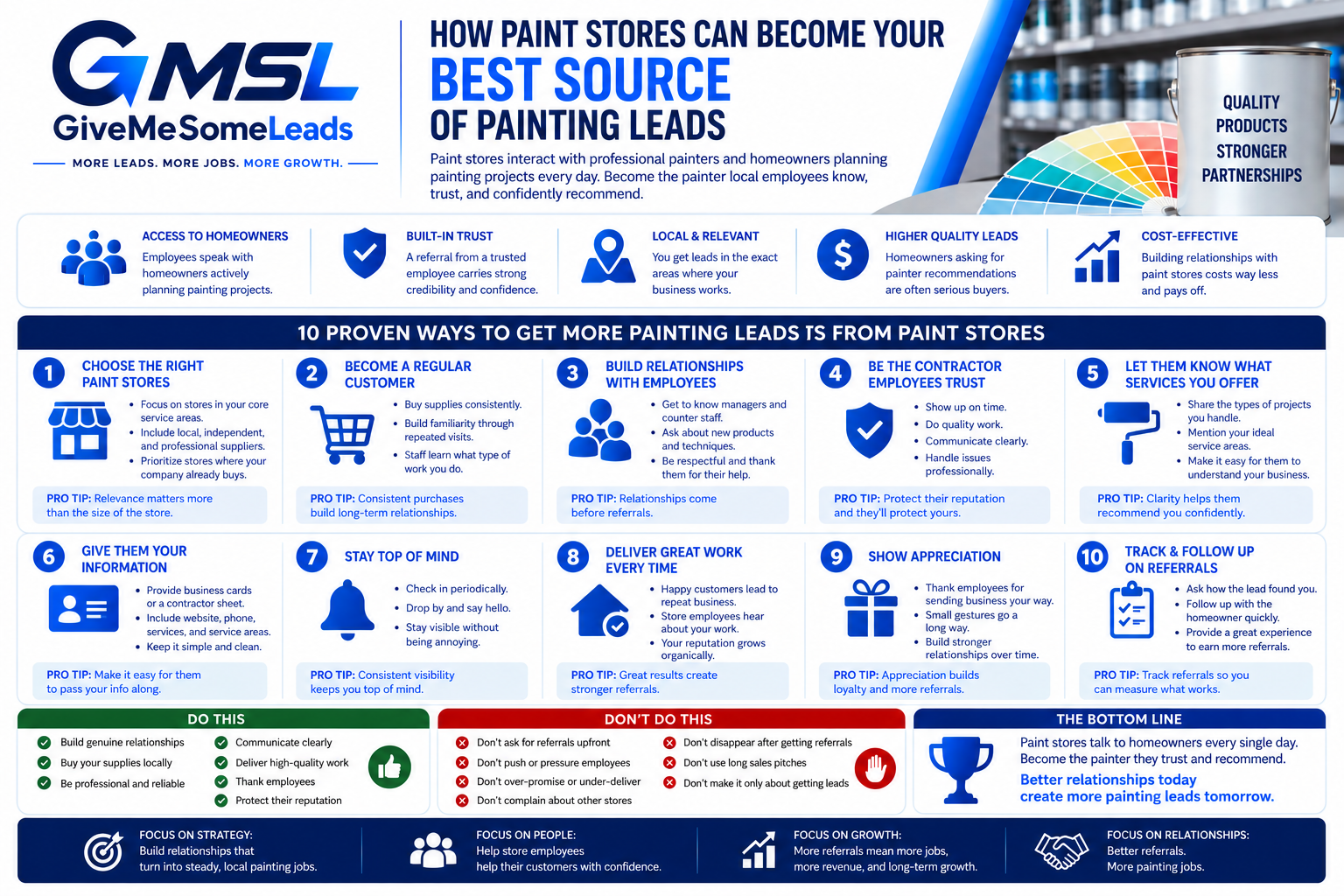
📊 Click the diagram to view a larger version. After opening it, turn your phone sideways for the best viewing experience.
Build Relationships With Paint Sales Representatives
Do not focus only on the employees behind the counter.
Paint sales representatives can also be valuable connections.
They often interact with many contractors, builders, property managers, businesses, and suppliers across the market. They may know which companies specialize in certain services, which contractors work in specific areas, and which businesses are growing.
That does not mean you should treat them like a lead vending machine.
Build a professional relationship first.
Ask about new coatings, product specifications, application recommendations, contractor programs, training opportunities, and product updates.
Over time, the representative learns more about your company, your service area, your project types, and how professionally you operate.
That familiarity can create opportunities naturally.
Use sales representatives as a professional resource, not just a referral source. Ask good questions, learn from them, and build trust over time.
The more people in the local painting supply network understand what you do and how you work, the easier it becomes for the right opportunities to find you.
A paint sales representative knows one contractor who specializes in high quality cabinet painting and another who focuses mostly on exterior repaints.
When a homeowner or business asks for help, the representative is more likely to think of the contractor whose positioning is clear.
That is why staying visible, professional, and easy to understand matters.
Attend Contractor Events and Training
Paint suppliers often host contractor events, product demonstrations, training sessions, and professional programs.
These can be valuable for more than product education.
They can help you meet store employees, sales representatives, other contractors, and people connected to the local painting market.
The immediate goal does not always need to be getting a lead the same day. Sometimes the value is being seen, remembered, and connected to the local professional network.
When you attend these events, ask good questions, learn about new products, and build real conversations. Over time, people start to recognize your company as a serious painting business, not just another contractor buying materials.
Attend events with the mindset of building relationships, not collecting leads on the spot.
Some referral relationships start long before the first customer is ever sent your way.
A painter attends a product training event at a local paint store.
They meet the store manager, talk with a sales representative, and ask questions about exterior coatings.
A few months later, when a homeowner asks the store for an exterior painter, that same painter is easier to remember because they have already shown up professionally.
Be Responsive When You Receive a Referral
This part is critical.
If a paint store finally sends someone your way, treat that referral seriously.
The homeowner may call, text, or submit a form. If you take three days to respond, the store employee may not recommend you again.
Remember, the employee put their credibility behind your company.
You are not only trying to win one painting project. You are protecting a relationship that could lead to many more projects in the future.
Respond quickly, qualify the lead, schedule the estimate, communicate clearly, do great work, and thank the referral source afterward.
A referred lead should feel like a priority because it came through trust.
When a referral comes from a store, respond as fast as possible and keep the customer experience strong from the first conversation.
A referral partner is watching what happens after they send someone your way. Make them feel safe recommending you again.
A paint store sends 5 homeowners to a contractor over a few months.
Contractor A responds slowly and only books 1 estimate.
Contractor B responds quickly, qualifies the leads, and books 4 estimates.
The store is more likely to keep recommending Contractor B because the experience is smoother and more reliable.
Tell the Store What Happened
When a paint store sends you a referral, do not disappear after the job is won.
Report back.
Next time you visit the store, say something simple like:
That small update matters.
It tells the employee their recommendation worked. It also confirms that the homeowner was taken care of.
This makes future referrals easier because the store now has confidence that sending people to you leads to a good outcome.
Most contractors forget this step.
That is why doing it can make you stand out.
Always close the loop with the person who recommended you. A simple thank you and project update can strengthen the relationship.
Reporting back turns one referral into proof that the store made the right recommendation.
A store employee recommends your company to a homeowner planning cabinet painting.
You win the job, complete it, and the customer is happy.
The next time you are in the store, you thank the employee and let them know the project went well.
Now they feel more confident mentioning your company again.
Say Thank You
You do not need an elaborate referral program to show appreciation.
Sometimes a genuine thank you is enough.
A simple thanks for thinking of us can go a long way, especially when it feels sincere.
Depending on store policy and local rules, you may occasionally bring coffee or lunch for the team as a general gesture of appreciation. But the relationship should not feel like you are paying for specific referrals.
Simple appreciation reinforces trust without making the relationship feel transactional.
Keep it professional.
The goal is appreciation, not pressure.
You want the store to recommend you because they trust your company, not because the relationship feels transactional.
Keep appreciation simple and professional. Thank people for their trust, not just for the lead.
Strong referral relationships are built on trust and respect, not awkward transactions.
A paint store employee sends you a strong exterior painting opportunity.
You call quickly, schedule the estimate, win the job, and complete the project well.
The next time you visit, you thank the employee personally.
That small moment helps strengthen the relationship because it shows you noticed and appreciated the recommendation.
Do Not Pressure Employees for Leads
One of the easiest ways to damage a paint store relationship is to pressure employees for leads.
Do not walk in every week asking:
That gets annoying fast.
Repeated pressure makes the relationship uncomfortable.
Buy materials, communicate well, send customers back, and let trust grow naturally.
Paint store employees are there to help customers, sell products, answer questions, and manage a busy store. They are not your sales team.
Instead, stay visible through a normal business relationship.
Buy materials. Be respectful. Talk professionally. Do good work. Share occasional updates. Send customers their way when appropriate.
The objective is to become the company that comes to mind when the right opportunity appears.
You do not need to force it.
You need to become easy to trust and easy to remember.
Do not ask for referrals every time you visit. Build the relationship first, and let referrals happen naturally when the opportunity fits.
If employees feel pressured, they may avoid recommending you. If they trust you, they are more likely to remember you when it matters.
Painter A visits the store only when they want referrals.
Painter B visits regularly, buys materials, treats the staff well, sends customers to the store, and stays professional.
Over time, Painter B becomes the safer and more natural recommendation.
Build Relationships With Multiple Stores
Once you have a simple relationship process working with one paint store, you can start expanding carefully.
Do not rush into every store in the region. Start with the suppliers connected to your best service areas.
For example, if your painting company works in four main cities or neighborhoods, you may want relationships with paint stores in each of those markets. That way, your referral network is not depending on only one location or one employee.
No single store needs to send a huge number of leads.
One store may send a few exterior painting leads. Another may send cabinet painting opportunities. Another may introduce you to a sales representative or another local contractor.
Together, those relationships can become a meaningful source of work over time.
The key is to keep the same standard everywhere. Be professional, buy materials, communicate clearly, explain the type of projects you want, respond quickly to referrals, and thank people when they send someone your way.
Expand only after your first relationship process is working. It is better to have three strong store relationships than ten weak ones.
A referral network becomes stronger when it is spread across several real relationships, not dependent on one person remembering you.
A painter builds a strong relationship with one local supplier and starts receiving occasional referrals.
Instead of stopping there, they repeat the process in two other important service areas.
Over time, the company is known by multiple stores, sales reps, and local professionals. That creates more chances for the right homeowner to hear their name.
Track Paint Store Referrals
Paint store referrals should still be tracked.
Just because a lead comes from a relationship does not mean you should treat it casually.
Inside your CRM or tracking sheet, create clear lead sources such as paint store downtown, paint store north location, paint sales rep, or supplier referral.
Then track the full path.
Referral received, qualified lead, estimate, customer, revenue.
This helps you understand whether the relationship is actually creating business.
Without tracking, you may only think, that store sends us some work.
With tracking, you can see how many leads came in, how many were qualified, how many became estimates, how many became customers, and how much revenue was created.
That gives you a much better reason to keep investing in the relationship.
Ask every new lead how they heard about you. If they mention a paint store, record the exact store or person when possible.
Referral relationships feel personal, but they should still be measured like any other customer acquisition channel.
Over 12 months, one paint store sends 18 leads.
Out of those leads, 14 are qualified, 11 become estimates, and 7 become customers.
If those 7 customers generate 55,000 dollars in painting revenue, that relationship is clearly valuable.
The numbers are only an example, but the lesson is important.
You cannot understand the value of a referral source if you never track it.
Compare Referral Quality, Not Just Volume
Paint stores may never generate the same number of leads as Google Ads, Facebook Ads, or Local SEO.
That does not mean they are less valuable.
A smaller number of strong referrals can sometimes create better business than a larger number of weak leads.
For example, Google Ads may generate 60 leads and 12 customers.
Illustrative comparison: fewer leads can still create nearly the same number of customers when referral quality is stronger.
A paint store may generate 15 leads and 8 customers.
The ad channel created more lead volume, but the paint store referrals may have a stronger close rate because trust already exists.
That is why you should compare lead sources by more than volume.
Look at qualification rate, estimate rate, close rate, average project value, customer acquisition cost, revenue, and profit.
A lead source is not better just because it creates more activity.
It is better when it creates profitable customers.
Compare paint store referrals against other channels using customers and revenue, not just lead count.
Lead volume gets attention, but lead quality is what usually creates better business.
Lead Source A creates 80 leads and 10 customers.
Lead Source B creates 20 leads and 9 customers.
At first, Lead Source A looks stronger because it creates more leads.
But Lead Source B is almost matching the customer count with far fewer opportunities.
That means Lead Source B may be sending better quality leads.
Why Paint Store Leads Can Be High Quality
Paint store leads can be strong because of the timing.
A homeowner inside a paint store is already thinking about a painting project. They may be choosing colors, comparing finishes, buying samples, asking about primer, planning an exterior repaint, or realizing that the project is bigger than they expected.
They are not just casually seeing an ad while scrolling.
They are already taking steps toward the project.
That is why a paint store recommendation can happen at the perfect moment.
The homeowner has a problem, the store employee is helping them think through it, and your company can become the suggested solution.
This is similar to other referral relationships with realtors, interior designers, general contractors, flooring contractors, and home inspectors.
Those people often meet homeowners around the time a project becomes necessary.
Build relationships with people who meet homeowners before, during, or right after the need for painting becomes clear.
The best referrals often happen close to the buying moment, when the customer already knows they need help.
A homeowner walks into a local paint store planning to repaint the exterior themselves.
After discussing surface preparation, primer, two story access, material quantities, and application, they realize the project is bigger than expected.
They ask:
The employee says:
The homeowner visits your website, sees your exterior painting page, local project photos, strong reviews, before and after examples, and an easy estimate form.
The store created the introduction.
Your online reputation helped finish the trust building process.
Turn One Paint Store Relationship Into a System
A paint store relationship becomes more valuable when it is part of a repeatable system.
Start by identifying suppliers in your core service areas.
Then become familiar by purchasing regularly and getting to know the team.
Explain the type of painting projects you want so employees understand when your company is a good fit.
Provide easy to share contact information where the store allows it.
Reciprocate by sending customers to the store when it makes sense.
When a referral comes in, respond quickly, communicate well, and treat the homeowner professionally.
Afterward, report back and thank the person who recommended you.
Then track the lead, customer, and revenue.
Finally, repeat the process with other stores in important markets.
The system is simple, but over several years, it can help build a strong local referral network.
Keep the process simple enough that you can repeat it. Identify, build trust, make referrals easy, respond well, thank the source, track the result, and repeat.
One relationship is good. A repeatable referral system is better.
A painter starts with one supplier near their best service area.
They buy materials there regularly, build trust with the team, explain their ideal projects, leave simple contact information where allowed, and send customers back for color help.
When referrals come in, they respond quickly and report back.
After a few months, they repeat the same process with another store.
That is how one relationship turns into a system.
Paint Stores Should Be Part of a Larger Lead Generation System
Paint store referrals can be valuable, but they should not be your only source of leads.
Referral volume can change.
One month a store may send several opportunities. The next month, nothing may come in.
That is normal.
A stronger painting business combines paint store referrals with customer referrals, Google Business Profile, Local SEO, Google Ads, professional partnerships, a high converting website, reviews, and follow up.
Each channel plays a different role.
Google Ads can capture people searching today.
Local SEO builds long term visibility.
Customer referrals transfer trust.
Paint stores can introduce you to homeowners already thinking about painting.
Your website and reviews help confirm that trust.
Together, these channels create a more resilient customer acquisition system.
Do not stop your marketing because one referral source starts working. Use that momentum to strengthen the rest of your system.
Paint store referrals work best when they support your full marketing system, not when they become the only system.
A painting company gets 8 paint store referrals in one month and feels busy.
The next month, they only get 2.
If referrals are the only lead source, that creates stress.
But if the company also has Google Ads, Local SEO, reviews, past customer follow up, and a strong website, the business is not depending on one channel to survive.
Common Paint Store Referral Mistakes
Many painters miss paint store referral opportunities because they approach the relationship the wrong way.
They ask for leads immediately, visit only when they want something, treat employees like lead generators, or leave too much promotional material without building trust.
Some are rude or difficult at the counter, which can damage the relationship before it ever starts.
Others fail to explain what type of projects they want, so the store does not know when to recommend them.
Some respond slowly when a referral finally comes in, which makes the store less likely to recommend them again.
Other mistakes include doing poor work for referred customers, never thanking the person who recommended them, depending on only one employee, never sending business back, and failing to track results.
Remember, you are building a professional relationship.
You are not buying access to someone else’s customers.
Treat every store relationship with respect. Be useful, be professional, respond quickly, and protect the trust people give you.
Paint store referrals are earned through trust, not pressure.
Painter A drops off business cards and keeps asking employees if they have leads.
Painter B buys materials regularly, treats the staff well, sends customers to the store, responds quickly to referrals, and thanks employees when they help.
Painter B is much easier to recommend because the relationship feels natural and professional.
Frequently Asked Questions
1. Can paint stores refer customers to painting contractors?
Some stores and employees may recommend contractors when customers ask, depending on store policy. The goal is to build enough familiarity and trust that your company is easy to remember when the right homeowner asks for help.
2. How do I get a paint store to recommend my painting company?
Become a reliable customer, build genuine relationships with the team, explain the services and areas you focus on, maintain a strong reputation, and take excellent care of every referral that comes your way.
3. Should I ask paint store employees directly for referrals?
You can make it clear that your company is available when appropriate, but avoid repeatedly asking for leads. Focus first on becoming a contractor they feel comfortable recommending.
4. Should I leave business cards or referral materials at paint stores?
Ask the manager first. If materials are allowed, keep them simple and useful. Your company name, services, service area, phone number, website, and a QR code can make the next step easier for homeowners.
5. Which paint stores should contractors focus on?
Start with reputable stores inside your strongest service areas, especially suppliers your company already uses regularly. A smaller store close to your best customers can be more valuable than a larger store far outside your ideal market.
6. Are paint store referrals better than Google Ads leads?
Neither channel is automatically better. Paint store referrals may arrive with more trust, while Google Ads can create more predictable volume. Compare qualified leads, estimates, customers, project value, revenue, and customer acquisition cost.
7. Should painting contractors build relationships with paint sales representatives?
Yes. Sales representatives can become valuable professional connections because they interact with contractors, suppliers, builders, property managers, and other businesses across the market. Build the relationship around professionalism and product knowledge first.
8. How should paint store referrals be tracked?
Record the exact store or representative when possible, then track referral received, qualified lead, estimate, customer, and revenue. This shows which supplier relationships are actually contributing to growth.
Become the Painter Local Paint Stores Feel Confident Recommending
Paint stores can become an excellent source of painting leads, but the strategy is not walking in, dropping business cards, and asking for leads.
The stronger approach is to become a regular, build relationships, be professional, explain what you specialize in, send business back, take excellent care of referrals, say thank you, and stay memorable.
As we have seen in this article, every relationship you build can eventually become a referral opportunity.
Always remember that, and never underestimate a new connection or conversation. Be consistent with your approach, keep building trust, and over time you will create more opportunities for your business.
The most valuable referral partnerships are built by becoming the contractor people feel confident recommending, not by repeatedly asking people to send you customers.
Ready to Build a Stronger Painting Referral and Lead Generation System?
GiveMeSomeLeads helps home improvement contractors build stronger lead generation systems using high converting websites, Google Ads, Local SEO, landing pages, tracking, and practical customer acquisition strategy.