
Painting contractors don't need more leads.
They need more profitable customers.
A lead provider might promise:
“50 painting leads every month.”
That sounds great:until half don't answer, some are outside your service area, others want tiny projects, and the best prospects are shared with several competing painters.
Meanwhile, another provider sends only 20 opportunities, but those leads generate eight estimates and four customers.
Which is better?
The answer is obvious.
Yet contractors frequently compare providers based primarily on:
Cost per lead.
We believe that's the wrong metric to focus on.
Instead, measure:
Cost per qualified lead → Cost per estimate → Cost per customer → Revenue → Profit
From our experience, a painting lead provider should be judged by whether its opportunities consistently become profitable projects. This is why it’s important to track where your leads come from and which ones actually become customers. We know tracking can get technical, which is why a good marketing agency should provide clear reporting with actual numbers, allowing you to see for yourself which lead sources are performing well and which ones are not.
GMSL Insight: A $30 lead that never becomes a customer is expensive. A $150 lead that becomes a $10,000 project can be extremely valuable.
What Is a Painting Lead Provider?
Painting lead providers connect contractors with potential customers, but the business models can differ significantly.
Lead Marketplaces
Platforms attract homeowners and distribute opportunities to contractors. Depending on the provider, the same opportunity may reach multiple businesses.
Pay Per Lead Advertising
You pay when a potential customer contacts your company rather than paying for each advertising click.
Google's Local Services model, for example, charges advertisers for valid leads.
Lead Generation Agencies
An agency generates leads specifically for your company through channels such as:
- Google Ads
- Landing pages
- Local SEO
- Conversion optimization
Instead of simply purchasing contact information, you're building a customer acquisition system around your own company.
Understanding which model you're buying is the first step.
Opportunities may be distributed to more than one contractor.
The channel charges around valid customer inquiries rather than every click.
Your campaigns, landing pages, tracking, and brand create the opportunity directly.
Find Out Whether Leads Are Exclusive
One of your first questions should be:
“How many painting contractors receive each lead?”
Imagine a homeowner requests an interior painting estimate.
The lead goes to:
Painter A
Painter B
Painter C
Painter D
Now everyone starts calling.
The homeowner receives multiple sales pitches, and contractors compete for attention.
Compare that with someone clicking your company's Google ad, visiting your landing page, and contacting your business directly.
Very different situation.
Ask:
- Are leads exclusive?
- How many contractors receive them?
- Is exclusivity guaranteed?
- Does exclusivity cost more?
GMSL Insight: A lead isn't necessarily yours just because you paid to receive it.
More direct competition for the same opportunity.
More control over the brand, offer, qualification, and follow up.
Understand Where Leads Come From
Ask:
“How are you generating these painting leads?”
Potential sources include:
- Google Search
- SEO
- Home service marketplaces
- Affiliate websites
- Partnerships
Lead source can affect intent.
Someone searching:
“Exterior painter near me”
may be much closer to hiring than someone casually clicking a social media advertisement.
Both can become customers.
But they may require different sales processes.
Ask Who Owns the Marketing Assets
Suppose you spend thousands with a lead provider.
When you stop paying, what remains?
With some marketplaces:
Very little.
The platform owns the traffic and customer acquisition system.
Compare that with investing in:
- Your website
- Landing pages
- Google Business Profile
- Reviews
- SEO rankings
- Customer database
- Conversion data
Those assets strengthen your own business.
From Our Experience
We believe contractors should understand the difference between:
Renting leads
and:
Building a lead generation system you control.
Purchased leads can work, but long term dependency creates risk.
The opportunity source can disappear immediately.
Website, reviews, SEO, data, landing pages, and customer relationships stay with the business.
Don't Choose Based on Cost Per Lead
Consider two providers.
Provider A
100 leads × $35 = $3,500
10 customers.
Cost per customer: $350
Provider B
50 leads × $90 = $4,500
20 customers.
Cost per customer: $225
Provider B's leads cost much more.
Yet its customers are cheaper to acquire.
That's why:
Cheap leads ≠ Cheap customers
The objective is profitable projects, not an impressive CPL.
100 leads → 10 customers
$350 per customer50 leads → 20 customers
$225 per customerCalculate Cost Per Qualified Lead
Suppose you receive 50 leads.
But:
- 8 are outside your area
- 5 want services you don't provide
- 7 are below your minimum project size
- 5 can't be reached
Only:
25 are qualified.
If you spent $2,500:
Raw CPL:
$50
Cost per qualified lead:
$100
The second number tells you much more.
Calculate Cost Per Estimate and Customer
Continue the example.
From 25 qualified leads:
15 schedule estimates.
Your $2,500 investment generated:
$166.67 per estimate
Five become customers.
Your customer acquisition cost is:
$500
Now compare that $500 against:
- Average project value
- Gross margin
- Repeat business
- Referral potential
That's how you determine whether the provider makes financial sense.
Compare Lead Cost With Project Value
A $500 customer acquisition cost means very different things to different painters.
Contractor A
Average project: $8,000
CAC: $500
Potentially excellent.
Contractor B
Average project: $1,000
CAC: $500
Probably difficult to sustain.
That's why asking:
“What's a good cost per painting lead?”
without considering project economics doesn't tell the whole story.
Check Geographic Targeting
A good lead 60 miles away can still be a bad lead for your company.
Ask whether you can target:
- ZIP codes
- Cities
- Counties
- Service areas
Also ask whether unwanted locations can be excluded.
Poor targeting wastes both marketing dollars and your sales team's time.
Target the Right Painting Services
Your provider should understand what you actually want to sell.
Potential services include:
- Interior painting
- Exterior painting
- Cabinet painting
- Commercial painting
- Multifamily painting
- Specialty coatings
If your ideal project is a $7,000 whole home repaint, a stream of $400 touch up requests isn't necessarily useful.
Pro Tip
Define your ideal project before evaluating providers.
You can't judge lead quality without defining what a good lead means for your company.
Understand Lead Validation
Ask what happens when you receive:
- Spam
- Fake information
- Duplicate inquiries
- Wrong services
- Wrong locations
Does the provider offer credits?
Is there a dispute process?
How quickly must bad leads be reported?
Know the policy before spending money.
Read the Contract
Understand:
- Contract length
- Cancellation policy
- Setup fees
- Monthly fees
- Lead pricing
- Refund policy
- Credit policy
- Auto renewal
- Territory restrictions
Don't rely solely on what the salesperson tells you.
Read what you're actually agreeing to.
Don't Buy More Leads Than You Can Handle
More leads don't automatically create more revenue.
If your company can properly follow up with 30 leads per week but receives 100:
- Calls go unanswered
- Response times increase
- Estimates get delayed
- Follow up disappears
Marketing and sales capacity need to match.
GMSL Insight: More leads don't fix a weak sales process. They often make the weakness more expensive.
Respond Quickly
The lead provider creates the opportunity.
Your company still has to convert it.
Build a process:
Lead Arrives
↓
Call
↓
No Answer
↓
Text
↓
Follow Up
Speed becomes especially important with shared leads because other painters may be contacting the homeowner too.
Track Beyond the Lead
A report saying:
80 leads generated
doesn't tell you whether the campaign worked.
Track:
Marketing Spend
↓
Leads
↓
Qualified Leads
↓
Estimates
↓
Customers
↓
Revenue
↓
Profit
Without this, you know what marketing cost.
You don't know what it earned.
Ask for Real Performance Data
Be cautious when providers make vague claims such as:
“Our contractors get incredible ROI.”
Ask for actual context.
Look for:
- Lead costs
- Qualification rates
- Estimate rates
- Close rates
- Customer acquisition costs
Case studies can be useful, but another painting company's performance doesn't guarantee yours.
Markets, competition, sales processes, and project values vary.
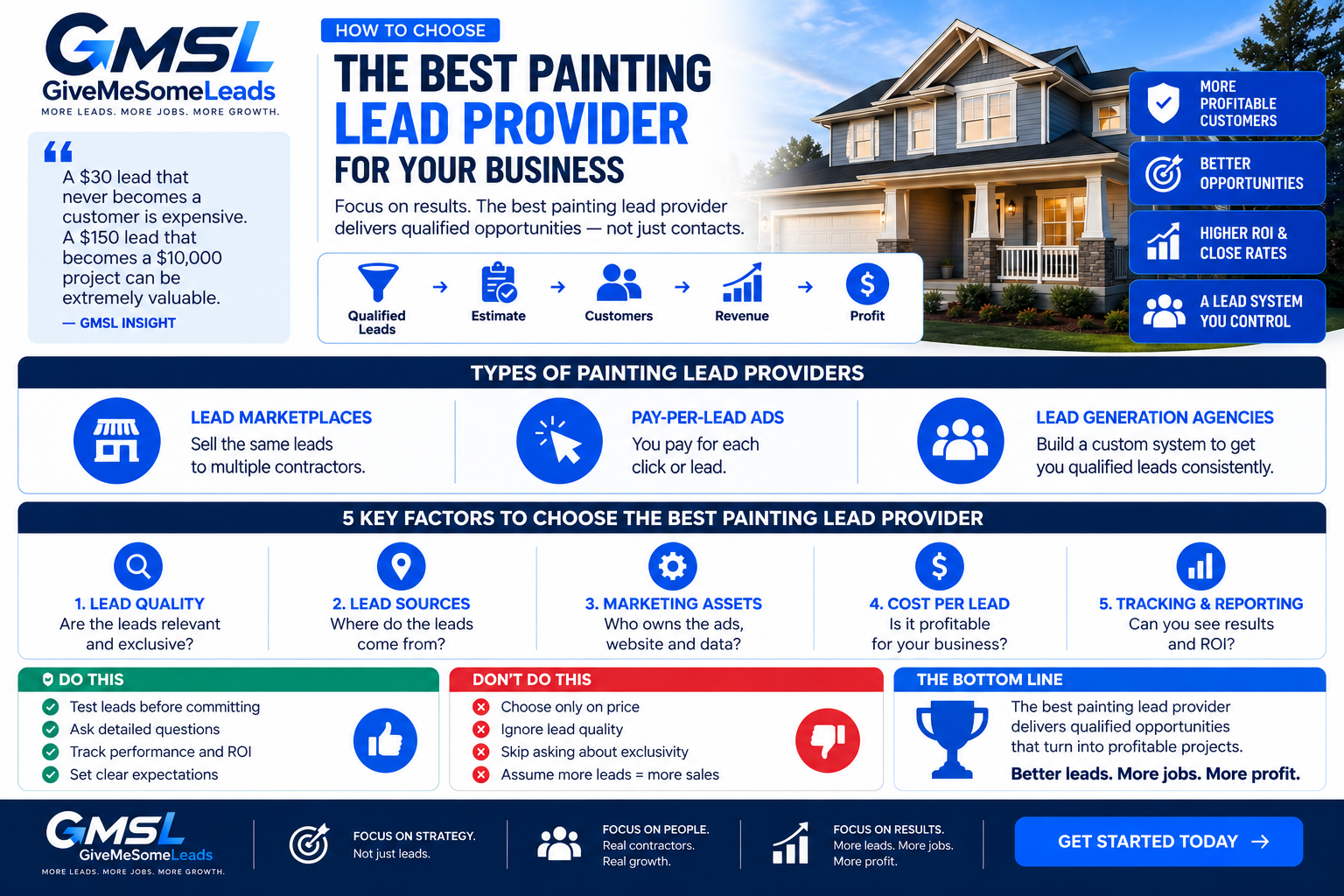
📊 Click the diagram to view a larger version. After opening it, turn your phone sideways for the best viewing experience.
Consider Google Local Services
Where eligible, Google's Local Services platform can provide another lead generation option.
Instead of paying for advertising clicks, businesses pay for valid leads.
It can be worth comparing against:
- Lead marketplaces
- Google Ads
- SEO
- Referrals
As with every channel, don't evaluate it solely on lead cost.
Track what happens after the lead arrives.
Compare Buying Leads With Generating Your Own
Buying Leads
Advantages
- Fast to start
- Potential immediate volume
- Minimal marketing infrastructure
Disadvantages
- Leads may be shared
- Less control
- Provider dependency
- Limited long term asset creation
Generating Your Own Leads
Using:
- Google Ads
- Local SEO
- Google Business Profile
- Website
- Landing pages
- Referrals
Advantages
- More control
- Direct customer relationships
- Stronger branding
- Long term marketing assets
Disadvantages
- Requires expertise
- Requires setup and optimization
- SEO takes time
Neither approach should be judged emotionally.
Run the numbers.
The strongest system usually combines several profitable channels instead of depending on one source.
Real Life Example
Imagine a painting company tests two strategies.
Lead Provider
Spend: $3,000
60 leads
30 qualified
18 estimates
5 customers
Cost per customer: $600
Direct Google Campaign
Total investment: $4,000
35 leads
25 qualified
18 estimates
7 customers
Cost per customer: $571
These figures are illustrative.
The lead provider produced almost twice as many raw leads.
But both produced the same number of estimates, and the direct campaign generated more customers.
If you only compared cost per lead, you might make the wrong decision.
30 qualified • 18 estimates • 5 customers
$600 per customer25 qualified • 18 estimates • 7 customers
$571 per customerQuestions to Ask a Painting Lead Provider
Before signing, ask:
- Where do the leads come from?
- Are they exclusive?
- How many contractors receive each lead?
- Can I select painting services?
- Can I control geographic targeting?
- How are leads validated?
- What happens with bad leads?
- What are the cancellation terms?
- Who owns the customer data?
- Can I track leads through revenue?
- What happens if I pause?
- Can you show real contractor results?
A reputable provider should be comfortable answering these questions.
How to Test a Lead Provider
Don't immediately make a new provider your primary lead source.
Run a controlled test.
Step 1 : Know Your Current Numbers
Understand your current lead volume, close rate, average project value, and acquisition cost.
Step 2 : Track Every Lead
Record the source.
Step 3 : Qualify
Separate legitimate projects from raw inquiries.
Step 4 : Track Estimates
Measure how many opportunities reach the sales stage.
Step 5 : Track Customers
Measure jobs won.
Step 6 : Track Revenue
Determine what those customers are actually worth.
Then decide whether to:
Scale
Maintain
or:
Cancel
Red Flags to Watch For
Be cautious if a provider:
- Won't explain lead sources
- Won't disclose whether leads are shared
- Guarantees unrealistic results
- Focuses only on lead volume
- Avoids discussing customer acquisition cost
- Has unclear cancellation terms
- Provides poor geographic control
- Can't explain its bad lead policy
- Pressures you into a long contract immediately
You're investing in customer acquisition.
Treat the decision accordingly.
What Makes a Good Painting Lead Provider?
Look for opportunities that are:
Relevant
The customer actually needs painting.
Local
They're inside your service area.
Qualified
The project matches your company.
Trackable
You can measure what happened.
Profitable
Customers justify the acquisition cost.
The standard shouldn't be:
“They sent us 100 leads.”
It should be:
“They helped us acquire profitable painting customers.”
Real painting need
Inside your service area
Fits your ideal project
You can follow the outcome
Customer value justifies cost
Frequently Asked Questions
1. What is the best painting lead provider?
There isn't one that's best for every painter. Compare providers based on your market, services, project value, budget, lead quality, exclusivity, and customer acquisition cost.
2. How much should painting leads cost?
There is no universal ideal CPL. A lead's value depends on qualification, close rate, project value, and profitability.
3. Are shared painting leads worth it?
They can be profitable, but understand how many competitors receive each lead and track the resulting cost per customer.
4. Are exclusive painting leads better?
They reduce direct competition for the same inquiry, but exclusivity doesn't automatically mean the lead is qualified.
5. Should painters buy leads or generate their own?
Both can work. However, building your own website, SEO visibility, Google Ads campaigns, reviews, and referral network reduces long term dependency on third party providers.
6. Are Google Local Services Ads pay per lead?
Yes. Google's Local Services model charges eligible businesses for valid leads rather than individual advertising clicks.
7. How long should I test a lead provider?
Test long enough to generate a meaningful number of opportunities and follow them through your sales cycle. Don't judge a provider from only a handful of leads.
8. How should I measure a painting lead provider?
Track: Spend → Leads → Qualified Leads → Estimates → Customers → Revenue → Profit That's what tells you whether the provider actually works.
Final Thoughts
Choosing the best painting lead provider isn't about finding:
The most leads.
or:
The cheapest leads.
It's about finding the customer acquisition method that produces the strongest business results.
Before signing, understand:
Where the leads come from.
Whether they're exclusive.
How they're qualified.
What areas and services you can target.
What happens with bad leads.
What the contract requires.
Then measure what actually matters.
A $40 lead that goes nowhere costs you money and sales time.
A $150 lead that becomes a profitable $12,000 exterior repaint can be an excellent investment.
That's why we believe painting contractors should stop asking:
“How much does the lead cost?”
and start asking:
“How much does it cost us to acquire a profitable customer?”
GMSL Insight: Measure painting leads by what they become:not simply by what they cost when they arrive.
The best lead provider isn't the one that fills your CRM with the most names. It's the one that helps fill your schedule with profitable painting projects.
Ready to Build a Better Painting Customer Acquisition System?
GiveMeSomeLeads helps painting contractors compare lead sources, improve direct lead generation, strengthen Local SEO, optimize Google Ads, and track every opportunity through customers and revenue.
- Lead source and provider evaluation
- Google Ads, Local SEO, and direct lead generation
- Qualified lead, customer, revenue, and ROI tracking