
A painting website can look beautiful and still generate almost no business.
That is because design and conversion are not the same thing.
Your website has one main job. It needs to turn the right visitors into real conversations with your painting company. A homeowner may find you through Google Search, Google Maps, Google Ads, Facebook, a referral, a yard sign, a local Facebook Group, or even a paint store recommendation. But once they land on your website, they start judging whether your company is worth contacting.
They want to know what services you offer, where you work, whether they can trust your crew, whether you have completed projects like theirs, and how they can request an estimate. If those answers are not clear quickly, they can leave and choose another painter.
From our experience, the highest converting contractor websites are usually not the most complicated. They are the clearest.
A strong painting website should make the next step feel easy. It should show real work, build trust, explain services clearly, work well on mobile, and make it simple for homeowners to call or request an estimate.
Google has reported that 53 percent of mobile site visits are abandoned when pages take longer than 3 seconds to load. Even a strong painting website can lose leads if the mobile experience is slow or frustrating. Source: Think with Google
Do not build your website to impress another web designer. Build it to help a homeowner feel confident enough to contact your painting company.
A beautiful website is not enough. The website needs to create trust, answer questions, and move visitors toward a real estimate request.
A homeowner searches for an exterior painter and opens three websites.
The first website looks fancy, but the homepage does not clearly say where the company works or what services it offers.
The second website has nice photos, but the phone number is hard to find on mobile.
The third website immediately shows exterior painting in the homeowner’s city, real before and after photos, Google reviews, a clear phone number, and a button to request an estimate.
The third website has the best chance of turning that visitor into a lead because it answers the homeowner’s questions faster.
Make the Homepage Immediately Clear
The first section of your painting website should tell homeowners exactly what you do, where you do it, and what they should do next.
Many painting websites waste this opportunity with vague headlines like Quality You Can Trust or Transforming Spaces Since 2002. Those phrases sound professional, but they do not clearly explain the service.
Now the homeowner understands the service, the location, and the next step within a few seconds. A clear homepage also helps filter out people who are not a good fit.
Read your homepage headline out loud. If a homeowner cannot understand your service and location in a few seconds, the message needs to be clearer.
Clarity is one of the strongest conversion tools on a contractor website.
Weak homepage message: Bringing Color to Life.
Better homepage message: Professional Interior and Exterior Painting in Tampa.
The second version is not as fancy, but it is much clearer. A homeowner instantly understands what the company does and where it works.
Put Your Best Painting Work Above the Fold
Painting is visual, so your website should use that advantage immediately.
The first image a visitor sees should ideally be a real project completed by your company. This could be a finished living room, an exterior transformation, painted kitchen cabinets, a high end interior project, or a clean commercial repaint.
Homeowners are buying confidence that your crew can improve their home, protect their property, communicate well, and deliver a result they will be happy with.
Use a real project photo that matches the type of customer you want more of. If you want more exterior repaints, show a strong exterior transformation.
Real project photos help homeowners picture the result before they ever contact you.
A painting company wants more cabinet painting jobs, but the homepage image shows a random stock photo of a painter holding a roller.
A better homepage image would show a real kitchen cabinet transformation completed by the company. Now the visitor can immediately see proof related to the service they may want.
Make the Phone Number Easy to Find
If a homeowner wants to call your painting company, do not make them search for the phone number.
Place it where people naturally expect to find it. That includes the header, service pages, major call to action sections, the footer, and mobile buttons. On mobile, the phone number should be easy to tap.
A homeowner may be ready to ask for an estimate, but if they cannot quickly find the phone number, they may leave and call another company.
Open your website on your phone and give yourself five seconds. Can you see what the company does, where it works, and how to call? If not, simplify the first screen.
When someone is ready to contact you, the website should make that action effortless.
Imagine 100 homeowners visit your painting website from mobile devices.
If 20 are interested but only 8 can quickly find the phone number, you are losing opportunities because of friction.
If the phone number is clear, clickable, and visible across important pages, more ready visitors can turn into calls.
Build the Website Around Trust
Painting requires trust. A homeowner may be inviting your crew into their home, around their furniture, near their family, or onto their property for several days.
Your website should not only say that you are trustworthy. It should show proof.
BrightLocal’s 2026 Local Consumer Review Survey reported that 97 percent of consumers read reviews for local businesses. Source: BrightLocal 2026 Local Consumer Review Survey
Add proof near your strongest claims. If you say your company is trusted locally, support it with reviews, project photos, or local examples.
Claims tell homeowners what you want them to believe. Proof gives them a reason to believe it.
Company A says: We are trusted local painters.
Company B shows strong Google reviews, real before and after photos, team photos, warranty information, and recent projects in the homeowner’s city.
Company B gives the homeowner more reasons to feel confident.
Show Real Before and After Photos
Few marketing assets are stronger for painting contractors than good before and after photos.
Painting creates visible transformation. A dark room becomes brighter. A faded exterior becomes fresh again. Old cabinets look updated. A worn commercial space feels professional.
Many painting companies already have enough content for a better website. The problem is that the photos are scattered across phones, old social posts, text messages, and project folders. Create a simple process for collecting them consistently.
Create a photo process for every project. Capture before photos, preparation photos, final photos, and close ups of important details.
Your best website content may already exist. It just needs to be collected, organized, and used properly.
A painting company completes 80 projects in a year but only saves photos from 5 of them.
Another company captures before and after photos on every project. After one year, they have a strong library for the homepage, service pages, project galleries, Google Business Profile, Facebook, and ads.
Create Separate Pages for Your Main Services
One of the biggest website mistakes painting contractors make is putting every service on one generic page.
A page called Our Painting Services with a few short bullets is usually not enough. It may mention interior painting, exterior painting, cabinet painting, and commercial painting, but it does not give each service enough space to explain the customer’s problem, your process, your proof, and the next step.
A better approach is to create separate pages for your main services.
This helps homeowners because they can quickly find the service that matches their project. Someone looking for cabinet painting wants to see cabinet projects, cabinet reviews, cabinet questions, and a clear reason to contact you.
Separate service pages can also help with SEO because each page can focus on a specific service, customer problem, location, and search intent.
Build your service pages around the work you actually want more of. If cabinet painting is profitable, do not hide it inside one small paragraph on a general painting page.
A general services page tells homeowners what you offer. A strong individual service page helps them believe you are the right company for that specific project.
A homeowner searches for cabinet painting.
Company A has one general painting services page with a small cabinet painting bullet.
Company B has a full cabinet painting page with before and after photos, process details, reviews, common questions, and a clear estimate form.
Company B feels more relevant because the page matches exactly what the homeowner is looking for.
Write Service Pages Around the Customer’s Problem
Most homeowners do not visit a painting website because they want to read about paint products. They visit because something needs to change.
Maybe their walls are scuffed, their exterior paint is peeling, their cabinets look outdated, or they are preparing a home for sale. The service page should speak directly to that situation.
When your service page explains the problem clearly, the visitor feels understood. Instead of only saying we offer exterior painting, explain why peeling or faded paint matters and how proper preparation supports a better result.
Before writing a service page, list the problems customers usually mention during estimates. Use those problems to shape the page.
A strong service page does not only describe what you do. It shows the homeowner that you understand what they are dealing with.
A homeowner has peeling exterior paint and is worried the problem will get worse.
One website simply says it provides exterior painting services.
Another website explains preparation, scraping, surface condition, primer, weather exposure, and how the company handles repainting projects properly.
The second website builds more trust because it answers the homeowner’s real concern.
Create a Strong Project Gallery
Painting contractors should have a project gallery, but it should not be a random wall of photos with no structure.
A good gallery helps visitors find work that feels similar to their own project.
This matters because homeowners are looking for proof. A homeowner planning an exterior repaint wants to see exterior projects. Someone thinking about cabinet painting wants to see cabinets.
You do not need hundreds of photos on one page. It is better to show fewer strong projects in an organized way than to overwhelm visitors with every photo your company has ever taken.
Organize your gallery by service and use your best photos first. The goal is not to show everything. The goal is to show the right proof quickly.
A project gallery should help homeowners picture their own result, not make them scroll through unrelated photos.
A painting company has 150 project photos on one gallery page with no categories.
A homeowner looking for cabinet painting has to scroll through exterior homes, bedrooms, decks, trim, and commercial walls before finding cabinets.
Another company separates the gallery by service type, so the visitor can immediately see relevant transformations.
Build Individual Project Case Studies
Photos are powerful, but project case studies can make them even stronger.
A project case study explains the story behind the work. It shows what the homeowner needed, what problem the company solved, what process was used, and what the final result looked like.
Now the website is doing more than showing pretty pictures. It is showing how your company solves real painting problems.
Project case studies can also support Local SEO because they connect services to real locations, real project types, and real examples of work.
Turn your best projects into simple case studies. Explain the problem, the work completed, and the result.
A good case study gives context to your photos and makes your work easier to trust.
A homeowner is planning a full interior repaint before moving into a new home.
They find a case study showing a similar project with the timeline, preparation, wall repairs, color update, and final result.
That gives the homeowner more confidence because the company has already handled a similar situation.
Put Reviews Throughout the Website
Do not hide every testimonial on one review page.
Reviews should appear throughout the website where they support the decision the homeowner is making.
A short review that says great painters is fine, but a specific review is much stronger when it mentions furniture protection, communication, clean work, or finishing on time.
BrightLocal’s 2026 Local Consumer Review Survey reported that 97 percent of consumers read reviews for local businesses, and 54 percent visit a business website after reading positive reviews. Source: BrightLocal 2026 Local Consumer Review Survey
Match reviews to the page they appear on. Cabinet painting reviews belong on the cabinet painting page. Exterior painting reviews belong on the exterior painting page.
Reviews are stronger when they appear close to the service, project, or decision they support.
A homeowner is considering cabinet painting but feels nervous about finish quality.
On the cabinet painting page, they see a review mentioning smooth cabinets, a clean crew, and satisfaction with the finished result.
That review is more persuasive because it speaks directly to the service the homeowner is considering.
Show Your Team
Homeowners are not hiring a website. They are hiring real people who may be working inside their home, around their furniture, near their family, or on their property for several days.
That is why team photos can make a painting website feel more trustworthy.
You do not need perfect corporate headshots. Real, clean, professional photos are enough. Show the people behind the company in a way that feels honest and credible.
Use real team photos when possible. A real photo of your crew or owner usually builds more trust than a generic stock image of a painter.
The more personal the service feels, the more important trust becomes. Painting is personal because the work often happens inside someone’s home.
One painting website uses only stock photos and gives no information about the people behind the company.
Another shows the owner, crew members, and a short explanation of how the company works.
The second company feels easier to trust because the homeowner can see real people behind the business.
Build a Better About Page
Many painting company About pages say the same thing: We are committed to quality, integrity, and customer satisfaction.
That sounds professional, but it does not make the company memorable because almost every contractor can say it.
The goal is not a long autobiography. The goal is to help homeowners understand why your company is different and why they should feel comfortable contacting you.
Nielsen Norman Group has reported that users often leave web pages in 10 to 20 seconds, while pages with a clear value proposition can hold attention longer. Source: Nielsen Norman Group
Write the About page like you are explaining the company to a homeowner during an estimate. Keep it real, clear, and specific.
A strong About page does not just describe the company. It helps homeowners feel like they know who they are contacting.
Weak About page: We are a trusted painting company dedicated to quality and customer satisfaction.
Better About page: ABC Painting was started by a local painter who wanted to build a more organized and professional painting company for homeowners in the Dallas area. Today, the team focuses on interior repaints, exterior painting, and cabinet painting with clear communication, careful preparation, and clean job sites.
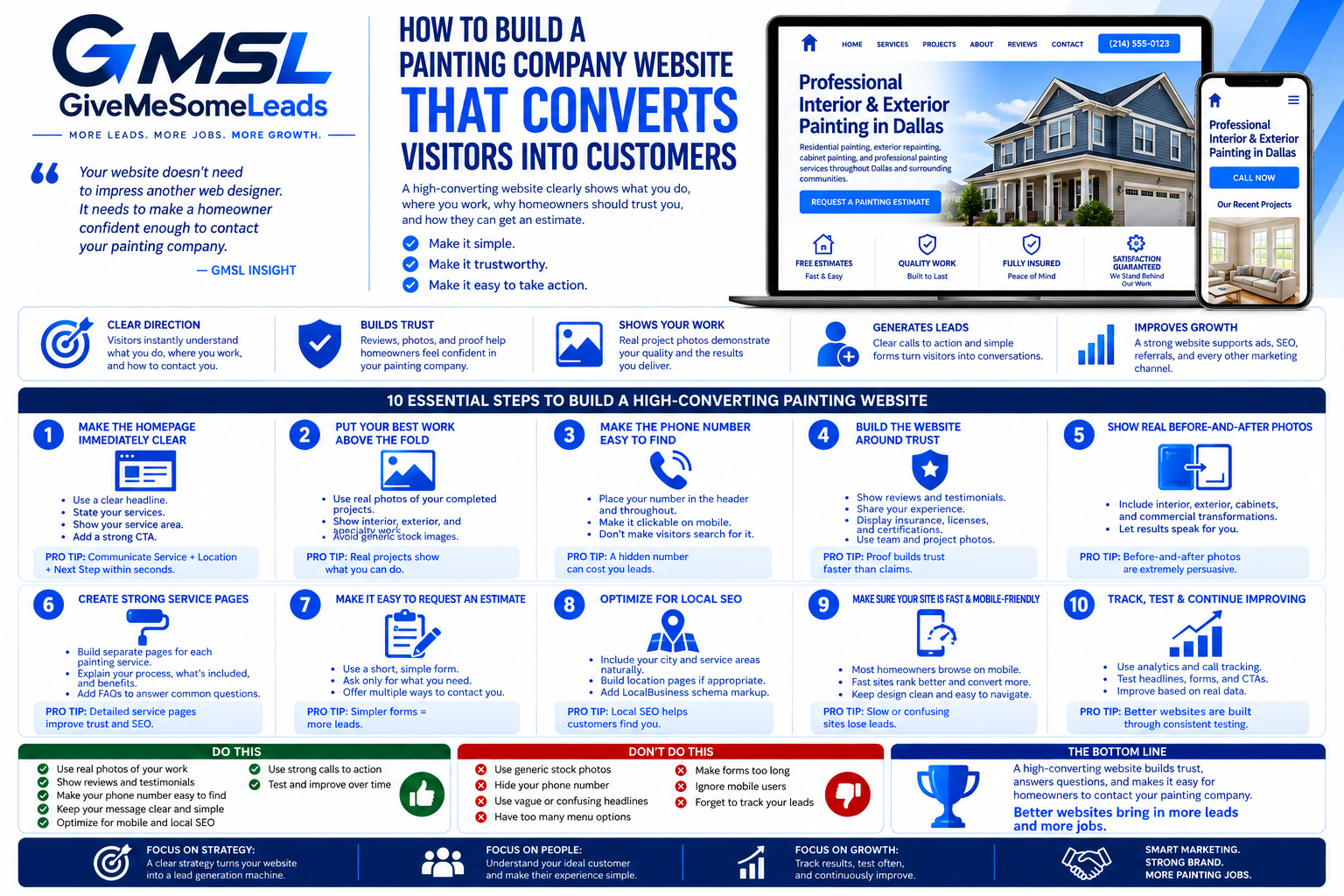
📊 Click the diagram to view a larger version. After opening it, turn your phone sideways for the best viewing experience.
Explain Your Painting Process
Homeowners may not know what happens after they contact your company. That uncertainty can create friction.
A clear process makes the project easier to understand and easier to buy.
This does not need to be complicated. It just needs to remove uncertainty and answer the questions homeowners usually ask before hiring you.
Use your process section to answer the questions homeowners usually ask before hiring you.
A clear process reduces uncertainty. Less uncertainty can make it easier for a homeowner to request an estimate.
A homeowner wants to repaint several rooms but is nervous about how disruptive the project will be.
A website that explains furniture protection, surface preparation, scheduling, communication, painting, cleanup, and final walkthrough feels more reassuring than a website that only says contact us today.
Explain Your Preparation Work
Preparation is one of the biggest differences between professional painting and simply putting paint on a wall.
Much of the preparation work becomes invisible after the project is finished, so your website should explain it before the project begins.
This is especially important because two estimates may look similar in price while including very different levels of preparation.
Do not assume homeowners understand why preparation matters. Explain it simply and connect it to durability, appearance, and the final finish.
If an important part of your workmanship becomes invisible after the project is finished, explain it before the project begins.
Two painters estimate an exterior repaint.
One says: We will paint the house.
The other explains cleaning, scraping loose paint, sanding rough areas, caulking gaps, priming bare surfaces, protecting landscaping, and applying the finish coat.
Even if the second estimate is higher, the homeowner has a better understanding of what they are paying for.
Make Estimate Requests Simple
A contact form should make it easy for homeowners to start a conversation. It should not feel like homework.
At the beginning, you usually only need the basics. Name, phone number, email, ZIP code or service area, painting service, and a short project description are often enough.
Optional photo uploads can also help, but the key is balance. Get enough information to respond properly without creating so much friction that the homeowner gives up.
Keep the first form simple. Ask for the details you need to start the conversation, then gather the rest later.
The easier it is to request an estimate, the fewer ready homeowners you lose to friction.
Imagine 50 homeowners open your estimate form in one month.
If a long form causes only 15 to complete it, you may be losing serious opportunities.
If a shorter, clearer form helps 25 complete it, the website creates more leads from the same traffic.
The traffic did not change. The form experience did.
Use Clear Calls to Action
Your calls to action should tell the homeowner exactly what happens next.
Vague buttons like Learn More, Submit, or Get Started make the visitor interpret what the click means.
Learn More
Get Started
Schedule an Estimate
Get an Exterior Painting Quote
A stronger call to action is specific to the service and the decision the visitor is making.
Use calls to action that match the homeowner’s goal. On an exterior painting page, Request an Exterior Painting Estimate is clearer than Contact Us.
A call to action is not just a button. It is the bridge between interest and a real lead.
A homeowner visits an exterior painting page.
One website has a button that says Submit.
Another website has a button that says Request an Exterior Painting Estimate.
The second button is clearer because it explains the action and connects directly to the service.
Place Calls to Action Throughout Longer Pages
Do not put one button at the top of a long page and assume every visitor will scroll back up when they are ready.
Longer pages need calls to action placed at natural decision points.
The goal is not to overload the page with buttons. Place them where the homeowner has just seen enough information to consider taking the next step.
Add a call to action after strong proof sections, such as reviews, before and after photos, project examples, or service explanations.
The best call to action appears when the homeowner naturally starts thinking, this company might be a good fit.
A visitor reads about cabinet painting, views before and after photos, and sees a customer review from another cabinet project.
Right after that proof, a button says Request a Cabinet Painting Estimate.
The timing makes sense because the visitor has just seen reasons to trust the company.
Make the Website Excellent on Mobile
Many homeowners will visit your painting website from their phones, so the mobile experience cannot be treated as an afterthought.
Visitors should be able to view project photos, tap the phone number, browse services, read reviews, and fill out the estimate form without frustration.
Google has reported that 53 percent of mobile site visits are abandoned when pages take longer than 3 seconds to load. Source: Think with Google
Test the full mobile path yourself. Start on the homepage, visit a service page, look at the gallery, read reviews, and submit the form.
A painting website is only strong if it works well where homeowners actually use it, and many of them will use it on a phone.
A homeowner visits your website from their phone after seeing your company on Google Maps.
The phone number is hidden, photos load slowly, and the estimate form is hard to use.
They leave and contact another painter. The lead was lost because the mobile experience created friction.
Make the Website Fast
Painting websites often become slow because of large image files.
You do not need to remove your best photography. You need to deliver it properly.
Compress images, resize them before uploading, avoid unnecessary scripts, limit heavy plugins, remove pointless animations, and be careful with autoplay videos or oversized background images.
Google’s mobile speed research reported that 53 percent of mobile site visits are abandoned if pages take longer than 3 seconds to load. Source: Think with Google
Before uploading project photos, resize and compress them. Use clear images, but do not upload giant files straight from a phone or camera.
Your project photos should help you win leads, not slow the website down so much that visitors leave.
A painting company uploads 40 large project photos straight from a phone. The gallery looks good once it loads, but mobile visitors wait too long.
Another company compresses and sizes similar project photos properly. The site still looks professional, but it feels faster and easier to use.
Do Not Overdesign the Website
A painting website does not need paint splashes flying across the screen, constant animations, moving backgrounds, five popups, and videos everywhere.
Those elements may look interesting at first, but they can distract from the real goal.
Before adding any design element, ask one question: Does this help the homeowner choose us?
Keep the design simple enough that the homeowner’s attention stays on your services, proof, reviews, photos, and estimate request.
Good design should make the decision easier. If it distracts from the next step, it is not helping the business.
One painting website has animations, popups, moving backgrounds, and too many sections competing for attention.
Another uses clean design, strong project photos, clear service pages, simple navigation, reviews, and obvious calls to action.
The second website may look less flashy, but it does a better job helping homeowners make a decision.
Add Local SEO From the Beginning
A painting website should clearly explain where your company works.
Most homeowners are looking for a painter near them, in their city, or in a nearby service area. If your website does not make your location clear, homeowners and search engines may have a harder time understanding where your business is relevant.
You can build dedicated location pages for important markets, but they should not be thin copies where only the city name changes. Include real local projects, reviews, photos, services, and neighborhoods served.
Google has reported that 76 percent of people who search on a smartphone for something nearby visit a related business within a day, and 28 percent of those nearby searches result in a purchase. Source: Think with Google
Build location pages only for areas you actually serve and want more projects from. Quality local pages are better than dozens of weak city pages.
Local SEO should make your website more relevant to real homeowners in real service areas.
A homeowner searches for an exterior painter in Plano.
One website only says it serves the surrounding area.
Another has a dedicated Plano painting page with exterior projects, local reviews, service details, and a clear estimate request form.
The second website feels more relevant because it matches the homeowner’s location and project intent.
Create Useful Content for Homeowners
Your website should not only sell your services. It should also answer the questions homeowners are already asking before they contact a painter.
Use real experience from actual painting jobs. Explain what homeowners usually misunderstand, what affects the project, what problems your team often sees, and what people should consider before hiring a contractor.
Build content around the questions customers ask during estimates. Those questions are often strong topics for blog posts, service pages, and FAQ sections.
Useful content works best when it is based on real homeowner questions, not random SEO topics.
A homeowner searches how long interior painting takes because they are worried about disruption inside the home.
If your article explains room size, preparation, drying time, furniture movement, number of coats, and scheduling, the homeowner gets a useful answer.
If they later decide to hire a painter, your company is already positioned as helpful and knowledgeable.
Give Customers Pricing Context
You do not always need to publish fixed prices on your painting website.
Painting projects vary based on size, surface condition, access, preparation, paint type, number of rooms, trim, ceilings, cabinets, exterior materials, and other details. But you should still give homeowners pricing context.
Pricing context helps qualify leads and gives serious homeowners a better understanding of what affects the investment.
You can explain pricing factors without locking yourself into fixed numbers. The goal is to educate homeowners and reduce unrealistic expectations.
Better pricing context often creates better leads because homeowners understand what goes into the work before they contact you.
A homeowner wants an exterior repaint but assumes every company will be priced the same.
Your website explains that preparation, siding condition, access, number of stories, and trim details can all affect the estimate.
Now the homeowner is better prepared for a professional conversation instead of only comparing the lowest number.
Connect Your Website to Google Business Profile
Many homeowners may find your painting company on Google Maps before they ever visit your website.
The path often starts with a local search, continues through your Google Business Profile, and then moves to your website for deeper proof.
Your Google Business Profile and website should feel consistent. Use the same company name, phone number, service area, branding, services, and quality of work across both places.
BrightLocal’s 2026 Local Consumer Review Survey reported that 97 percent of consumers read reviews for local businesses. Source: BrightLocal 2026 Local Consumer Review Survey
Review your Google Business Profile and website side by side. Make sure the services, photos, service areas, and contact information match.
Google Business Profile can help homeowners discover you. Your website helps them decide whether to trust you.
A homeowner finds a painter on Google Maps. The profile has strong reviews and good project photos, so they click the website.
If the website continues the same trust with strong photos, clear contact options, local proof, and relevant services, the path feels consistent.
If the website looks abandoned or unclear, the homeowner may return to Google and choose another painter.
Track What the Website Actually Produces
Do not judge your painting website by how it looks or by compliments alone. Measure what it actually produces.
This gives you a much clearer picture of whether the website is helping the business grow. A site can generate many form submissions and still perform poorly if those inquiries are not qualified.
The website affects every other marketing channel. Google Ads, Local SEO, Facebook, referrals, yard signs, and paint store recommendations may all send people to your website. If the website converts better, every traffic source becomes more valuable.
Track calls, forms, qualified leads, estimates, customers, and revenue. Do not stop at traffic or form submissions.
Your website should not only generate more inquiries. It should help generate more of the right inquiries.
Imagine your painting website gets 1,000 visitors per month and produces 20 leads.
After improving the homepage, service pages, reviews, project photos, mobile layout, calls to action, and estimate form, the same 1,000 visitors produce 35 leads.
You did not buy more traffic. You made the traffic you already had more valuable.
Do Not Stop at Lead Conversion Rate
Lead conversion rate matters, but it does not tell the full story.
A painting website that generates more form submissions is not automatically better if those leads are weak, outside your service area, too small, or unlikely to become real customers.
12 form submissions
2 customers
8 form submissions
4 customers
At first, Page A looks stronger because it generated more leads. Page B created more customers. That is why painting contractors should track the full journey from visitor to qualified lead, estimate, customer, and revenue.
Nielsen Norman Group has reported that users often leave web pages in 10 to 20 seconds, while a clear value proposition can hold attention longer. Source: Nielsen Norman Group
Do not judge your website only by how many forms it gets. Judge it by how many qualified leads, estimates, customers, and dollars it creates.
More leads do not always mean more business. Better qualified leads are often more valuable than higher lead volume.
Page A is broad, uses generic photos, and attracts more submissions, but many inquiries are poor fit projects.
Page B explains the service area, shows real projects, gives pricing context, explains preparation, and makes the ideal project type clear.
Page A creates activity. Page B creates better opportunities.
Real Life Example: Same Traffic, Better Website
Imagine a painting company receives 1,500 visitors per month.
25 leads
45 leads
The company did not buy more traffic. The website made better use of the traffic it already had.
Before asking how to get more traffic, ask how much value you are getting from the traffic you already have.
A better website can make every marketing channel more profitable because it improves what happens after the visitor arrives.
Old website: 1,500 monthly visitors produce 25 leads.
Improved website: 1,500 monthly visitors produce 45 leads.
That is 20 more opportunities from the same traffic. If even a few extra leads become customers, the website improvement can create meaningful value.
The Ideal Painting Company Homepage
A high converting painting homepage should be simple, visual, and easy to understand.
The hero should immediately explain what the company does, where it works, and what the visitor should do next. After that, the page should build trust, introduce the main services, show real project proof, explain the process, mention service areas, answer common questions, and end with a clear call to action.
Your homepage should guide the visitor from understanding to trust to action. Do not make them figure out the path themselves.
The best painting homepages do not try to say everything at once. They show the right information in the right order.
A homeowner lands on a painting website because they need an exterior repaint.
The homepage immediately says the company provides exterior painting in their city, shows a real exterior transformation, displays strong reviews, explains the process, links to the exterior painting page, and gives a simple button to request an estimate.
The visitor does not have to search, guess, or dig.
Common Painting Website Mistakes
A beautiful website is not enough if it does not help generate business.
Duplicate city pages are another common mistake. Creating many nearly identical pages and only changing the city name can make the website feel thin and unhelpful. Local pages should include real local proof and useful information.
Google has reported that 53 percent of mobile site visits are abandoned when pages take longer than 3 seconds to load. Source: Think with Google
Look at your website from the homeowner’s point of view. Can they quickly understand your service, trust your company, see proof, and contact you easily?
A painting website should not only look professional. It should help turn visitors into qualified leads, estimates, and customers.
Frequently Asked Questions
What should a painting company website include?
Include your main services, service areas, real project photos, before and after examples, reviews, company information, phone number, estimate form, common questions, and clear calls to action.
Should painting contractors use real project photos?
Yes. Real painting projects provide evidence of your workmanship and usually create more trust than generic stock photography.
Should each painting service have its own page?
Important services usually benefit from dedicated pages, especially interior painting, exterior painting, cabinet painting, and commercial painting when those services matter to the business.
Should painting websites show prices?
Exact prices are not always practical, but explaining the factors that affect project cost can educate homeowners and improve lead qualification.
Should painters create location pages?
Yes, for important markets you genuinely serve. Each page should contain useful original local content instead of being a copy with only the city name changed.
What is a clear call to action for a painting website?
Actions such as Request a Painting Estimate, Schedule an Estimate, or a service specific estimate request are usually clearer than vague buttons.
How do I know if my painting website is working?
Track visitors, calls, forms, qualified leads, estimates, customers, and revenue. Do not evaluate the site based only on traffic or form submissions.
Does a painting company still need a website if most leads come from referrals?
Yes. Referred homeowners often research companies online before contacting them. A strong website can reinforce the recommendation with project photos, reviews, service information, and company credibility.
Final Thoughts
A painting company website should do more than look nice.
It should help homeowners understand what you do, where you work, why they can trust you, and how they can request an estimate.
The best websites are built around clarity, proof, trust, mobile experience, strong service pages, real project photos, reviews, simple forms, clear calls to action, and proper tracking.
Your website should support every marketing channel. Google Ads, Local SEO, Google Business Profile, referrals, Facebook Groups, paint store recommendations, and project content all work better when the website can turn attention into real opportunities.
Before buying more traffic, make sure your website is ready to convert the traffic you already have.
As we’ve seen, the key is to keep your website simple and make it easy for visitors to take action, such as submitting an estimate request form. You should also continuously improve your site so it accurately reflects your business, because it is often the first impression homeowners get when they find you online. You don’t need a huge website. A well built website with the right structure, information, and calls to action can help you compete with and even outperform much larger companies.
A high converting painting website does not just attract visitors. It helps turn the right visitors into conversations, estimates, and customers.
Ready to Build a Painting Website That Generates Better Leads?
GiveMeSomeLeads helps painting contractors improve website conversion, service pages, Local SEO, project content, reviews, lead tracking, and customer acquisition.