
Introduction
Most contractors don't have a workmanship problem.
They have a customer acquisition problem .
You can have excellent crews, strong reviews, competitive pricing, and great service, but if the phone isn't ringing consistently, growth becomes unpredictable.
That's where contractor lead generation comes in.
The goal isn't simply to generate more inquiries.
It's to generate more qualified opportunities from homeowners who:
- Need a service you provide
- Live inside your service area
- Have a legitimate project
- Are ready to speak with a contractor
- Can realistically become profitable customers
From our experience, one of the biggest mistakes contractors make is chasing lead volume instead of customer quality.
A marketing campaign that generates 100 weak leads isn't necessarily better than one that generates 30 qualified opportunities.
The real system should look like:
Visibility → Trust → Lead → Qualification → Estimate → Customer → Review → Referral
That's what creates sustainable growth.
What Is Contractor Lead Generation?
Contractor lead generation is the process of attracting potential customers and turning their interest into real sales opportunities.
A lead might come from:
- Google Ads
- Google Maps
- Organic Google Search
- Website forms
- Phone calls
- Referrals
- Past customers
- Professional partnerships
- Yard signs
- Direct mail
But a lead isn't automatically valuable.
Someone searching for a job at your company is technically an inquiry.
Someone 80 miles outside your service area may fill out your form.
Someone looking for a $200 repair may contact a contractor specializing in $20,000 projects.
That's why the better progression is:
Lead → Qualified Lead → Estimate → Customer → Revenue
1. Define the Customer You Actually Want
Before generating more leads, define what a good customer looks like.
Ask:
What Services Do You Want More Of?
For example:
- Roof replacements
- Kitchen remodeling
- Interior painting
- Masonry restoration
- Epoxy garage floors
- Window replacement
Where Do You Want Them?
Identify your strongest cities, neighborhoods, and ZIP codes.
What Project Size Makes Sense?
A company specializing in large renovations may not want hundreds of small handyman inquiries.
What Type of Customer?
Homeowner?
Property manager?
Commercial business?
General contractor?
This becomes the foundation of your lead generation strategy.
2. Focus on Qualified Leads, Not Raw Lead Volume
Consider two campaigns.
Campaign A
60 leads 20 qualified 8 estimates 2 customers
Campaign B
30 leads 24 qualified 15 estimates 6 customers
Campaign A generated twice as many leads.
Campaign B generated three times as many customers.
Which campaign would you rather scale?
This is why cost per lead alone can be misleading.
You should eventually measure:
Cost Per Lead
↓
Cost Per Qualified Lead
↓
Cost Per Estimate
↓
Cost Per Customer
The closer your metrics get to actual revenue, the better your decisions become.
3. Use Google Ads to Capture High-Intent Demand
Google Search Ads can be one of the fastest ways for contractors to reach homeowners already looking for their services.
A homeowner searches:
“Roofing contractor near me”
or:
“Kitchen remodeler Dallas”
or:
“House painter near me”
They're not casually browsing.
They've identified a need.
That's what makes Google valuable.
A simple customer journey looks like:
Google Search
↓
Relevant Ad
↓
Service-Specific Landing Page
↓
Estimate Request
Pro Tip
Prioritize searches with strong buying intent.
Someone searching:
“How much does house painting cost?”
may still be researching.
Someone searching:
“Painting contractor near me”
is usually closer to hiring.
4. Use Negative Keywords
Google Ads can become expensive quickly if irrelevant searches consume the budget.
A contractor campaign may accidentally attract searches involving:
- Jobs
- Salaries
- Courses
- Training
- DIY
- Materials
- Wholesale
- Free supplies
For example:
“Roofing jobs near me”
contains the word roofing but doesn't represent a customer.
Review search terms regularly and exclude irrelevant patterns.
From our experience, this is one of the most basic campaign-management tasks, and one of the easiest to neglect.
5. Target Your Best Geographic Areas
Don't advertise everywhere simply because your crews could travel there.
Analyze:
- Previous customers
- Average project value
- Close rate
- Drive time
- Competition
- Crew efficiency
Real-Life Example
Suppose:
Area A
35 leads 4 customers
Area B
20 leads 8 customers
Area A produces more lead volume.
Area B produces twice as many customers.
Lead generation should follow business economics, not just map radius.
6. Build Service-Specific Landing Pages
One of the most common contractor lead generation mistakes is sending every paid visitor to the homepage.
Imagine someone searches:
“Epoxy garage flooring contractor near me.”
They click your advertisement and land on a homepage covering:
- Commercial flooring
- Concrete repair
- Industrial coatings
- Garage epoxy
- Company history
Instead, create:
Garage Epoxy Search
↓
Garage Epoxy Ad
↓
Garage Epoxy Landing Page
↓
Estimate Request
The message remains consistent.
That makes the customer's decision easier.
7. Make Your Landing Pages Convert
A contractor landing page should quickly answer:
What do you do?
Where do you work?
Why should I trust you?
How do I contact you?
Include:
- Clear headline
- Real project photos
- Reviews
- Service area
- Trust signals
- Simple form
- Phone number
- CTA
Don't make paid visitors search through your website to figure out whether you provide the service they already searched for.
8. Invest in Local SEO
Google Ads can generate immediate visibility.
Local SEO builds visibility over time.
A strong contractor SEO strategy can include:
- Google Business Profile
- Service pages
- Location pages
- Project case studies
- Reviews
- Helpful content
- Local authority
The goal is to appear when homeowners search:
“Contractor near me”
“Roof replacement Dallas”
“House painters Tampa”
“Kitchen remodeler Phoenix”
Organic visibility takes longer to develop, but it can become a valuable long-term customer acquisition asset.
9. Optimize Your Google Business Profile
For local contractors, Google Business Profile can be one of the most important lead sources.
Keep it accurate with:
- Business name
- Category
- Services
- Service areas
- Phone
- Website
- Hours
- Project photos
- Reviews
Google says local results are mainly influenced by relevance, distance, and prominence .
You can't control where every homeowner is located.
But you can strengthen the information and reputation surrounding the business.
10. Build a Google Review System
Reviews help homeowners decide whether they trust you.
Don't leave them to chance.
Build:
Project Complete
↓
Final Walkthrough
↓
Confirm Satisfaction
↓
Send Review Link
↓
Follow Up
↓
Respond
One successful project can now create:
Revenue + Review + More Trust
From Our Experience
Contractors frequently say:
“Customers love us, but they don't leave reviews.”
Often, the real issue is simpler:
Nobody consistently asks.
Make the request part of project completion.
11. Turn Every Project Into Marketing Content
Your crews are already creating marketing assets.
Document them.
Capture:
Before
Show the customer's original problem.
During
Show preparation, craftsmanship, materials, and progress.
After
Show the completed transformation.
Then reuse those photos across:
- Website
- Google Business Profile
- Landing pages
- Project pages
- Sales presentations
12. Build Project Case Studies
Don't simply create one giant project gallery.
Turn your strongest jobs into individual case studies.
For example:
Kitchen Remodel in Austin
The Problem
Explain the homeowner's original situation.
The Project
Explain what your team completed.
The Result
Show the transformation.
Then include:
- Before photos
- Progress photos
- Finished photos
- Customer review
- Related service
Now the page demonstrates:
Experience + Service + Location + Proof
That's far more valuable than saying:
“We provide high-quality remodeling.”
13. Build Strong Service Pages
Your website shouldn't expect one homepage to rank and convert for everything.
Create dedicated pages for important services.
A roofing company might create:
- Roof Replacement
- Roof Repair
- Metal Roofing
A painter:
- Interior Painting
- Exterior Painting
- Cabinet Painting
A remodeler:
- Kitchen Remodeling
- Bathroom Remodeling
- Basement Remodeling
Each page should explain:
Problem → Solution → Process → Proof → CTA
The more important the service is to your revenue, the stronger the page should be.
14. Create Useful Location Pages
If you serve multiple important cities, build location-specific pages.
For example:
Roofing Contractor in Dallas
Roofing Contractor in Plano
Roofing Contractor in Frisco
But avoid copying one page 30 times.
Each location page should contain genuine local value:
- Projects
- Reviews
- Photos
- Services
- Areas served
- FAQs
Pro Tip
Don't build pages for every city you can theoretically reach.
Start where:
Project values are strongest.
Close rates are highest.
Operations are most efficient.
15. Create Helpful SEO Content
Not every customer begins by searching for a contractor.
They may search:
- How much does a new roof cost?
- Should I repaint or replace siding?
- How long does a kitchen remodel take?
- Epoxy flooring vs polyaspartic
- How much does exterior painting cost?
- When should brick mortar be repaired?
Answer those questions professionally.
Content can introduce your company before the homeowner begins requesting estimates.
Use real experience wherever possible.
Instead of generic SEO copy, include:
“From our experience, one of the most common problems homeowners underestimate is…”
That's how your expertise becomes part of the marketing.
16. Use Facebook and Instagram Strategically
Social media can work especially well for visually impressive trades.
Examples include:
- Painting
- Remodeling
- Epoxy flooring
- Deck building
- Landscaping
- Exterior renovation
Use:
- Before-and-after transformations
- Customer testimonials
- Project videos
- Crew content
- Educational tips
Social media works differently from Google.
Often captures existing demand.
Facebook / Instagram
Can reach homeowners before they're actively searching.
That means social leads may require more qualification and follow-up.
17. Use Retargeting
Many visitors don't contact a contractor during their first website visit.
They may still be:
- Comparing companies
- Reviewing budgets
- Discussing timing
- Researching materials
Retargeting can keep your company visible afterward.
For example:
Someone visits your kitchen remodeling page.
Later they see an advertisement showing:
Before-and-After Kitchen Transformation
with:
Planning Your Remodel? View More Recent Projects.
You're staying visible during the decision process.
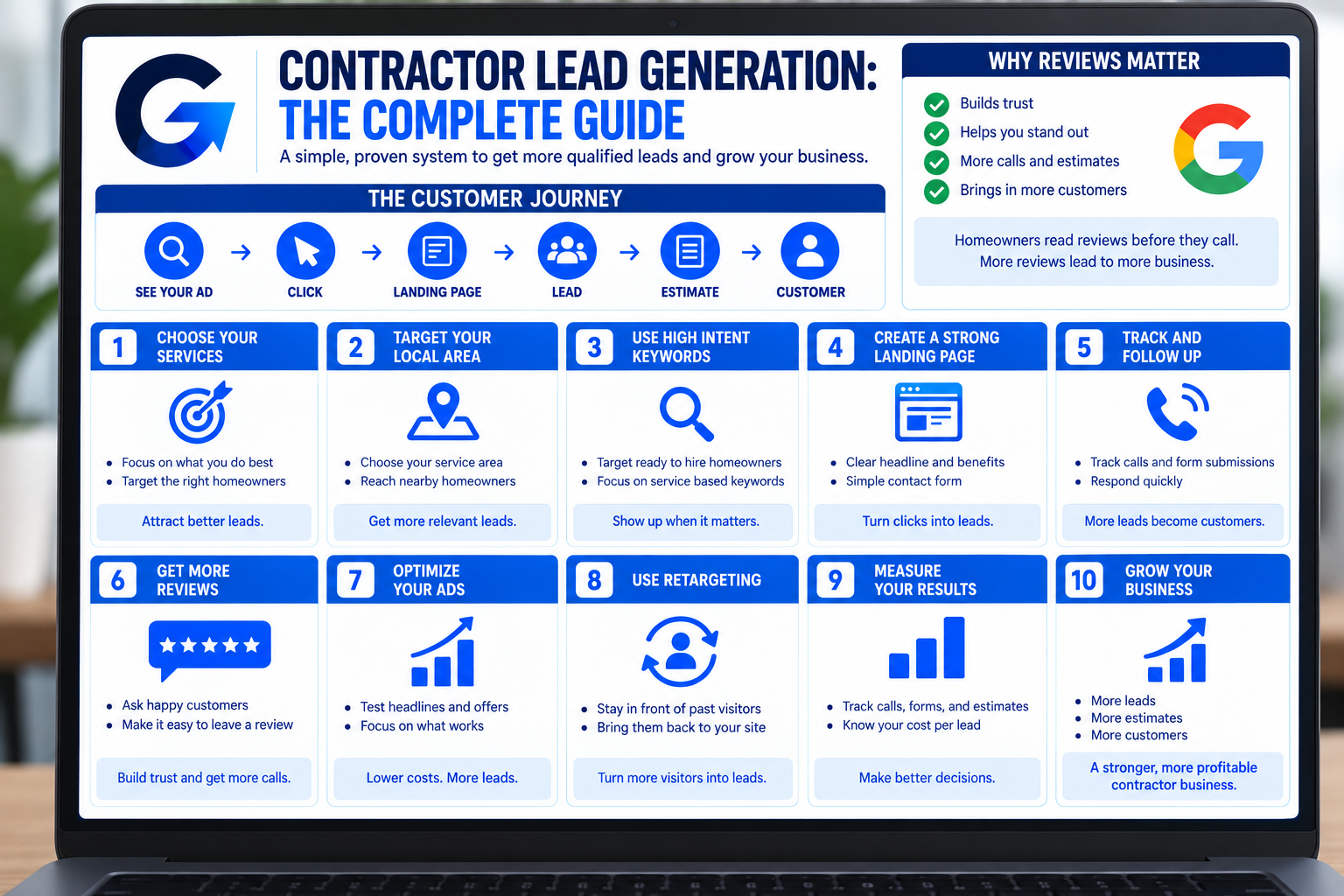
📊 Click the diagram to view a larger version. After opening it, turn your phone sideways for the best viewing experience.
18. Build a Referral System
Some of the strongest contractor leads come from:
“My neighbor used you.”
or:
“My realtor gave me your number.”
But referrals shouldn't be entirely accidental.
After a successful project:
- Ask for a review
- Mention referrals
- Make your information easy to share
- Stay connected with past customers
The goal isn't to pressure people.
It's to make recommending you easy.
19. Build Professional Referral Partnerships
Contractors can also generate opportunities from professionals who regularly encounter customers needing related work.
Potential partners include:
- Realtors
- Home inspectors
- General contractors
- Designers
- Property managers
- Suppliers
- Complementary trades
For example:
A flooring contractor's customer needs interior painting.
They recommend you.
Later, your painting customer needs flooring.
You recommend them.
The strongest relationships work both ways.
20. Market Around Active Projects
Contractor work is often visible.
Use that advantage.
Depending on the trade and local rules, use:
- Yard signs
- Neighbor introductions
- Door hangers
- Branded vehicles
- Direct mail
A contractor working in one neighborhood may naturally create opportunities nearby.
Real-Life Example
You're repainting one home's exterior.
The neighbor sees the transformation and asks:
“Who did the work?”
Your current project becomes your next lead source.
21. Use Your Website to Qualify Leads
A website doesn't need to convince everyone to contact you.
It should attract the right customers.
Clearly communicate:
- Services
- Service areas
- Project types
- Experience
- Process
- Pricing factors where appropriate
If you primarily handle $20,000+ remodeling projects, your website shouldn't accidentally position the company like a handyman service.
Better positioning can reduce weak inquiries.
22. Ask Better Questions on Lead Forms
There's a balance.
Too many questions reduce form completion.
Too few give your sales team no context.
Useful fields might include:
- Name
- Phone
- ZIP code
- Service needed
- Project description
Depending on the trade, you could also ask about:
- Timeline
- Property type
- Approximate project scope
Keep it simple.
Collect enough information to begin a useful conversation.
23. Respond Quickly
A strong lead can become weak if nobody responds.
The homeowner may contact multiple contractors.
Use:
Lead Arrives
↓
Call
↓
No Answer
↓
Text
↓
Follow Up
Don't assume someone isn't interested because they missed one call.
They're probably busy.
From Our Experience
Sometimes the fastest way to generate more customers isn't finding another lead source.
It's improving what happens after your existing leads arrive.
24. Qualify Before Sending an Estimator
Your estimator's time has value.
Before scheduling every onsite appointment, understand:
- Where is the property?
- What service is needed?
- What is the approximate scope?
- When does the customer want the work?
- Are they the decision-maker?
Qualification doesn't mean interrogating the homeowner.
It means understanding whether the opportunity fits your business.
25. Follow Up After Estimates
A homeowner may receive your proposal and disappear.
That doesn't automatically mean:
Lost Lead.
They may be:
- Comparing companies
- Reviewing financing
- Discussing the project
- Waiting for timing
Follow up professionally.
Instead of:
“Have you decided?”
try:
“I wanted to make sure you received the proposal and see if you had any questions about the scope or options we recommended.”
Useful follow-up can create additional customers without generating another lead.
26. Reactivate Old Leads
Your CRM may already contain future customers.
Review:
- Old inquiries
- Previous estimates
- Postponed projects
- Past customers
A simple message can reopen the conversation:
“We provided an estimate for your project previously and wanted to see whether it's still something you're considering. We'd be happy to answer any questions or update the proposal if needed.”
You already paid or worked to generate that opportunity.
Don't forget about it.
27. Don't Depend Entirely on Purchased Leads
Lead marketplaces can create opportunities.
But understand what you're buying.
Ask:
- Is the lead shared?
- How many contractors receive it?
- How was it generated?
- Does it match your service?
- Is it inside your area?
- What percentage becomes customers?
Purchased leads aren't automatically bad.
The problem is building a business that can only survive by continuously purchasing the next homeowner's contact information.
28. Build Lead Sources You Own
Over time, invest in assets such as:
- Website
- Google Business Profile
- Reviews
- Local SEO
- Project content
- Customer database
- Referral network
- Brand
These don't eliminate marketing costs.
But they strengthen your own business rather than leaving every opportunity controlled by a third-party provider.
That's where long-term lead generation becomes more sustainable.
29. Track Lead Source
Every inquiry should have a source.
Examples:
- Google Ads
- Google Maps
- Organic Search
- Referral
- Yard sign
- Realtor
- Past customer
- Lead marketplace
Then follow:
Source → Lead → Qualified Lead → Estimate → Customer → Revenue
Without attribution, contractors often say:
“Most of our business comes from word of mouth.”
Maybe.
Or maybe Google actually influences half of it.
Track it.
30. Measure Cost Per Qualified Lead
Raw CPL isn't enough.
Suppose:
Campaign A
40 leads $70 CPL 10 qualified
Campaign B
25 leads $110 CPL 20 qualified
Raw lead cost makes Campaign A look better.
Cost per qualified lead:
A
$2,800 ÷ 10 = $280
B
$2,750 ÷ 20 = $137.50
Campaign B is far more efficient at generating real opportunities.
That's why qualification matters.
31. Track Cost Per Customer
Continue measuring.
Suppose your marketing investment is:
$5,000
and it generates:
5 customers.
Customer acquisition cost:
$1,000
Now compare that against:
- Average project value
- Gross profit
- Sales commission
- Overhead
- Customer lifetime value where relevant
That's how you determine whether lead generation actually works financially.
32. Track Revenue and Profit
Revenue tells you part of the story.
Profit tells you more.
Imagine one marketing source generates:
$100,000 in revenue
but the jobs are low margin.
Another produces:
$75,000
with much stronger margins.
The second source could be more valuable.
Track:
Lead Source → Customer → Revenue → Gross Profit
The goal is not maximum revenue at any cost.
It's profitable growth.
Real-Life Example: Evaluating Lead Sources
Imagine a contractor tracks four channels:
| Source | Leads | Customers | Revenue |
|---|---|---|---|
| Google Ads | 45 | 7 | $105,000 |
| Local SEO | 30 | 8 | $124,000 |
| Google Maps | 22 | 7 | $112,000 |
| Referrals | 15 | 9 | $138,000 |
These numbers are illustrative.
Notice:
Google Ads generated the most leads.
But:
Referrals generated the most customers and revenue.
Without tracking the full journey, you could easily invest in the wrong channel.
Build a Contractor Lead Generation Flywheel
The strongest lead generation system becomes circular.
Marketing Generates Lead
↓
Lead Becomes Customer
↓
Complete Excellent Project
↓
Customer Leaves Review
↓
Capture Project Photos
↓
Create Case Study
↓
Customer Refers Someone
↓
Google Presence Gets Stronger
↓
More Leads
Then repeat.
That's very different from:
Buy Lead → Finish Job → Buy Another Lead
Each completed project strengthens future customer acquisition.
A Simple Contractor Lead Generation Strategy
If we were building a contractor lead generation system from scratch, we'd prioritize it like this:
Stage 1 , Foundation
Website + Google Business Profile + Reviews + Tracking
Stage 2 , Immediate Demand
Google Ads + Landing Pages
Stage 3 , Long-Term Visibility
Local SEO + Service Pages + Location Pages + Project Content
Stage 4 , Improve Conversion
Fast Follow-Up + Qualification + Better Estimates
Stage 5 , Expand Sources
Referrals + Partnerships + Social Media + Neighborhood Marketing
Stage 6 , Measure
Spend → Lead → Qualified → Estimate → Customer → Revenue → Profit
You don't need every marketing tactic at once.
Build the system in the right order.
Common Contractor Lead Generation Mistakes
Avoid:
- Chasing lead volume instead of quality
- Marketing every service equally
- Targeting unprofitable service areas
- Sending paid traffic to generic homepages
- Ignoring negative keywords
- Weak Google Business Profile
- Not asking for reviews
- Using only stock photos
- No project case studies
- Slow response
- No lead qualification
- Calling once and giving up
- No estimate follow-up
- Depending entirely on purchased leads
- Tracking leads but not customers
- Ignoring gross profit
- Turning marketing off every time you get busy
Most contractors don't need a secret lead source.
They need a stronger system around the channels already available to them.
Frequently Asked Questions
1. What is the best way for contractors to generate leads?
There isn't one universal source. A strong system often combines Google Ads for immediate demand with Local SEO, Google Business Profile, reviews, referrals, project content, and strong follow-up.
2. Are Google Ads good for contractor leads?
They can be because Google Search reaches customers actively searching for services. Results depend on targeting, competition, landing pages, tracking, and your sales process.
3. Is Local SEO worth it for contractors?
Yes, especially for businesses focused on specific service areas. SEO can build organic and Maps visibility over time and reduce dependence on paid traffic.
4. Should contractors buy leads?
Purchased leads can make sense when they produce profitable customers. Contractors should understand whether leads are shared and track qualification rate, close rate, customer acquisition cost, and profitability.
5. How can contractors get better-quality leads?
Improve service targeting, geographic targeting, keywords, landing pages, qualification questions, website positioning, reviews, and sales follow-up.
6. How quickly should contractors respond to leads?
As quickly as reasonably possible. High-intent customers may contact several companies, so delayed response can reduce your chance of booking the estimate.
7. What should contractors track?
At minimum: Source → Lead → Qualified Lead → Estimate → Customer → Revenue Then calculate CPL, cost per estimate, customer acquisition cost, close rate, and profitability.
8. Are referrals better than paid leads?
Not automatically. Referrals often begin with stronger trust, while paid channels offer greater control over volume. Compare actual customer acquisition economics.
9. How can contractors generate leads without buying them?
Build Local SEO, Google Business Profile, reviews, referral systems, partnerships, project content, and a high-converting website.
10. How much should contractors spend on lead generation?
There is no universal budget. Work backward from your growth goals, average project value, margins, close rate, capacity, and acceptable customer acquisition cost.
Final Thoughts
Contractor lead generation isn't about finding one magical platform.
It's about building a customer acquisition system .
Get found.
Build trust.
Generate the lead.
Qualify the opportunity.
Respond quickly.
Book the estimate.
Follow up.
Win the customer.
Then turn that customer into:
A review.
A referral.
Project photos.
A case study.
More local authority.
That's where lead generation begins to compound.
The strongest contractor businesses don't start from zero every month.
Every successful project strengthens the next one.
Generate customers today. Build customer acquisition assets for tomorrow. Then repeat.
Ready to Build a More Predictable Contractor Lead Generation System?
GiveMeSomeLeads helps contractors combine Google Ads, high-converting landing pages, Local SEO, Google Business Profile, reviews, call tracking, form tracking, and revenue attribution into one measurable customer acquisition system.
- Google Ads and high-converting landing pages
- Google Business Profile, Local SEO, and reviews
- Lead, estimate, customer, CPA, revenue, and profit tracking