
Introduction
A contractor can run a great Google Ads campaign and still waste money.
Why?
Because the click is only the beginning.
If a homeowner searches:
“Roof replacement contractor near me”
clicks your ad, and lands on a generic homepage talking about roofing, gutters, siding, financing, company history, and six other services, you've created unnecessary friction.
The homeowner searched for one thing.
Your landing page should answer that need directly.
A strong contractor landing page is designed around:
One service
One type of customer
One clear action
From our experience, this is one of the biggest differences between simply buying traffic and actually building a customer acquisition system.
What Is a Contractor Landing Page?
A landing page is a page built specifically for visitors arriving from a marketing campaign.
Unlike a homepage, it usually has a more focused purpose.
For example:
Homepage
May include:
- Roofing
- Siding
- Gutters
- About
- Financing
- Careers
- Blog
- Multiple service areas
Roof Replacement Landing Page
Focuses on:
- Roof replacement
- Your service area
- Why homeowners should trust you
- Recent roof projects
- Reviews
- Estimate request
The goal is simple:
Reduce distractions and help the right visitor take the next step.
Why Landing Pages Matter for Contractors
Contractor advertising can be expensive.
Every click has value.
If you're paying to bring someone to your website, the page should be built around the exact reason they clicked.
Imagine:
Google Search
↓
Relevant Ad
↓
Relevant Landing Page
↓
Estimate Request
That journey feels natural.
Now compare:
Google Search
↓
Relevant Ad
↓
Generic Homepage
↓
Visitor Searches for Service
↓
Gets Distracted
↓
Leaves
The second path creates more opportunities for the visitor to disappear.
1. Build One Landing Page Per Important Service
Don't send every campaign to the same page.
If you advertise:
- Roof replacement
- Interior painting
- Kitchen remodeling
- Epoxy flooring
- Masonry repair
each important service should ideally have its own focused experience.
For example:
Roof Replacement Ad → Roof Replacement Landing Page
Kitchen Remodeling Ad → Kitchen Remodeling Landing Page
Exterior Painting Ad → Exterior Painting Landing Page
This improves message consistency.
The homeowner sees exactly what they searched for.
2. Make the Headline Extremely Clear
The headline should immediately answer:
What do you do?
Where do you do it?
Weak:
Quality You Can Trust
Stronger:
Professional Roof Replacement in Dallas
or:
Interior Painting for Homeowners in Tampa
or:
Kitchen Remodeling in Phoenix
Clarity beats creativity.
The homeowner should understand the offer in a few seconds.
3. Match the Landing Page to the Advertisement
The message should stay consistent from search to page.
If your ad says:
Garage Epoxy Flooring , Free Estimates
the page should not begin with:
Commercial & Industrial Flooring Solutions
That mismatch creates doubt.
A better journey is:
Search
Garage epoxy flooring near me
Ad
Professional Garage Epoxy Flooring
Landing Page
Transform Your Garage With Professional Epoxy Flooring
Everything feels connected.
This is known as message match.
And it matters.
4. Use a Strong Hero Section
The top of the landing page should include the essentials.
Ideally:
- Clear headline
- Short supporting statement
- Real project image
- Primary CTA
- Phone number
- Trust signal
For example:
Professional Exterior Painting in Austin
Transform your home's exterior with professional preparation, quality coatings, and a clean, reliable painting process.
[Request an Estimate]
★★★★★ 4.9 Google Rating
The homeowner immediately understands:
Service + Location + Trust + Next Step
5. Use Real Project Photos
Stock photography can make a page look polished.
Real project photography proves you've actually completed the work.
Use:
- Before-and-after projects
- Finished work
- Crews in action
- Detailed workmanship
- Local projects
Real-Life Example
Imagine two kitchen remodeling landing pages.
Page A
Uses a beautiful stock kitchen from a luxury photo library.
Page B
Shows three kitchens the contractor actually remodeled locally.
The second page creates stronger evidence.
6. Show Before-and-After Transformations
For visual trades, before-and-after content can be especially powerful.
Examples:
Painting
Outdated room → Fresh modern interior
Epoxy Flooring
Stained concrete → Finished garage floor
Remodeling
Old kitchen → Complete transformation
Roofing
Aged roof → New roofing system
Before-and-after images help the homeowner understand the result quickly.
They're also much more engaging than generic paragraphs describing quality.
7. Put Reviews Near Important Decision Points
Don't hide testimonials at the very bottom.
Place strong reviews near:
- Hero section
- Project examples
- Estimate form
- Final CTA
Match reviews to the service where possible.
For example:
Kitchen Remodeling Landing Page
Use a kitchen remodeling testimonial.
Exterior Painting Landing Page
Use an exterior painting review.
A relevant review helps answer:
“Has this company successfully completed projects like mine?”
8. Show Trust Signals
Contractor leads often involve major purchases.
Build confidence.
Depending on your business, trust signals can include:
- Google rating
- Number of reviews
- Years in business
- Licensing where applicable
- Insurance
- Manufacturer certifications
- Warranty information
- Industry memberships
- Local awards
- Financing options where available
Don't overwhelm the page with 20 badges.
Use what genuinely matters.
9. Explain the Service Clearly
Don't assume the homeowner knows exactly what is included.
Explain the process.
For example, an exterior painting landing page might include:
Preparation
- Surface cleaning
- Scraping
- Sanding
- Caulking
- Priming where needed
Painting
- Professional application
- Quality coatings
- Multiple coats where required
Final Walkthrough
- Inspection
- Touch-ups
- Cleanup
This helps the homeowner understand what they're actually buying.
10. Explain Your Process
A simple process reduces uncertainty.
For example:
Step 1 , Request an Estimate
Tell us about your project.
Step 2 , Consultation
We evaluate the property and discuss your goals.
Step 3 , Proposal
You receive a clear scope and pricing.
Step 4 , Schedule
We coordinate the work.
Step 5 , Complete the Project
Our team performs the work.
Step 6 , Final Walkthrough
We review everything with you.
Homeowners are more comfortable when they understand what happens after clicking the CTA.
11. Keep the Form Simple
Don't turn the landing page form into a 25-question questionnaire.
Start with what you need.
For example:
- Name
- Phone
- ZIP code
- Service needed
- Short project description
Depending on the service, you may also ask:
- Project timeline
- Property type
- Approximate scope
The form should help you qualify without creating unnecessary friction.
Pro Tip
Ask yourself:
“Do we actually need this information before speaking with the homeowner?”
If not, remove the field.
12. Consider a Multi-Step Form
For more complex services, a short multi-step form can sometimes feel easier than displaying everything at once.
For example:
Step 1
What service do you need?
Step 2
Where is the property?
Step 3
When are you planning the project?
Step 4
Your contact information
This also allows you to collect useful qualification information.
But keep it simple.
Don't create a 12-step application just because the software allows it.
13. Make the Phone Number Prominent
Some homeowners prefer forms.
Others want to call.
Give them both options.
Your number should be:
- Visible at the top
- Clickable on mobile
- Repeated near important CTAs
- Easy to find at the bottom
Don't hide the phone number behind a menu.
A high-intent customer shouldn't have to hunt for it.
14. Use Clear Calls to Action
Avoid vague buttons like:
Submit
Learn More
Continue
Use:
Request an Estimate
Schedule a Consultation
Get a Roofing Estimate
Request Your Painting Quote
The homeowner should know exactly what happens next.
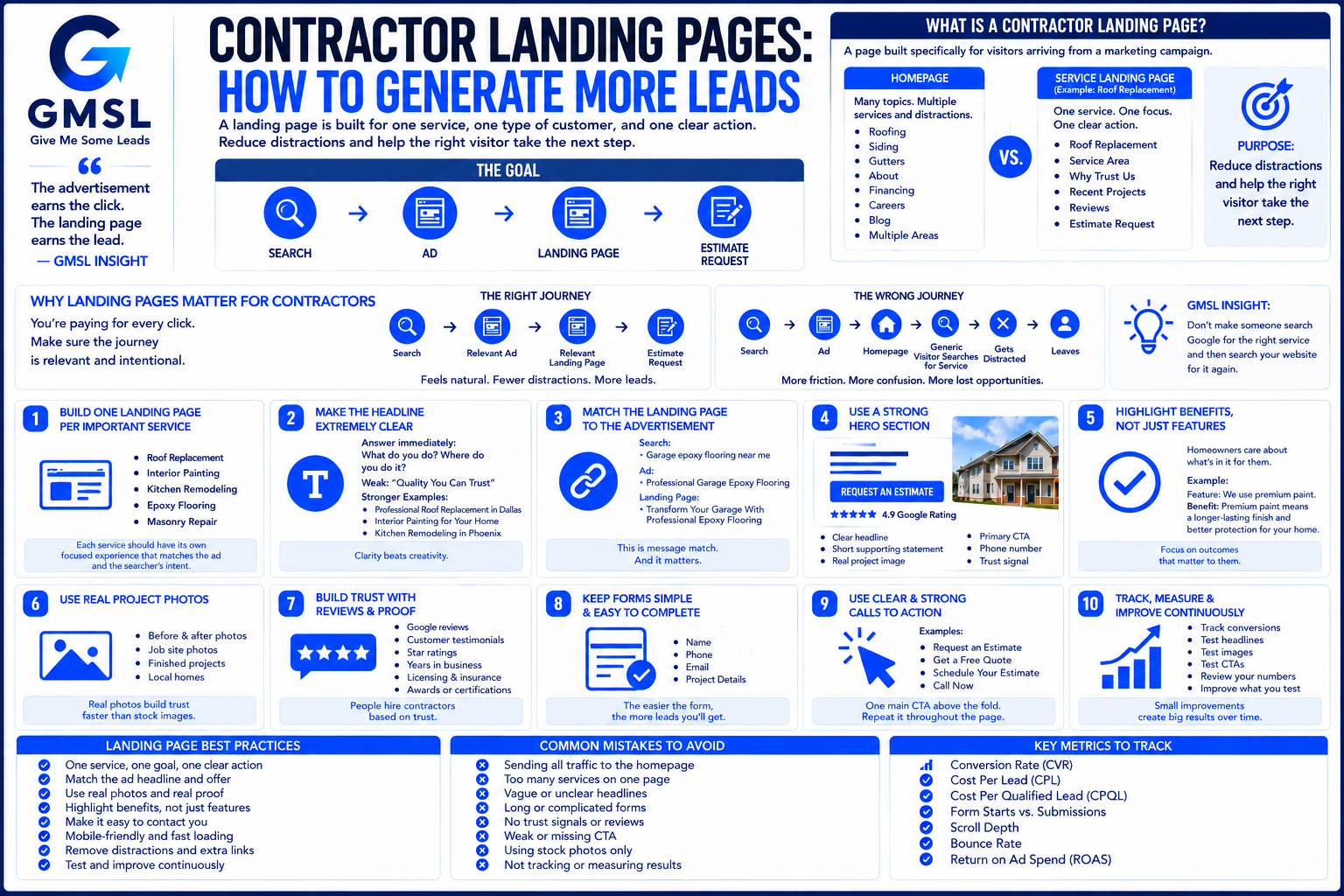
📊 Click the diagram to view a larger version. After opening it, turn your phone sideways for the best viewing experience.
15. Don't Use Too Many Calls to Action
A focused landing page doesn't need:
Call
Download Guide
Subscribe
Read Blog
Follow Facebook
Join Newsletter
Watch Video
Apply for Financing
all competing for attention.
For most contractor landing pages, the main action should be:
Request Estimate
with:
Call Now
as the secondary option.
Keep the page focused.
16. Remove Unnecessary Navigation
Your main website navigation gives visitors many places to go.
That's useful on a homepage.
It can be distracting on a landing page.
Depending on the campaign, you may simplify or reduce navigation so the page remains focused.
The visitor should still have enough information to trust the business.
But you don't necessarily want them leaving to read:
Careers
Blog Archive
Company News
when you paid for a high-intent roofing click.
17. Make the Page Mobile-Friendly
Many contractor leads come from people searching on phones.
The mobile experience should make it easy to:
- Read headline
- View projects
- Tap phone number
- Complete form
- Read reviews
- Click CTA
Test it yourself.
Open your landing page on your phone.
Try to submit the form.
If it feels annoying, fix it.
18. Make the Page Fast
Large project photos can make contractor websites painfully slow.
Compress images and avoid unnecessary:
- Scripts
- Animations
- Plugins
- Autoplay video
- Oversized files
A homeowner shouldn't wait five seconds to see the page they just paid you, in advertising terms, to visit.
Speed supports both user experience and conversion.
19. Explain Pricing Expectations Where Appropriate
You don't necessarily need to publish exact pricing.
But you can explain what affects cost.
For example:
Roof Replacement
- Roof size
- Material
- Pitch
- Tear-off
- Decking
- Complexity
Interior Painting
- Number of rooms
- Surface condition
- Trim
- Ceilings
- Repairs
Remodeling
- Size
- Materials
- Layout changes
- Cabinetry
- Plumbing
- Electrical
This helps homeowners understand why estimates vary.
It can also filter out unrealistic expectations.
20. Use FAQs to Remove Objections
Good FAQs answer questions that may prevent someone from contacting you.
For example:
- Do you provide free estimates?
- What areas do you serve?
- Are you insured?
- How long does the project take?
- Do you offer warranties?
- What happens after I request an estimate?
- Do you handle permits where required?
- Do I need to be home?
FAQs can reduce hesitation without forcing the homeowner to call just to ask something basic.
21. Add Location Relevance
If your advertising targets a specific market, reinforce that location on the page.
For example:
Roof Replacement in Tampa
Then mention:
Serving homeowners throughout Tampa, Brandon, Riverview, and surrounding communities.
You can also show:
- Local projects
- Local reviews
- Neighborhoods
- Relevant service areas
This reassures the visitor:
Yes, they actually work here.
22. Show a Real Team
People hire people.
If appropriate, show:
- Owner
- Estimator
- Project manager
- Crew
- Office team
This can be especially important for trades where workers spend significant time inside someone's home.
A completely anonymous company creates more uncertainty.
Real people help humanize the business.
23. Build Different Landing Pages for Different Traffic Sources
Not every visitor arrives with the same level of intent.
Google Search
Often high intent.
The page can be direct:
Service → Proof → Estimate
The homeowner may be earlier in the decision process.
You may need more:
- Visual transformation
- Education
- Social proof
- Context
The landing page should match the customer journey.
One page doesn't always need to serve every campaign.
24. Track Every Conversion
At minimum, track:
- Form submissions
- Phone calls
- Appointment bookings where available
But don't stop there.
Track:
Landing Page
↓
Lead
↓
Qualified Lead
↓
Estimate
↓
Customer
↓
Revenue
This gives you the full picture.
25. Measure Lead Quality by Landing Page
Suppose:
Landing Page A
100 visitors 15 leads 3 customers
Landing Page B
100 visitors 10 leads 5 customers
Page A has a better raw conversion rate:
15%
Page B:
10%
But Page B produces more customers.
Which one is better?
Probably Page B.
26. Track Cost Per Customer
Suppose your campaign generates:
30 leads
at:
$100 per lead
Spend:
$3,000
Those leads produce:
6 customers
Customer acquisition cost:
$500
Now compare that against:
- Average project value
- Gross profit
- Sales cost
- Marketing management fees
That's a meaningful business metric.
The landing page affects that number directly.
27. A/B Test Important Elements
Don't rebuild the entire page every week.
Test meaningful variables.
Examples:
- Headline
- Hero photo
- CTA
- Form length
- Review placement
- Before-and-after section
- Trust signals
Run tests long enough to collect useful data.
Avoid making five major changes simultaneously because then you won't know what actually improved performance.
Real-Life Example: Improving a Contractor Landing Page
Imagine a roofing contractor spends:
$5,000 per month on Google Ads.
Their campaign sends traffic to the homepage.
Results:
500 visitors
↓
25 leads
Conversion rate:
5%
They build a dedicated roof replacement landing page with:
- Clear headline
- Real roof photos
- Strong reviews
- Short form
- Click-to-call
- Service area
- Simple process
The same 500 visitors now produce:
40 leads
Conversion rate:
8%
If lead quality remains strong, that's:
15 additional opportunities without increasing advertising spend.
The numbers are illustrative.
But this demonstrates why conversion optimization can be one of the highest-leverage areas in contractor marketing.
The Ideal Contractor Landing Page Structure
A strong layout might look like:
1. Hero
Service + Location
Real project photo
Primary CTA
Phone number
Review rating
2. Trust
Reviews Credentials Experience
3. Customer Problem
Show that you understand why they searched.
4. Solution
Explain your service.
5. Before-and-After Projects
Show real work.
6. Process
Explain what happens.
7. Testimonials
Build confidence.
8. Service Area
Confirm local relevance.
9. FAQs
Remove objections.
10. Final CTA
Request Your Estimate
Simple.
Focused.
Built around conversion.
Contractor Landing Page Checklist
Before launching a page, check:
- One clear service
- Strong headline
- Geographic relevance
- Clear CTA
- Visible phone number
- Mobile click-to-call
- Real project photos
- Before-and-after content
- Customer reviews
- Trust signals
- Simple process
- Short form
- Service explanation
- FAQs
- Mobile-friendly design
- Fast load speed
- Form tracking
- Call tracking
- CRM attribution
- Customer tracking
If you can't measure what happens after the form is submitted, the system is incomplete.
Common Contractor Landing Page Mistakes
Avoid:
- Sending every campaign to the homepage
- Generic headlines
- Using only stock photography
- No customer reviews
- Long forms
- Hidden phone numbers
- Too many CTAs
- Excessive navigation
- No service-area information
- Slow load times
- Poor mobile design
- No pricing context
- No FAQs
- No conversion tracking
- Optimizing for leads but ignoring customers
Landing pages should remove friction, not create it.
Landing Pages vs. Homepages
A homepage and landing page have different jobs.
Homepage
Introduces the entire company.
It may contain:
- Multiple services
- About
- Blog
- Careers
- Different markets
- General company information
Landing Page
Focuses on one campaign.
It usually answers:
What service?
Where?
Why you?
What should I do next?
That's why landing pages can be so valuable for paid traffic.
They're built around the visitor's immediate intent.
Landing Pages Are Part of a Bigger System
A landing page won't fix everything.
Imagine:
Excellent Landing Page
but:
Slow Lead Response
You still lose opportunities.
Or:
Excellent Landing Page
but:
Weak Google Reviews
Trust suffers.
Or:
Excellent Landing Page
but:
Poor Sales Process
Customers don't close.
The complete system is:
Advertising
↓
Landing Page
↓
Lead
↓
Fast Response
↓
Qualification
↓
Estimate
↓
Follow-Up
↓
Customer
↓
Review + Referral
That's why landing pages should be treated as one part of the larger customer acquisition system.
Frequently Asked Questions
1. What is a contractor landing page?
A contractor landing page is a focused webpage designed for visitors arriving from a specific campaign, service, or offer. Its primary purpose is usually to generate calls or estimate requests.
2. Are landing pages better than contractor homepages?
For focused paid campaigns, they often can be because the page matches the exact service the visitor searched for and reduces unrelated distractions. Homepages still serve an important role for the broader company.
3. What should a contractor landing page include?
A strong page typically includes a clear headline, service area, project photos, reviews, trust signals, service explanation, simple form, phone number, FAQs, and a clear CTA.
4. How long should a contractor landing page be?
There is no universal ideal length. Include enough information to answer important customer questions and build trust without adding unnecessary sections simply to make the page longer.
5. Should contractor landing pages show prices?
Not necessarily. But explaining pricing factors or project minimums where appropriate can improve expectations and lead qualification.
6. How many form fields should a contractor landing page have?
Use the minimum amount needed to begin qualification. For many contractors, name, phone, email, ZIP code, service, and project description are enough to start.
7. Should every service have its own landing page?
Important paid campaigns usually benefit from service-specific landing pages because the page can closely match the search and advertising message.
8. Should contractor landing pages include reviews?
Yes. Relevant customer testimonials can help build trust, especially when they're connected to the same service being advertised.
9. How should landing page success be measured?
Track: Visitors → Leads → Qualified Leads → Estimates → Customers → Revenue Don't measure success solely by form-conversion rate.
Final Thoughts
A high-converting contractor landing page doesn't need to be complicated.
It needs to be focused.
The homeowner searched for a service.
Show them that service.
They want proof.
Show real projects and real reviews.
They want to know whether you serve their area.
Make it obvious.
They want to understand what happens next.
Explain the process.
Then give them an easy way to contact you.
The page should guide the visitor naturally from:
Interest
to:
Trust
to:
Action
And then your sales process takes over.
From our experience, this is where contractors can dramatically improve marketing performance without necessarily increasing advertising spend.
Sometimes the answer isn't:
“We need more traffic.”
It's:
“We need to convert more of the traffic we're already paying for.”
Make every click work harder by giving homeowners the exact information, proof, and next step they need to contact your company.
Ready to Build Contractor Landing Pages That Generate Profitable Customers?
GiveMeSomeLeads helps contractors combine Google Ads, high-converting landing pages, call tracking, form tracking, Google Analytics 4, Google Tag Manager, and customer attribution into one measurable acquisition system.
- Service-specific landing pages
- Phone-call and form-submission tracking
- Qualified lead, customer, CPA, and revenue optimization