
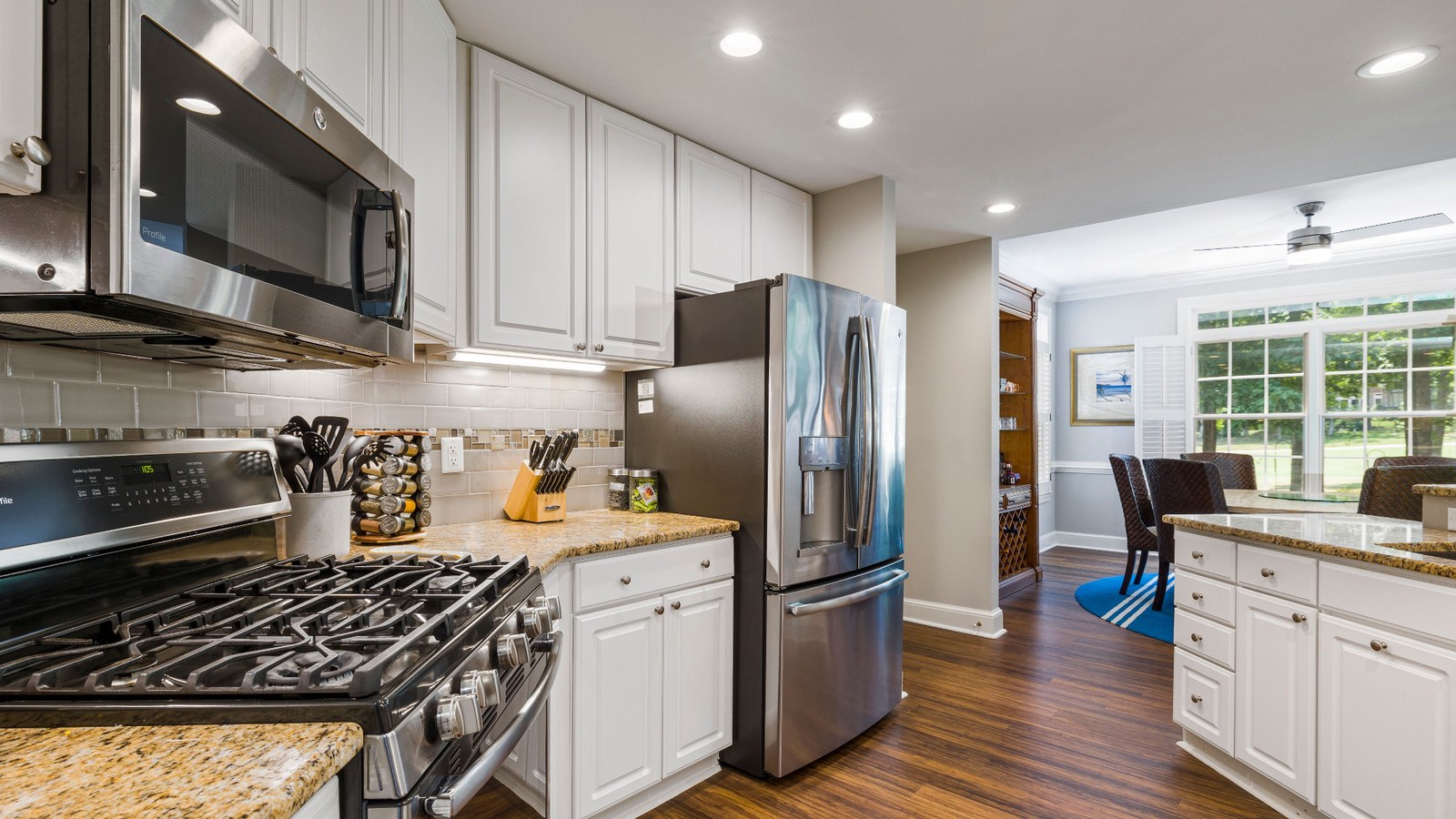
Generating kitchen remodeling leads is only the beginning.
The real opportunity comes from turning those leads into profitable projects.
A homeowner requesting a free estimate has not hired you yet. They are still evaluating the project, comparing options, thinking about the investment, and deciding which contractor they trust.
That is why improving your estimate-to-customer conversion rate can be just as valuable as generating more leads.
From Our Experience: One principle we follow is to keep forms as simple as possible. Every additional field creates more friction and gives homeowners another reason to abandon the request. We've consistently found that clean, modern layouts with only the essential questions generate higher conversion rates. The goal is to make requesting a free estimate feel quick, natural, and effortless while matching the homeowner's intent as closely as possible. You can always gather additional details during the qualification call after the lead has been captured.
Qualify Before Giving the Estimate
Not every homeowner requesting a free estimate is ready for a consultation at the property.
Before scheduling a visit, spend a few minutes learning about the project.
Ask questions such as:
The goal is not to interrogate homeowners.
It is to determine whether your company and the homeowner are a good fit before investing time in a consultation at the property.
A short qualification call can save hours of driving, measuring, preparing proposals, and following up on projects that were unlikely to move forward.
Every estimate requires time, fuel, scheduling, and preparation.
Qualifying homeowners first helps your team spend more time with serious opportunities and less time chasing projects that are outside your service area, budget, or specialization.
According to HubSpot, businesses that qualify leads before investing additional sales time generally improve efficiency by focusing their resources on opportunities that are more likely to convert into customers.
A remodeling company receives two estimate requests.
The first homeowner wants a complete kitchen renovation within the company's service area and plans to begin within the next two months.
The second lives outside the service area and is only gathering rough pricing for a possible future project.
A five minute qualification call helps the contractor prioritize the first opportunity while avoiding an unnecessary site visit for the second.
Create a simple qualification checklist so every member of your team asks the same core questions before scheduling an estimate.
In our experience working with contractors we've noticed that not every lead deserves an estimate. The goal is not to schedule more appointments. It is to schedule more qualified appointments that have a realistic chance of becoming profitable projects.
Respond Quickly
The sales process begins long before you arrive at the homeowner's house.
It begins the moment someone contacts your business.
Whenever possible, respond to new estimate requests quickly.
If the homeowner does not answer your call, follow a simple process:
A fast response demonstrates professionalism and reassures homeowners that your company is organized and attentive.
Homeowners often contact several contractors before making a decision.
The business that responds first frequently has the first opportunity to build trust, answer questions, and schedule the consultation.
Research by Lead Connect found that responding to new leads within the first five minutes can dramatically increase the likelihood of making contact compared with waiting longer.
Two kitchen remodeling companies receive the same online estimate request.
One calls the homeowner within ten minutes and schedules a consultation.
The other responds the following morning.
By then, the homeowner has already booked appointments with other contractors and is no longer actively looking.
If you cannot answer every inquiry immediately, use automated notifications so your team can return missed calls and form submissions as quickly as possible.
The way we look at it is simple: your response process is part of your customer experience. A homeowner's first impression is not your finished kitchen. It is how your company communicates from the very first interaction.
Do Not Treat the Estimate Like a Price Delivery
One of the most common mistakes contractors make is treating an estimate like a simple pricing appointment.
The process becomes:
For a major kitchen renovation, homeowners are rarely choosing a contractor based solely on price.
They are evaluating the person they trust to manage a significant investment inside their home.
Use the consultation to better understand:
The more you understand the homeowner's goals, the more relevant and valuable your proposal becomes.
A kitchen remodeling consultation is not just about collecting measurements.
It is your opportunity to demonstrate expertise, build trust, and show homeowners that you understand their vision before presenting a solution.
Studies on consultative selling consistently show that sales professionals who focus on understanding customer needs before presenting solutions achieve higher close rates than those who focus primarily on price.
Two contractors visit the same homeowner.
The first measures the kitchen, provides a price, and leaves.
The second asks detailed questions about how the family uses the space, discusses design priorities, explains the remodeling process, and recommends solutions tailored to their goals.
Even with a higher estimate, the second contractor creates significantly more value during the consultation.
Spend more time asking questions than talking about your company. Understanding the homeowner's goals helps you present solutions that feel personalized rather than generic.
One thing we've consistently seen is that homeowners do not simply buy a kitchen remodel. They buy confidence in the contractor guiding the entire project. A great consultation builds that confidence long before the proposal is delivered.
Ask Better Questions
Great sales conversations involve listening more than talking.
Instead of jumping straight into measurements and pricing, ask questions that help you understand what the homeowner truly wants to achieve.
Questions like these can uncover valuable insights:
The same kitchen renovation can represent completely different priorities for different homeowners.
Understanding those priorities allows you to build a proposal around what matters most to them.
The better you understand the homeowner's goals, the easier it becomes to recommend solutions that feel personalized rather than generic.
People do not just want a remodeled kitchen. They want a kitchen that solves their specific problems.
Research on consultative selling consistently shows that asking thoughtful discovery questions improves customer engagement and helps sales professionals better understand buyer needs before presenting solutions.
Two homeowners both request a complete kitchen remodel.
One is primarily concerned about storage.
The other wants an open layout for entertaining family and friends.
Although the scope of work appears similar, the conversation and ultimately the proposal should focus on entirely different priorities.
Avoid asking questions that can only be answered with yes or no.
Open ended questions encourage homeowners to explain what they are hoping to achieve and often reveal valuable information that influences the project.
A common pattern we've noticed is that homeowners do not hire contractors simply because they provide remodeling services. They hire contractors who demonstrate they understand the homeowner's vision better than anyone else.
Build Trust During the Consultation
Kitchen remodeling is one of the largest investments many homeowners will make inside their home.
They need confidence that your company can deliver what you promise.
Bring evidence that supports your experience, such as:
The more closely your examples resemble the homeowner's project, the easier it becomes for them to imagine working with your company.
Trust is not built by saying you are experienced.
It is built by demonstrating your experience through real projects and satisfied customers.
According to BrightLocal's Local Consumer Review Survey, most consumers regularly read online reviews before choosing a local business, making customer proof one of the strongest trust signals available.
A homeowner wants a high end kitchen renovation with custom cabinetry.
Instead of showing every project you have completed, you present several similar kitchens featuring custom cabinetry, large islands, premium countertops, and detailed craftsmanship.
The homeowner immediately sees that your company has completed projects similar to their vision.
Organize your portfolio by project type so you can quickly show homeowners examples that closely match their own remodeling goals.
One of the biggest opportunities we have seen is that proof builds confidence. The closer your examples resemble the homeowner's project, the easier it becomes for them to trust that you can successfully deliver the same results.
Explain Your Process
For many homeowners, uncertainty creates more stress than the renovation itself.
They do not just want to know what the finished kitchen will look like.
They want to understand what happens between today and project completion.
Walk them through your process step by step.
Also explain how communication works throughout the project.
The clearer your process becomes, the more comfortable homeowners feel moving forward.
Kitchen remodeling affects a family's daily routine for weeks or even months.
Helping homeowners understand the journey reduces uncertainty and builds confidence before construction even begins.
Research on customer experience consistently shows that setting clear expectations before a project begins improves customer satisfaction and reduces misunderstandings throughout the process.
A homeowner compares two remodeling companies.
One simply provides an estimate.
The other explains every stage of the renovation, expected timelines, communication process, and how unexpected issues are managed.
Even before work begins, the second company appears significantly more organized and professional.
Consider creating a simple one page remodeling timeline that homeowners can keep after the consultation. It reinforces your professionalism and helps them remember your process long after you have left.
One of our core philosophies is that homeowners are not only buying a finished kitchen. They are buying confidence in the journey required to get there. The clearer your process, the easier it becomes for homeowners to trust your company.
Make Your Proposal Easy to Understand
A kitchen remodeling proposal should do more than present a price.
It should clearly explain exactly what the homeowner is receiving and what happens next.
A well structured proposal should include:
Avoid overwhelming homeowners with unnecessary technical language. A proposal that is easy to read and understand makes it easier to make a confident decision.
Confusing proposals create uncertainty.
When homeowners clearly understand the scope, timeline, and investment, they spend less time guessing and more time evaluating whether your company is the right fit.
Research from the Nielsen Norman Group consistently shows that users are more likely to take action when information is presented clearly and is easy to understand.
Two contractors submit similar estimates.
One sends a one page document containing only a total price.
The other provides a professional proposal explaining every phase of the renovation, the materials included, payment milestones, warranty information, and the next steps.
Even before construction begins, the second proposal creates greater confidence.
Use headings, spacing, and simple language to organize your proposal. A document that is easy to scan is far more effective than one filled with dense paragraphs.
One important thing to remember is that homeowners should not have to guess what they are buying. The clearer your proposal, the easier it becomes for homeowners to understand the value your company provides.
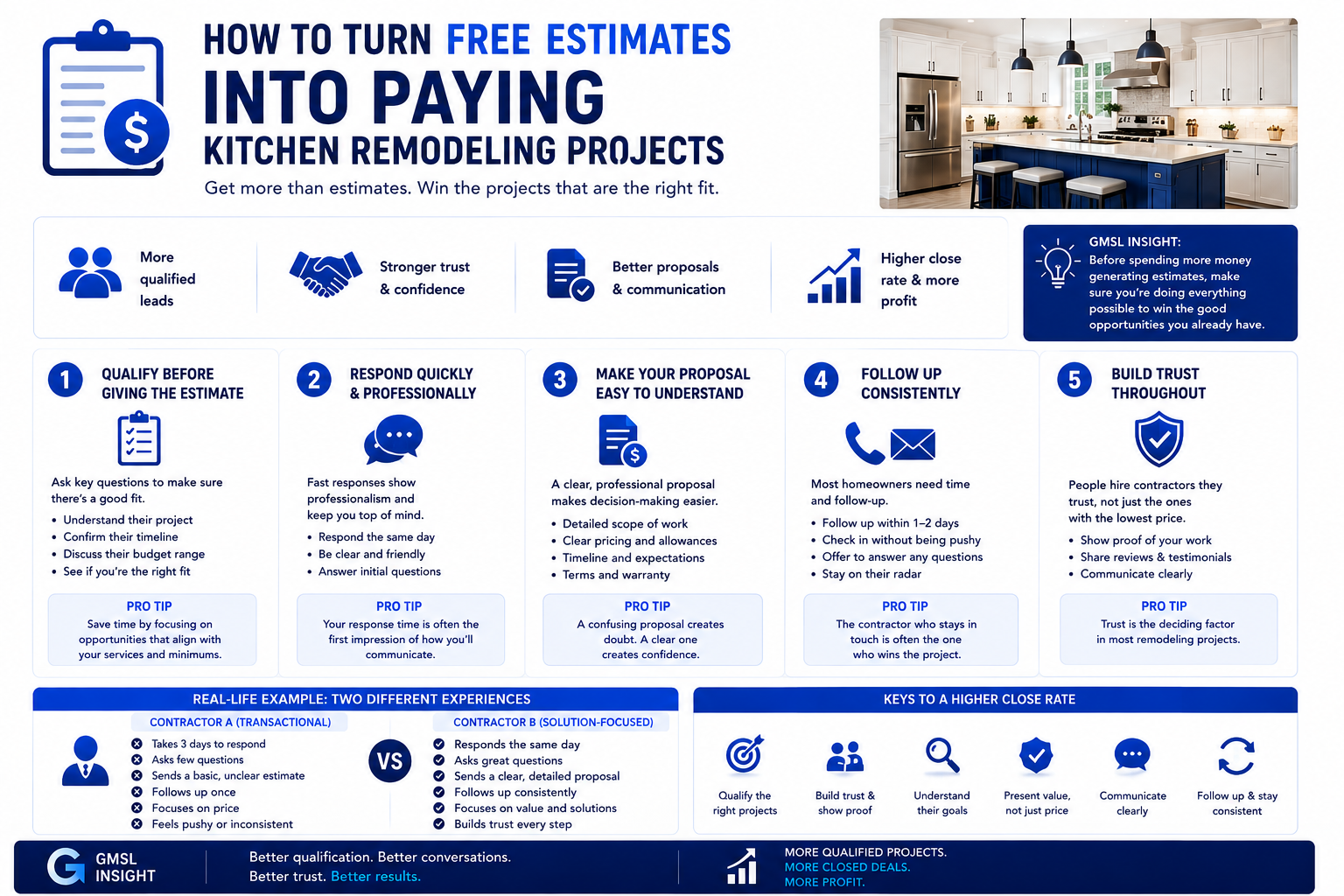
📊 Click the diagram to view a larger version. After opening it, turn your phone sideways for the best viewing experience.
Do Not Compete Only on Price
Many contractors assume they need to have the lowest estimate to win the project.
In reality, homeowners often evaluate much more than price.
They also consider:
A kitchen renovation is a significant investment that affects the homeowner's daily life for weeks or even months.
They are not simply choosing the lowest number.
They are choosing the company they trust to manage the entire project.
Competing only on price often leads to lower margins and attracts homeowners who compare contractors solely by cost.
Competing on value allows you to build a stronger business with customers who appreciate quality, communication, and professionalism.
Multiple homeowner surveys consistently show that trust, reviews, communication, and previous experience are among the most influential factors when selecting a contractor, alongside price.
One contractor submits the lowest estimate but provides little explanation.
Another charges slightly more while presenting a detailed proposal, showcasing similar completed kitchens, explaining the renovation process, and demonstrating strong customer reviews.
Many homeowners willingly invest more because they feel significantly more confident in the second contractor.
Instead of trying to justify your price, focus on demonstrating the value your company provides throughout the entire remodeling experience.
One of our core philosophies is that homeowners rarely remember who was the cheapest. They remember who inspired the most confidence. Your goal is not to win every estimate. It is to win the right projects by communicating the value behind your work.
Explain the Value Behind Your Price
If your proposal costs more than another contractor's, avoid immediately lowering your price.
Instead, help homeowners understand what they are receiving.
Your proposal may include:
Price by itself can appear expensive.
When homeowners understand everything included, they can evaluate the complete investment rather than comparing numbers alone.
Homeowners often compare proposals that appear similar at first glance but include very different levels of service.
Helping them understand those differences allows them to make a more informed decision.
Research in value based selling consistently shows that customers are less sensitive to price when they clearly understand the additional value, quality, and reduced risk associated with a purchase.
A homeowner receives two proposals.
One contractor simply lists a total investment.
The other explains the materials being used, warranty coverage, project management process, cleanup procedures, and communication throughout construction.
Although the second proposal is more expensive, the homeowner understands why and feels more comfortable making the investment.
Never criticize competing contractors.
Simply explain what your company includes and allow homeowners to compare the overall value for themselves.
One lesson we've learned is that people do not buy based on price alone. They buy when they understand the value behind the investment. The better you communicate that value, the less your proposal becomes a simple price comparison.
Give Homeowners Options
Sometimes homeowners want to move forward but are unsure about the exact scope of the project or the level of investment that makes the most sense.
Instead of presenting only one proposal, consider offering a few different options.
Essential Renovation
Refresh the existing kitchen while keeping the current layout.
Complete Remodel
New cabinetry, countertops, flooring, lighting, and a redesigned layout.
Premium Transformation
Custom cabinetry, luxury finishes, structural modifications, premium appliances, and personalized design features.
Every homeowner has different priorities and budgets.
Presenting multiple options gives people flexibility while allowing them to choose the level of investment they are most comfortable making.
Behavioral pricing research has consistently shown that offering multiple choices helps customers make purchasing decisions more confidently because they can compare value rather than deciding between only yes or no.
A homeowner initially hesitates after seeing the investment for a complete kitchen remodel.
Instead of losing the project, the contractor presents a second option that maintains the existing layout while updating the finishes.
The homeowner proceeds with the project, and several years later hires the same company for a larger renovation.
Keep your options simple. Three clearly defined packages are usually easier to compare than five or six different proposals.
A common pattern we've noticed is that homeowners appreciate having choices. Offering different solutions allows customers to select the option that best matches their goals instead of feeling forced into a single proposal.
Present the Estimate Whenever Possible
Whenever practical, review your proposal with the homeowner instead of simply emailing it.
Walking through the estimate together allows you to explain:
Most importantly, it gives homeowners the opportunity to ask questions immediately.
Sometimes the real obstacle is not the price.
It may be uncertainty about the schedule, financing, materials, or simply not understanding part of the proposal.
Presenting the estimate creates a conversation rather than leaving homeowners to interpret the proposal on their own.
That conversation often uncovers concerns that would otherwise remain hidden.
Sales research consistently shows that guided proposal presentations improve close rates because they create opportunities to answer objections before they become reasons for rejecting the proposal.
A homeowner receives two proposals.
One arrives by email with no explanation.
The other is presented during a short meeting where the contractor walks through every section, answers questions, and explains the remodeling process.
The homeowner leaves feeling informed and confident instead of confused.
Finish every proposal presentation by asking:
Rather than:
The first encourages discussion while the second often receives an automatic no.
Our perspective is simple: proposals should be conversations, not documents. Every question you answer during the presentation removes uncertainty and brings the homeowner one step closer to moving forward.
Make the Next Step Obvious
One of the easiest ways to lose momentum is ending the consultation with:
Instead, clearly explain what happens if the homeowner decides to move forward.
Giving homeowners a clear roadmap removes uncertainty and helps them understand exactly what to expect.
People are far more likely to take action when they understand the next step.
A clear process creates confidence and reduces hesitation after the consultation.
Research on customer experience consistently shows that reducing uncertainty throughout the buying process increases the likelihood that customers will complete the next step.
A remodeling company finishes every consultation by reviewing the next steps with the homeowner and providing a simple timeline.
Instead of wondering what happens after accepting the proposal, homeowners know exactly what to expect from the moment they say yes.
Before leaving the consultation, summarize the next steps in one or two simple sentences. Homeowners should never leave wondering how the process continues.
One of our core philosophies is that homeowners should not have to guess what happens next. A clear process builds confidence, reduces hesitation, and creates a smoother experience from the first consultation through the completed renovation.
Follow Up
Many kitchen remodeling projects are not won during the first consultation.
Homeowners often need time to compare contractors, discuss the project with family, review financing, finalize design ideas, or simply think about such a significant investment.
That is why following up is an important part of the sales process.
A simple follow up schedule might look like:
Instead of asking, "Have you made a decision?", ask whether they have questions about the proposal, materials, timeline, or project scope.
Many homeowners appreciate a contractor who remains available without being pushy.
Following up keeps the conversation open and often uncovers questions or concerns that would otherwise prevent the project from moving forward.
Research from the National Sales Executive Association has shown that many sales require multiple follow up attempts before a buying decision is made, yet many businesses stop after only one or two contacts.
A homeowner receives three remodeling proposals.
One contractor never follows up.
One sends a generic email.
The third calls to answer questions about materials, discusses financing options, and clarifies the project timeline.
The homeowner chooses the contractor who remained helpful throughout the decision process.
Every follow up should provide value. Answer questions, offer additional information, or clarify the proposal instead of simply asking whether the homeowner is ready to decide.
One important thing to remember is that following up is not about pressuring homeowners. It is about making sure unanswered questions or uncertainty do not prevent a qualified customer from moving forward.
Learn Why You Lose Estimates
Every estimate provides valuable information, even when you do not win the project.
Track the outcome of every proposal using categories such as:
Review this information regularly.
Patterns often reveal opportunities to improve your sales process, qualification process, or marketing strategy.
If you do not understand why projects are being lost, it is difficult to improve future results.
Your data can identify problems that are not obvious during daily operations.
Successful sales organizations routinely analyze wins and losses because understanding why deals are won or lost helps improve future sales performance.
A remodeling company believes its pricing is too high.
After reviewing one year's worth of lost estimates, they discover that most projects were actually lost because homeowners wanted to delay construction rather than because of price.
Instead of lowering prices unnecessarily, they improve their follow up process and begin winning more delayed projects.
Do not rely on memory. Record the reason each estimate was won or lost in your CRM so trends become easier to identify over time.
One of our core philosophies is that every lost estimate teaches something. The businesses that consistently improve are the ones that analyze their results instead of making assumptions.
Track Your Estimate Close Rate
Your close rate measures how effectively qualified estimates become paying customers.
For example:
Now imagine improving that result:
Improving your conversion process is often one of the fastest ways to grow your business.
Many contractors focus entirely on generating more leads while overlooking opportunities to convert more of the leads they already have.
A small improvement in close rate can produce significant revenue growth.
Sales performance research consistently shows that even modest improvements in conversion rates can generate substantial increases in revenue without increasing marketing spend.
Two remodeling companies each receive twenty qualified estimates every month.
One closes five projects.
The other closes seven.
Although both generate the same number of opportunities, the second company produces significantly more revenue simply because its sales process converts more homeowners.
Track your close rate monthly and compare it with previous periods. Small improvements become much easier to identify when you consistently measure performance.
We've found that growth does not always require more leads. Sometimes the biggest opportunity is improving what happens after those leads arrive.
Understand the Economics
Understanding your numbers helps you make better marketing and sales decisions.
Imagine your current sales funnel looks like this:
If your average kitchen remodeling project is worth $50,000, that is:
Now improve only your estimate conversion process:
The lead volume has not changed.
The marketing budget has not changed.
But now you have generated:
Before investing more money into advertising, evaluate whether improving your sales process could produce greater returns from your existing opportunities.
Many businesses achieve stronger returns by improving conversion rates before increasing lead generation because every improvement multiplies the value of existing marketing efforts.
A contractor plans to double their Google Ads budget.
Instead, they first improve their qualification process, proposal presentation, and follow up strategy.
Their close rate increases, producing additional projects without increasing advertising costs.
Review your entire customer journey regularly. Improvements at any stage of the funnel can significantly impact your final revenue.
At GiveMeSomeLeads, we believe that every stage of your marketing and sales system matters. Generating more leads is valuable, but improving your conversion process often delivers an even greater return because you are maximizing opportunities you have already paid to generate.
Deliver an Experience Worth Talking About
Winning the project is not the end of the customer journey.
It is the beginning of your next marketing opportunity.
A homeowner who has an exceptional remodeling experience can become one of your most valuable marketing assets.
Every completed kitchen can generate:
One successful project can continue bringing new business long after construction has finished.
Satisfied customers do not just create revenue.
They create trust.
Future homeowners are far more likely to contact your company when they see real projects completed for real people in their community.
According to BrightLocal's Local Consumer Review Survey, online reviews remain one of the most influential factors homeowners consider when choosing a local business.
A remodeling company completes a beautiful kitchen renovation.
The homeowner leaves a five star review, allows professional photos to be taken, recommends the company to a neighbor, and agrees to be featured in a project case study.
That single renovation continues generating new opportunities for months and even years after completion.
Before closing every project, create a simple checklist that includes taking professional photos, requesting a review, collecting a testimonial, and asking whether the homeowner would be comfortable referring friends or family.
The way we look at it is simple: every completed project should strengthen your marketing system. A great remodeling experience does not end with a happy customer. It creates the proof, reputation, and trust that help generate the next qualified customer.
Common Estimate Conversion Mistakes
Many remodeling companies focus heavily on generating leads but overlook opportunities to improve what happens after the lead arrives.
Common mistakes include:
Each of these issues can reduce your conversion rate, even if your marketing is producing qualified opportunities.
Generating more leads will not automatically increase your sales if your estimate process is not converting homeowners into customers.
Sometimes the greatest opportunity is not at the top of your sales funnel.
It is improving the middle and bottom of the funnel where homeowners make their final decision.
Research across multiple sales industries consistently shows that improving conversion rates often produces a higher return on investment than simply increasing lead generation because every improvement compounds across existing opportunities.
Two remodeling companies each receive forty qualified leads every month.
One focuses entirely on buying more advertising.
The other improves qualification, proposal presentations, follow up, and customer communication.
Although both generate the same number of leads, the second company closes significantly more projects because its sales process converts more opportunities.
Review your entire estimate process every few months. Small improvements at each stage often create much larger gains than one major change made once.
One of our core philosophies is that marketing and sales should function as one connected system. Bringing qualified homeowners to your business is only half the job. Converting those opportunities into satisfied customers is what ultimately drives long term growth.
Build a Better Free Estimate System
The strongest remodeling companies do not rely on individual sales techniques.
They build a repeatable process that consistently turns qualified opportunities into customers.
A complete system can look like this:
Every stage supports the next.
Marketing generates qualified opportunities.
Your sales process builds trust.
Excellent project execution creates reviews, referrals, testimonials, and new project content.
Those assets strengthen your marketing, making it easier to attract future customers.
This transforms a free estimate from a simple pricing appointment into a complete customer acquisition system.
Every homeowner who becomes a customer creates new reviews, project content, testimonials, and proof that strengthen your marketing, improve trust, and help generate the next qualified customer.
Rather than treating each estimate as an isolated opportunity, the goal is to build a repeatable system that becomes stronger with every completed project.
One of our biggest philosophies is that sustainable growth does not come from a single marketing campaign or sales tactic. It comes from building a customer acquisition system that continuously improves over time.
Every lead, estimate, customer, review, and completed project provides new data and new proof that help strengthen the next stage of the process.
The goal is not to perfect the system overnight. The goal is to improve it consistently so your business continues generating more qualified customers year after year.
Marketing and sales should work together as one continuous system. Every qualified lead is an opportunity to earn a customer, and every satisfied customer is an opportunity to generate the next qualified lead.
The businesses that grow consistently are the ones that continuously improve every stage of that cycle instead of focusing on just one part.
Frequently Asked Questions
How can kitchen remodelers close more estimates?
Improve qualification, response time, consultation quality, proposals, trust signals, communication, and follow-up. Track where opportunities are being lost instead of assuming price is always the problem.
Should kitchen remodeling estimates be free?
That depends on your business model and the amount of work involved. Some contractors offer free initial estimates while charging for detailed design or planning work. Clearly define what the free estimate includes.
Should I give the price during the appointment?
It depends on the complexity of the project. Simple work may allow faster pricing, while major renovations can require additional planning. Accuracy and professionalism are more important than rushing a number.
How quickly should I send a proposal?
As quickly as you can while still producing an accurate, professional proposal. Set expectations with the homeowner about when they will receive it and keep that promise.
Should I follow up after sending an estimate?
Yes. Homeowners may have questions or need time to decide. Professional follow-up keeps communication open without requiring aggressive sales tactics.
How many times should I follow up?
There is no universal number. Follow up based on project size, homeowner timeline, previous conversations, and level of interest.
Should I discount my estimate to win the project?
Not automatically. First determine whether price is actually the objection. If you reduce price, consider adjusting scope rather than simply sacrificing margin.
What is a good estimate close rate?
There is no universal benchmark for every kitchen remodeler. Close rate depends on lead source, qualification standards, pricing, market, project size, reputation, and sales process. Track your own rate and improve it over time.
What should I track after every estimate?
At minimum, track Lead Source → Qualified Lead → Estimate → Won/Lost → Reason → Project Value.
Final Thoughts
Free estimates are not just numbers on paper.
They are one of the most important moments in the kitchen remodeling customer journey.
The homeowner is deciding whether they trust your company, whether you understand what they want, whether you can manage a project this important, and whether the value justifies the investment.
Your job is not to pressure them into saying yes. It is to make the decision easier through clarity, expertise, proof, communication, and a professional process.
Qualify before driving across town. Listen before selling. Show relevant work. Explain your process. Present a clear proposal. Follow up. Track the result. Then improve.
The best estimate process does not simply deliver a price. It gives the homeowner enough confidence to choose who they want building their new kitchen.
Ready to Convert More Kitchen Remodeling Estimates?
GiveMeSomeLeads helps kitchen remodeling contractors improve the entire customer acquisition process from lead generation and qualification to landing pages, tracking, estimate conversion, and follow-up. Our philosophy is to build marketing systems that continuously improve over time, helping contractors generate more qualified homeowners while turning every completed project into future growth.
- Lead qualification and follow-up systems
- Conversion-focused websites and landing pages
- Customer acquisition and sales tracking