
One of the first questions kitchen remodeling contractors ask about Google Ads is: How much is this going to cost?
It is an important question, but a better one is: How much can I profitably afford to spend to acquire a new kitchen remodeling customer?
There is no universal Google Ads budget. A contractor selling $60,000 kitchen renovations in a competitive city has very different economics from a company averaging $15,000 projects in a smaller market.
Your Google Ads costs depend on many factors, including competition, location, keywords, search demand, landing page performance, close rate, average project value, and profit margins. No two kitchen remodeling companies will have exactly the same costs because every market and business is different. In this guide, we'll explain how these factors work together so you can better understand what influences your advertising costs and approach Google Ads like a professional. We'll also share many of our own insights, philosophy, and real-world experience working with home improvement contractors to help you avoid common mistakes and make smarter marketing decisions. By the end, you'll have a much clearer understanding of how to build a realistic budget, evaluate campaign performance, and invest confidently based on your own business goals rather than guesswork.
How Google Ads Pricing Works
Google Ads uses a real-time auction system. Every time a homeowner searches for kitchen remodeling contractor near me, multiple remodeling companies may compete for that advertising space.
Unlike traditional advertising, you do not pay simply because your ad appears. In most cases, you pay when someone clicks on your advertisement and visits your website or landing page.
The amount you pay depends on several factors, including:
Because these factors constantly change, there is no fixed price for a kitchen remodeling lead.
Why It Matters
Many contractors assume Google Ads has a standard monthly cost. In reality, every market is different.
A campaign in a small town will often behave very differently from one competing in a large metropolitan area with dozens of remodeling companies.
According to Google, every search triggers a new ad auction in real time, meaning advertisers compete dynamically based on relevance, bidding strategy, and overall ad quality rather than simply paying the highest amount.
A homeowner searches:
Four remodeling companies appear.
One has highly relevant ads, a dedicated kitchen remodeling landing page, and excellent conversion tracking.
Another sends visitors to a generic homepage.
Even if both companies bid similar amounts, Google may reward the better user experience with stronger ad visibility.
Do not focus only on bidding higher.
Improving your landing page, ad relevance, and conversion rate often produces better results than simply increasing your budget.
One misconception we hear regularly is that the company spending the most always wins Google Ads.
That is not how the platform works.
Google wants to deliver relevant results for homeowners, so campaign quality often matters just as much as budget.
What Does a Kitchen Remodeling Click Cost?
There is no universal cost per click for kitchen remodeling.
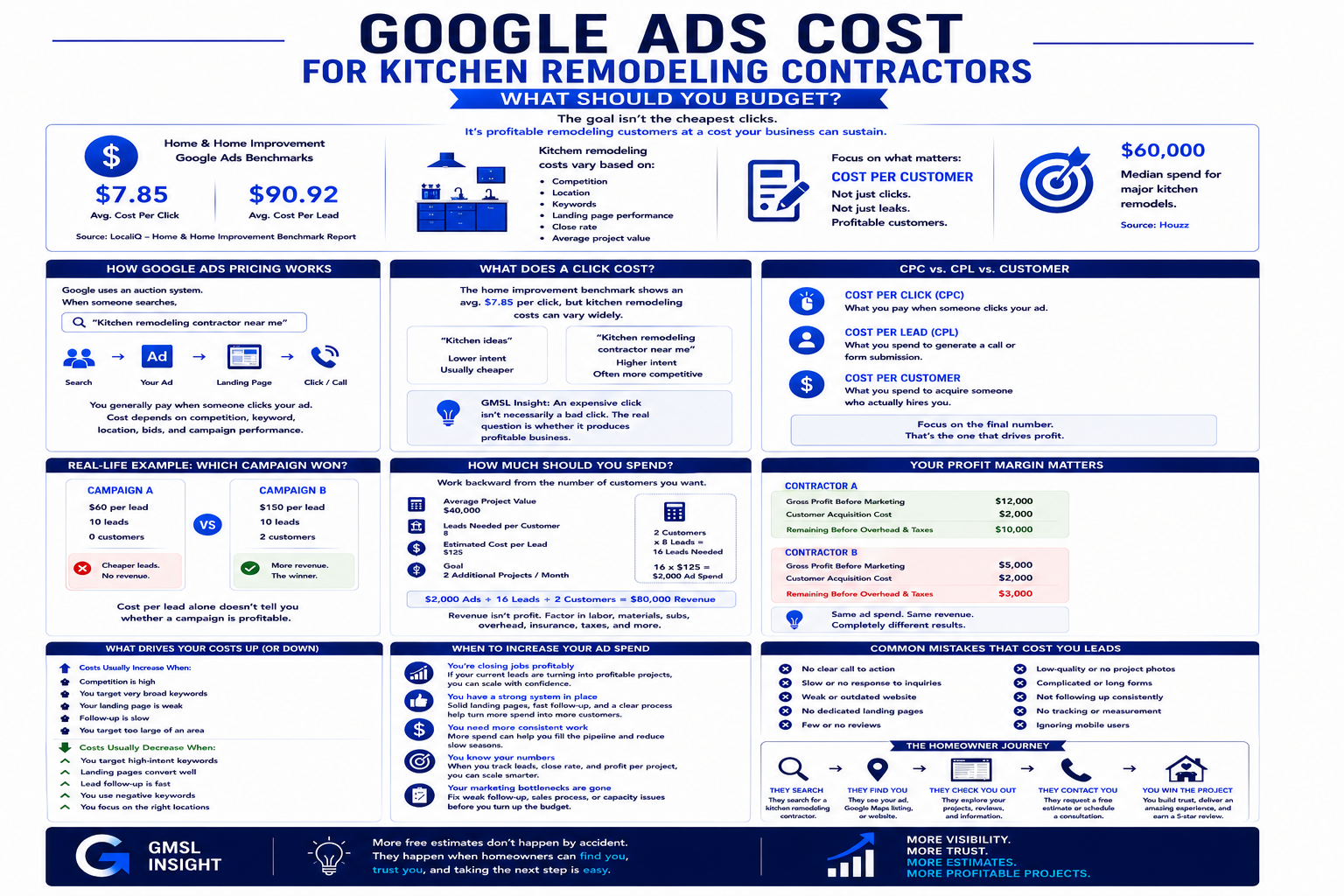
Broader home improvement benchmarks have reported average click costs around $7.85, but actual kitchen remodeling campaigns often vary depending on your local market and the keywords you are targeting.
Kitchen Ideas
Usually someone looking for inspiration.
Kitchen Remodeling Contractor Near Me
Usually someone looking for a company to hire.
Although the second search may cost more, it usually represents significantly stronger buying intent.
Why It Matters
Many contractors become discouraged when they see expensive clicks.
However, a higher click cost often means you are reaching homeowners who are much closer to requesting an estimate.
According to WordStream, high-intent commercial keywords generally command higher advertising costs because they are more likely to generate revenue for advertisers.
A remodeling company pays $18 for one click.
That visitor requests a consultation and eventually signs a $65,000 kitchen remodel.
Suddenly, the $18 click becomes one of the least expensive parts of acquiring that customer.
Judge keywords by customer quality, not click price.
An expensive click that generates profitable remodeling projects is usually a much better investment than a cheap click that never becomes a customer.
We almost never evaluate campaigns based solely on click costs.
What matters is whether those clicks eventually produce qualified consultations, profitable projects, and long-term business growth.
Cost Per Click vs Cost Per Lead vs Cost Per Customer
Many contractors focus on cost per click because it is one of the first numbers Google Ads displays.
In reality, it is usually one of the least important.
Think about your marketing in three stages.
Cost Per Click
The amount you pay every time someone clicks your advertisement.
Cost Per Lead
The amount you spend to generate a phone call or estimate request.
Cost Per Customer
The total advertising investment required to acquire someone who actually hires your company.
Why It Matters
Lower click costs do not automatically produce more profitable campaigns.
What matters is how efficiently your advertising turns homeowners into paying customers.
Cheaper Leads
Generates inexpensive leads that rarely schedule consultations.
More Customers
Generates fewer leads, but far more homeowners become paying customers.
Although Campaign B costs more per lead, it produces a much stronger return on investment.
Track your entire customer journey.
Every marketing decision becomes easier when you know exactly where opportunities are won or lost.
One of the biggest mistakes we see is contractors celebrating cheap leads.
We would rather help a client generate fewer leads that consistently become profitable remodeling projects than hundreds of inquiries that never turn into revenue.
How Much Should a Kitchen Remodeler Spend?
There is no universal Google Ads budget for kitchen remodeling companies.
The right budget depends on your local market, competition, average project value, profit margins, close rate, growth goals, and how many additional customers you want to generate.
Then work backward.
Revenue is not profit, but this approach connects your advertising budget to a measurable business objective instead of choosing a random monthly number.
Why It Matters
Many contractors choose advertising budgets based on what feels comfortable rather than what their business actually needs.
Working backward from your growth goals creates a much more predictable marketing strategy.
A remodeling company wants to complete three additional kitchen remodels every month.
Instead of arbitrarily increasing its advertising budget, the owner calculates approximately how many qualified consultations are needed, estimates the advertising cost required to generate them, and tracks results each month.
Marketing becomes much easier to manage because every dollar now supports a specific business objective.
Start with your customer goal, not your advertising budget.
One of the biggest mistakes we see is contractors asking how much they should spend before knowing how many customers they actually want.
We always recommend starting with your business goals first, then letting the numbers determine your advertising budget instead of the other way around.
Your Profit Margin Matters
Two remodeling companies can generate exactly the same project using exactly the same Google Ads campaign and still achieve completely different financial results.
Imagine both companies acquire a $40,000 kitchen remodel for $2,000 in advertising.
$12,000 Gross Profit
Customer Acquisition Cost: $2,000
$10,000 remaining before overhead and taxes.
$5,000 Gross Profit
Customer Acquisition Cost: $2,000
$3,000 remaining before overhead and taxes.
That is why your marketing budget should always be based on your own financial numbers, not another contractor's.
Why It Matters
Marketing only makes sense when it supports a profitable business.
Two companies may generate identical revenue while producing completely different profits because of labor costs, material costs, overhead, and operational efficiency.
Two remodeling companies each complete a $50,000 kitchen renovation.
One carefully tracks profitability and confidently increases its advertising budget because customer acquisition remains highly profitable.
The other only looks at revenue and unknowingly spends beyond what its margins can comfortably support.
Compare advertising with your own numbers:
Marketing decisions should always be based on business economics, not industry averages.
Every remodeling company has different costs, different margins, and different growth objectives.
The contractors who understand their numbers make much better long-term decisions.
What Makes Google Ads More Expensive?
Google Ads costs can vary significantly depending on how your campaigns are managed.
Many contractors assume expensive advertising is caused only by competition.
In reality, campaign quality often plays an equally important role.
Why It Matters
Advertising costs are not determined by one factor alone.
Improving your targeting, landing pages, and conversion rates can often lower your customer acquisition cost without reducing your advertising budget.
A remodeling company notices its advertising costs increasing.
Within several weeks, lead quality improves while wasted spending decreases.
Before increasing your advertising budget, improve your campaign.
Better targeting often produces better customers without spending another dollar.
One misconception we hear frequently is that expensive Google Ads automatically mean poor performance.
We would much rather pay more for homeowners genuinely planning a kitchen remodel than attract inexpensive clicks from people who never intended to hire a contractor.
Your Landing Page Changes the Economics
Imagine you pay for 100 visitors through Google Ads.
5% Conversion Rate
100 Visitors → 5 Leads
10% Conversion Rate
100 Visitors → 10 Leads
Both campaigns purchased the same amount of traffic.
Sometimes improving your website is far more profitable than increasing your advertising budget.
Why It Matters
Every visitor you already pay for is an opportunity.
If your landing page converts more homeowners into consultations, your advertising budget immediately becomes more efficient without increasing your ad spend.
Two remodeling companies each spend $3,000 on Google Ads.
The first sends visitors to its homepage.
The second sends them to a dedicated kitchen remodeling landing page featuring recent projects, customer reviews, financing information, and a simple consultation form.
Both companies purchase similar traffic, but one consistently generates more qualified consultations because the homeowner's experience is much better.
Treat your landing page as part of your Google Ads campaign.
Improving these elements can often increase leads without spending another dollar on advertising.
One of the biggest opportunities we see is not inside Google Ads.
It is on the website homeowners visit after clicking.
You already paid to earn that click. Your landing page should do everything possible to convert that opportunity into a consultation.
📊 Click the diagram to view a larger version. After opening it, turn your phone sideways for the best viewing experience.
Cheap Leads Do Not Always Mean Better Results
A lower cost per lead does not automatically mean a better campaign.
| Metric | Campaign A | Campaign B |
|---|---|---|
| Ad Spend | $3,000 | $3,000 |
| Leads | 30 | 15 |
| Cost Per Lead | $100 | $200 |
| Customers | 1 | 3 |
| Cost Per Customer | $3,000 | $1,000 |
Campaign A generated twice as many leads.
Campaign B generated three times as many customers.
Why It Matters
Marketing decisions based only on cost per lead can be misleading.
The objective is not generating more inquiries. It is generating more profitable remodeling projects.
A remodeling company pauses a campaign because leads cost $180 each.
Another campaign produces $95 leads.
After reviewing customer data, they discover the more expensive campaign consistently closes larger kitchen remodels while the cheaper campaign produces mostly small renovation inquiries.
The campaign they almost paused was actually the more profitable one.
That answer is usually much more valuable than knowing which campaign generated the cheapest leads.
We rarely optimize campaigns for lower lead costs alone.
We would much rather help a contractor acquire fewer homeowners who are ready to invest in a quality kitchen remodel than generate dozens of inexpensive inquiries that never become paying customers.
When Should You Increase Your Budget?
Increasing your Google Ads budget should be a business decision, not an emotional one.
If your campaigns consistently generate profitable customers and your business has room to take on additional projects, increasing your investment may help accelerate growth.
Why It Matters
Scaling a profitable campaign can create predictable growth.
Scaling an unprofitable campaign usually increases losses.
A remodeling company consistently acquires customers for less than its target customer acquisition cost.
Instead of doubling its advertising budget overnight, it gradually increases spending while monitoring lead quality, close rate, and profitability.
Growth remains controlled because every decision is based on data.
Scale slowly.
Healthy campaigns usually stay healthy when they are scaled carefully.
One of the biggest mistakes we see is contractors increasing budgets simply because Google recommends it.
Your advertising budget should grow only when your business is consistently generating profitable customers and has the capacity to deliver an exceptional customer experience.
When Should You Reduce or Reallocate Spend?
Increasing your budget is not always the answer.
If your campaigns are not producing qualified customers, it is usually better to improve what you already have before spending more money.
Why It Matters
Many contractors assume poor results mean they need more traffic.
In reality, the biggest opportunity is often improving traffic quality, landing page experience, or the sales process before investing additional money.
A remodeling company notices its advertising costs increasing while consultation requests remain flat.
Within several weeks, lead quality improves while advertising costs remain almost unchanged.
Whenever performance starts declining, review your entire customer acquisition system before increasing your budget.
Often the solution is not spending more. It is improving what already exists.
One of the biggest mistakes we see is businesses trying to solve every marketing problem with a larger budget.
More advertising rarely fixes weak landing pages, poor follow-up, or inaccurate targeting.
Improving the system usually produces better long-term results.
Do Not Forget Management Costs
Your total marketing investment includes more than the amount you pay Google.
Looking at your complete investment provides a much more accurate picture of profitability.
Why It Matters
Many contractors evaluate only their Google Ads bill while overlooking the cost of managing campaigns properly.
Successful advertising should always be measured using your total customer acquisition cost rather than advertising spend alone.
Two remodeling companies each spend $3,000 on Google Ads.
One manages campaigns internally.
The other hires a professional agency.
Although the second company spends more overall, it generates significantly more qualified customers because the campaigns are continuously optimized.
The total investment produces a stronger return.
Always calculate your total customer acquisition cost.
Include every expense directly related to generating new customers, not just your Google Ads budget.
Marketing should not be judged by cost alone.
It should be judged by return.
We would rather see a contractor invest slightly more while consistently acquiring profitable customers than save money on management while losing opportunities every month.
What Should a New Advertiser Start With?
There is no universal starting budget for Google Ads.
Your budget should be large enough to generate meaningful data while remaining financially comfortable for your business.
Too little spending may produce too few clicks to evaluate performance.
Too much spending before your website, landing page, conversion tracking, and follow-up process are ready can waste money quickly.
Start with a sustainable investment.
Learn what generates qualified customers.
Improve the system.
Then gradually increase your budget as performance becomes predictable.
Why It Matters
Many contractors expect immediate results from Google Ads.
The first few months should be viewed as an opportunity to collect data, identify improvements, and build a stronger campaign rather than expecting perfect performance from day one.
A remodeling company launches its first Google Ads campaign.
Instead of immediately doubling the budget after the first few leads, they spend several weeks reviewing:
Only after understanding the numbers do they begin scaling.
The result is much more predictable growth.
Be patient.
The goal is not simply launching a campaign.
The goal is building a profitable customer acquisition system that continues improving month after month.
We encourage every contractor to think long-term.
Your first campaign probably will not be your best campaign.
Businesses that achieve the strongest results are usually the ones that continuously learn from their data, improve their system, and scale only after proving profitability.
Common Google Ads Budget Mistakes
Even experienced contractors sometimes make avoidable budgeting mistakes that reduce profitability.
Why It Matters
Successful Google Ads campaigns are not built by spending the most money.
They are built by making better decisions with every dollar invested.
Two remodeling companies spend the same monthly budget.
One reviews campaign performance every week and makes small improvements.
The other leaves campaigns untouched for months.
Over time, one company steadily improves profitability while the other slowly wastes more of its advertising budget.
Review your campaigns regularly.
Small improvements made consistently usually outperform large changes made occasionally.
One of our core philosophies is that profitable Google Ads campaigns are not built overnight.
They are built through continuous testing, tracking, optimization, and smart business decisions.
The goal is not generating the most clicks or even the most leads.
The goal is building a predictable customer acquisition system that consistently generates profitable kitchen remodeling projects.
Frequently Asked Questions
How much does Google Ads cost for kitchen remodeling contractors?
There is no fixed amount. Costs vary by location, competition, keywords, targeting, and campaign performance. Broad home-improvement benchmarks can provide context, but individual kitchen remodeling campaigns vary substantially.
What is a good cost per lead?
A good CPL is one that allows you to acquire customers profitably based on your project value, margins, and close rate. There is no universal number.
Is $1,000 per month enough for Google Ads?
It depends on your market and keyword costs. In highly competitive markets, a small budget may not generate enough activity to properly evaluate performance.
Should I care about cost per click?
Yes, but do not stop there. Cost per lead, cost per estimate, and cost per customer tell you much more about business performance.
Why are kitchen remodeling keywords expensive?
One kitchen remodeling customer can represent tens of thousands of dollars in revenue, which makes high-intent searches valuable to competing contractors.
When should I increase my Google Ads budget?
Consider increasing it when you are consistently generating profitable customers and your business has capacity for additional work.
Can a better landing page reduce my cost per lead?
Yes. If more paid visitors become leads, your effective cost per lead can decrease even if your cost per click stays the same.
Should management fees be included when calculating ROI?
Yes. Include ad spend, campaign management, landing pages, tracking, and other relevant marketing expenses when evaluating your total investment.
Final Thoughts
There is no perfect Google Ads budget for every kitchen remodeling contractor.
The right amount depends on your market, average project value, margins, close rate, and customer acquisition cost.
Instead of asking How much does Google Ads cost?, ask How much can I sustainably invest to acquire a profitable customer?
Then measure:
Ad Spend → Leads → Estimates → Customers → Revenue
A $1,000 campaign that produces nothing is expensive. A $5,000 campaign that consistently generates profitable remodeling projects may be a great investment.
Build the system, measure the customers, optimize what works, and scale when the numbers make sense.
Ready to Build a More Profitable Google Ads System?
GiveMeSomeLeads helps kitchen remodeling contractors build customer acquisition systems through Google Ads, high-converting landing pages, conversion tracking, local SEO, and better lead follow-up.
- Google Ads campaign strategy
- Landing pages and conversion optimization
- Customer acquisition tracking