
If you're looking to grow your roofing business, one of the first questions you'll ask is: “How much do roofing leads cost?”
The answer depends on where those leads come from. Some lead providers charge as little as $20 per lead, while exclusive, high-intent roofing leads can cost $200 or more. The cheapest leads are not always the best value, and the most expensive leads are not always the most profitable.
Understanding the differences between lead sources can help you spend your marketing budget wisely, improve your customer acquisition cost, and generate a stronger return on investment.
Related Insight
If you haven't read it yet, check out our guide: Exclusive Roofing Leads vs. Shared Leads . Learn how exclusive and shared roofing leads differ in cost, competition, lead quality, and close-rate potential and why generating your own leads can provide greater control and long-term growth.
What Is a Roofing Lead?
A roofing lead is a homeowner or property owner who has expressed interest in roofing services. That interest may come from a phone call, contact form, estimate request, advertisement, referral, or lead marketplace.
Common roofing lead types include:
- Roof replacement
- Roof repair
- Storm damage repair
- Emergency roofing
- Roof inspections
- Insurance claims
- Commercial roofing
Not every lead is equal. A homeowner actively searching for “roof replacement near me” is usually more valuable than someone casually requesting several estimates through a shared lead marketplace. Intent matters.
Average Cost of Roofing Leads
Roofing lead prices vary significantly by source, market, service, and lead exclusivity. The following ranges are useful planning estimates rather than guaranteed prices.
| Lead Source | Average Cost Per Lead | Typical Characteristics |
|---|---|---|
| Shared Lead Services | $20–$75 | Lower upfront cost, but commonly sold to multiple contractors. |
| Exclusive Lead Providers | $80–$250 | Higher upfront cost with less direct competition for the same inquiry. |
| Google Ads | $75–$300+ | Direct, high-intent inquiries with costs that depend heavily on location and competition. |
| Local SEO | Varies | Requires an ongoing investment, but average acquisition costs may decrease over time. |
| Referrals | Usually low | High trust and strong close potential, but difficult to scale predictably. |
| Repeat Customers | Usually low | Strong trust and lower acquisition costs when customer relationships are maintained. |
Although Google Ads often produces a higher cost per lead than shared marketplaces, those inquiries usually have much stronger buying intent. A contractor generating fewer but better-qualified opportunities can often close more jobs than one purchasing a high volume of low-quality inquiries.
Another major advantage of Google Ads is that a professional marketing agency can implement advanced conversion tracking to measure every phone call, form submission, and qualified lead. By analyzing this data each week, campaigns can be continuously optimized to improve lead quality, reduce your cost per acquisition, and generate more profitable customers over time.
Related Insight
If you haven't read it yet, check out our guide: Google Ads for Contractors: How to Generate More Qualified Leads . Learn how contractors can use targeted Google Ads campaigns, high-converting landing pages, and accurate conversion tracking to attract more qualified prospects and reduce wasted ad spend.
Why Roofing Lead Prices Vary
Location
Large metropolitan areas such as Houston, Dallas, Phoenix, Denver, and Atlanta often have more roofing companies competing for the same searches. More competition commonly increases advertising and acquisition costs.
Roofing Service
Full roof replacement, metal roofing, commercial roofing, and insurance-related work may justify higher lead costs because each signed project can produce more revenue than a minor repair.
Competition
Markets with more active advertisers usually experience higher bids, more aggressive competition, and a higher cost to generate qualified opportunities.
Seasonality
Demand often rises after severe storms and during spring and summer. More homeowner demand can attract more advertisers, which may increase lead prices.
Shared vs. Exclusive Roofing Leads
Choosing between shared and exclusive leads can significantly affect response rates, close rates, and the amount of competition your sales team faces.
| Shared Leads | Exclusive Leads |
|---|---|
| Sold to multiple contractors | Sent to one contractor |
| Lower upfront cost | Higher upfront cost |
| More direct competition | Less direct competition |
| Often lower response rates | Often higher response rates |
| Often lower close rates | Potentially higher close rates |
Exclusive leads typically cost more, but they can produce a better return because you are not competing with several roofing companies for the same homeowner.
It's much harder to close a customer who has already spoken with several other roofing companies. When a lead is shared, homeowners are often comparing multiple quotes, making price the deciding factor instead of quality, trust, and expertise. Exclusive leads give you the opportunity to be the first conversation and build a stronger relationship from the start.
Read our detailed comparison: Exclusive Roofing Leads vs. Shared Leads.
Google Ads Roofing Lead Costs
Google Ads remains one of the fastest ways to generate qualified roofing inquiries. Instead of buying a homeowner's information from a third party, prospects contact your company directly after searching for roofing services.
Potential advantages include:
- Higher purchase intent
- Exclusive inquiries
- Full control over advertising and targeting
- Stronger brand visibility
- Scalable campaign budgets
- Real-time optimization
Cost per lead varies by market and competition, but contractors should evaluate Google Ads based on customer acquisition cost and revenue, not clicks, impressions, CTR, or low CPC.
With an accurate tracking system in place, your marketing becomes much more predictable and easier to optimize. By tracking every qualified phone call, form submission, and signed customer, a professional marketing agency can continuously improve campaign performance, reduce your cost per acquisition, and generate more profitable customers over time.
SEO Lead Costs
SEO works differently from paid advertising. Instead of paying for each click or lead, you invest in a website, content, local visibility, and authority that can generate organic traffic over time.
Potential benefits include:
- Lower long-term acquisition costs
- Increased authority
- Consistent search visibility
- Greater homeowner trust
- Sustainable lead generation
SEO generally takes longer to produce results than paid advertising, but a strong organic presence can reduce your blended cost per lead over time.
Many marketing agencies advertise SEO as a simple monthly package, but successful SEO is much more than optimizing your website. It requires consistently publishing high-quality content that answers what homeowners are searching for, building topical authority, and allowing time for those efforts to compound. As more valuable content is indexed, your organic visibility and lead generation can continue to grow over time.
Cost Per Signed Roofing Job
Cost per lead only tells you what it costs to generate an inquiry. It does not tell you whether that lead becomes a qualified opportunity, a booked estimate, or a paying customer.
To understand which marketing source is actually profitable, track the full path from the first inquiry to the signed roofing contract.
The goal is not simply to generate the cheapest leads. The goal is to acquire profitable roofing customers at a sustainable cost.
Why a More Expensive Lead Can Actually Cost Less
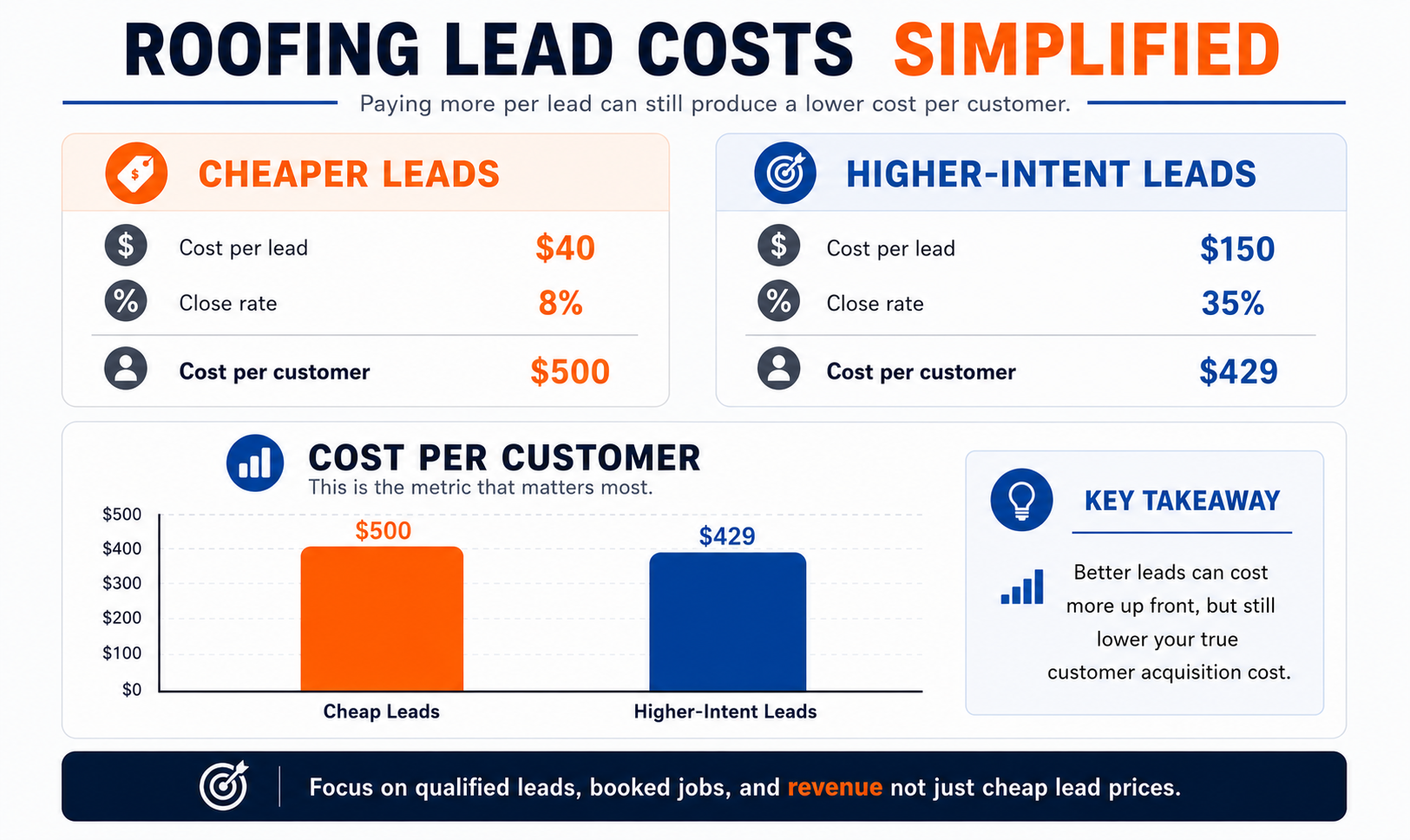
Imagine two roofing companies each receive 100 leads. Company A buys cheaper leads, while Company B pays more for leads with stronger buying intent.
Lower-Cost Leads
Higher-Intent Leads
What Happened?
At first glance, Company B appears to be paying much more because each lead costs $150 instead of $40.
However, those leads have stronger buying intent. Company B closes 35 customers, while Company A closes only 8.
despite paying significantly more for each individual lead.
The lesson: Do not judge a lead source only by its cost per lead. Judge it by how much it costs to acquire a paying customer.
📊 Click the diagram to view a larger version. After opening it, turn your phone sideways for the best viewing experience.
How to Reduce Your Roofing Lead Costs
Improve Your Website
A slow, outdated, or confusing website can waste paid traffic. Improve load speed, mobile responsiveness, calls to action, reviews, trust signals, project photos, and contact forms.
Optimize Google Ads Weekly
Review search terms, negative keywords, ad copy, landing pages, conversion tracking, audience signals, and bid strategy to reduce wasted spend.
Use Dedicated Landing Pages
Send visitors to focused pages for roof replacement, roof repair, storm damage, emergency roofing, and commercial roofing instead of a generic homepage.
Track Every Conversion
Track phone calls, form submissions, qualified leads, booked estimates, signed jobs, and revenue so your budget can be allocated to the campaigns that create profitable customers.
A professional tracking system also improves lead quality over time by providing Google Ads with more accurate conversion data. Google has invested billions of dollars in AI to better understand user intent, and when your campaigns track real business outcomes instead of just clicks or form submissions, Google's algorithms can optimize toward the people most likely to become profitable customers.
Are Cheap Roofing Leads Worth It?
Not always. Low-cost roofing leads may be:
- Shared with multiple contractors
- Poorly qualified
- Outside your service area
- Difficult to contact
- Focused primarily on the lowest price
Many contractors achieve better results by investing in higher-quality, exclusive opportunities that are more likely to convert into profitable roofing jobs.
Frequently Asked Questions
What is the average cost of a roofing lead?
Roofing leads commonly range from $20 to $250 or more, depending on the source, location, service, competition, lead quality, and whether the inquiry is shared or exclusive.
Are Google Ads roofing leads exclusive?
Generally, the inquiry goes directly to the roofing company whose ad and landing page generated it. The homeowner can still contact other companies independently, but the lead itself is not typically resold as a shared marketplace lead.
Are exclusive roofing leads worth the extra cost?
They can be when the provider delivers legitimate, in-market opportunities and your team follows up quickly. Less direct competition may improve contact and close rates.
What is more important than cost per lead?
Cost per qualified lead, cost per booked estimate, close rate, customer acquisition cost, customer lifetime value, revenue, and overall return on investment provide a more complete picture of marketing performance.
Final Thoughts
Roofing lead costs vary widely, but the lowest-priced lead is not always the most profitable.
Successful roofing companies focus on generating qualified, exclusive opportunities that convert into paying customers instead of chasing the lowest possible cost per lead.
Whether you invest in Google Ads, SEO, contractor websites, or dedicated landing pages, success comes from building a complete acquisition system that attracts the right homeowners and turns more of them into signed jobs.
Ready to Generate More Qualified Roofing Leads?
GiveMeSomeLeads helps roofing contractors build customer acquisition systems designed to generate profitable customers, not vanity metrics
- Google Ads management
- High-converting contractor websites
- Landing pages built to convert
Stop competing for low-quality shared leads. Build a measurable system that connects high-intent searches to qualified leads, booked estimates, and revenue.