
One of the most common questions contractors ask before investing in marketing is:
How much does a contractor lead cost?
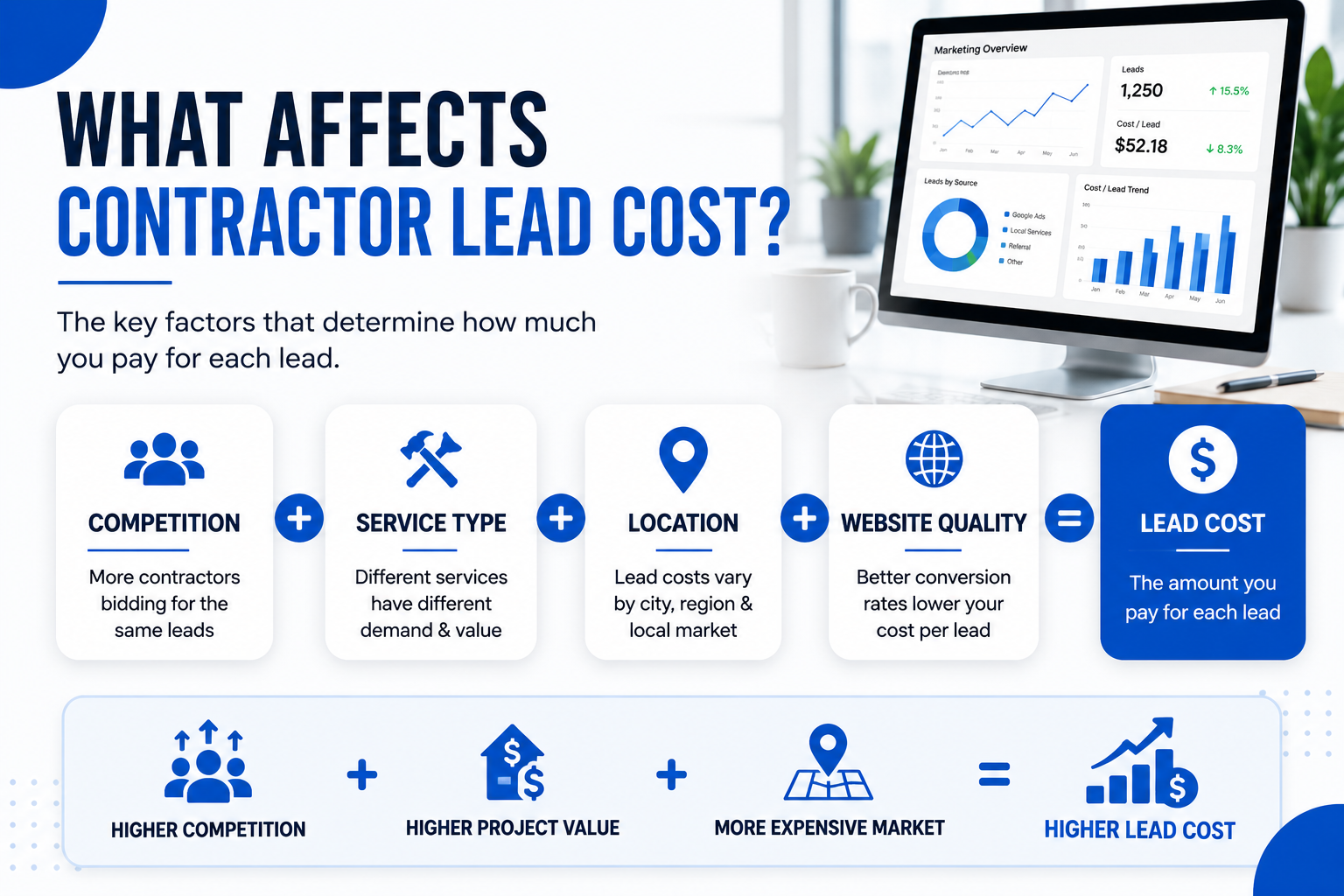
The answer depends on several factors, including your location, service type, competition, website quality, and marketing strategy.
While many contractors focus on finding the cheapest leads possible, the reality is that lead quality often matters far more than lead cost.
In this guide, we'll explain what influences contractor lead costs and how successful contractors improve lead quality while maximizing return on investment.
What Is a Contractor Lead?
A contractor lead is a potential customer who expresses interest in your services.
Examples include:
- Phone calls
- Contact form submissions
- Estimate requests
- Appointment bookings
However, not every lead becomes a paying customer.
Some leads are highly qualified and ready to move forward, while others may simply be gathering information or comparing multiple contractors.
This is why understanding lead quality is just as important as understanding lead cost.
This is also why having a strong marketing team and a reliable tracking system in place is so important. Proper tracking helps identify which leads are generating real opportunities and which leads are wasting time and budget.
By filtering out low-quality leads and focusing on the sources that consistently produce qualified homeowners, contractors can improve lead quality, reduce wasted spend, and get more value from every marketing dollar invested.
Why Lead Costs Vary
There is no universal cost for contractor leads.
Several factors influence how much you may pay to generate a lead.
Competition
One of the biggest factors affecting lead costs is competition.
If many contractors are advertising the same services in the same area, costs often increase.
For example, highly competitive industries such as roofing and remodeling often require larger marketing investments than less competitive niches.
However, higher costs at the beginning don't always mean higher costs forever. With the right strategy, ongoing optimization, and strong campaign management, costs can often improve over time.
As campaigns are optimized and your business becomes more relevant to the searches you're targeting, lead quality often improves while advertising costs become more efficient over time.
This is why long-term optimization is so important. The goal isn't simply to generate leads today, but to continuously improve performance and maximize return on investment month after month.
More competition usually means:
- Higher advertising costs
- More businesses competing for visibility
- Increased lead costs
Service Type
Different services produce different project values.
A contractor specializing in roof replacements may be willing to invest more per lead than a contractor offering smaller handyman services because the potential project value is significantly higher.
Examples include:
- Roofing
- Kitchen Remodeling
- Bathroom Remodeling
- Window Replacement
- Flooring
- Painting
Higher-value projects can often support higher lead acquisition costs.
For example, it may make sense to pay more for a lead when the potential project value is $20,000 compared to a smaller home service repair worth only a few hundred dollars.
In many cases, a single qualified lead can generate a significant return on investment. Beyond the initial project, satisfied customers may also provide referrals, repeat business, and positive reviews that help generate additional opportunities in the future.
This is why successful contractors often focus on the overall value of a lead rather than simply trying to generate the lowest-cost lead possible.
Location
Lead costs vary significantly from one market to another.
Large metropolitan areas often have:
- More competition
- Higher advertising costs
- More contractors bidding for the same searches
Smaller markets may have lower costs due to reduced competition.
This is why two contractors offering the same service can experience very different lead costs depending on where they operate.
Marketing Channels Influence Lead Costs
Different marketing channels produce different results.
Common contractor lead sources include:
- Google Ads
- SEO
- Google Business Profile
- Local Service Ads
- Referrals
- Social Media
Each channel has different advantages and costs.
Some channels produce results quickly, while others focus on long-term growth.
The most successful contractors typically use multiple lead sources rather than relying on a single channel.
The more lead sources you have working together, the more opportunities you create for your business. If one channel slows down, other channels can continue generating leads and helping maintain a steady flow of work.
However, for newer contractors or businesses looking to grow quickly, Google Ads is often one of the fastest ways to generate visibility and attract qualified homeowners. Unlike SEO, which can take time to build momentum, Google Ads can place your business in front of potential customers almost immediately.
As your business grows, adding additional lead sources such as SEO, Google Business Profile optimization, referrals, and partnerships can help create a more predictable and sustainable lead generation system.
📊 Click the diagram to view a larger version. After opening it, turn your phone sideways for the best viewing experience.
Cheap Leads vs Quality Leads
One of the biggest mistakes contractors make is focusing only on the cost of a lead.
A cheaper lead isn't always a better lead.
For example:
A $30 lead that never turns into a project may have little value.
Meanwhile, a $150 lead that becomes a $20,000 project may produce an excellent return on investment.
The goal is not simply to generate more leads.
The goal is to generate qualified leads that have a higher probability of becoming profitable projects.
This is why many successful marketing campaigns focus heavily on lead quality rather than lead volume alone.
This is only possible with a proper tracking system. By tracking calls, forms, and booked jobs, contractors can identify which marketing efforts generate the best leads and continuously optimize for better results.
Why Tracking Matters
Without proper tracking, it's difficult to know which marketing efforts are producing results.
Many contractors know how many leads they receive each month but don't know:
- Which campaigns generated those leads
- Which leads turned into estimates
- Which estimates became projects
- Which marketing channels generated revenue
This is why tracking is so important.
When calls, form submissions, booked appointments, and completed projects are tracked properly, marketing decisions become much easier.
A strong tracking system allows contractors and marketers to identify what works, eliminate wasted spend, and continuously improve performance over time.
Without tracking, marketing decisions often become guesswork rather than data-driven improvements.
How Better Websites Reduce Lead Costs
Many contractors assume lead costs are determined entirely by advertising.
In reality, your website plays a major role.
Contractor A receives 100 visitors and generates 5 leads.
Contractor B receives 100 visitors and generates 10 leads.
Both received the same traffic, but Contractor B generated twice as many opportunities.
This is why high-converting websites are so valuable.
A better website can improve:
- Conversion rates
- Lead quality
- User experience
- Marketing efficiency
Over time, stronger conversion rates can significantly reduce the effective cost of acquiring new leads.
This is why investing in a high-quality landing page can make a major difference. A well-designed landing page built by marketers who understand conversion optimization can help turn more visitors into leads without increasing your advertising budget.
Small improvements in messaging, layout, trust signals, and calls to action can often have a significant impact on conversion rates, helping contractors get more value from every click and every marketing dollar spent.
How SEO Influences Lead Costs
SEO often requires patience.
Unlike paid advertising, SEO takes time to build momentum.
However, once rankings improve, SEO can become one of the most cost-effective lead generation channels available.
A strong SEO strategy can help:
- Increase website visibility
- Generate organic traffic
- Attract homeowners actively searching for services
- Reduce dependence on paid advertising
This is why many contractors invest in SEO early. The benefits can continue compounding over time as Google rewards websites that consistently provide value to users.
Related Insight
If you haven't read it yet, check out our guide: Contractor SEO: How to Rank Higher and Generate More Leads . Discover how SEO helps contractors increase visibility, attract qualified homeowners, and generate long-term organic leads.
How Google Ads Influences Lead Costs
Google Ads can generate leads much faster than SEO.
When homeowners search for specific services, Google Ads allows your business to appear directly in front of those potential customers.
However, successful campaigns require more than simply running advertisements.
Lead costs are influenced by:
- Keyword targeting
- Landing page quality
- Tracking systems
- Ad relevance
- Ongoing optimization
In our experience, some of the biggest improvements in lead quality occur when campaigns are continuously optimized using real conversion data.
The better the tracking system, the easier it becomes to identify which keywords and campaigns generate the most profitable leads.
Related Insight
If you haven't read it yet, check out our guide: Google Ads for Contractors: How to Generate More Qualified Leads . Learn how Google Ads can help contractors appear in front of homeowners actively searching for their services and generate qualified leads faster.
How Marketing Agencies Improve Lead Costs
A good marketing agency doesn't simply generate more leads.
Its goal is to generate better leads.
Successful agencies focus on:
- Tracking
- Conversion optimization
- Landing pages
- Keyword selection
- Lead quality
- Ongoing campaign management
Many of the biggest improvements in marketing performance come from small optimizations made consistently over time.
By analyzing data and refining campaigns regularly, agencies can often help contractors reduce wasted spend while improving lead quality.
In a world where more data is available than ever and AI continues to transform marketing, it's becoming increasingly important to track, measure, and filter what is actually generating results. The businesses that make the best decisions are often the ones that have access to the best data.
We believe a strong marketing team should be capable of building a reliable tracking system that identifies which leads are producing real opportunities and which efforts need improvement. This allows campaigns to be optimized based on facts rather than assumptions, helping contractors generate better results over time.
What Actually Matters Most?
Many contractors ask:
"How much should I pay for a lead?"
A better question is:
"How much revenue does that lead generate?"
The true value of a lead depends on:
- Lead quality
- Conversion rate
- Project value
- Profitability
The cheapest lead isn't always the most profitable.
The most successful contractors focus on return on investment rather than lead cost alone.
Final Thoughts
Contractor lead costs vary significantly depending on competition, location, service type, website quality, and marketing strategy.
Instead of focusing solely on generating the cheapest leads possible, focus on attracting qualified homeowners who are actively searching for your services.
The contractors achieving the best results often combine:
- High-converting websites
- SEO
- Google Ads
- Call tracking
- Conversion optimization
Together, these systems help create a predictable flow of qualified leads while maximizing marketing performance over time.
Need More Contractor Leads?
Book a free consultation and we'll review your current marketing strategy, website performance, lead generation opportunities, and areas where you may be losing potential customers.
📊 Get My Free Local Market Analysis