
Facebook Marketplace looks attractive to painting contractors for one simple reason.
Local homeowners are already there.
They are browsing furniture, tools, appliances, home décor, renovation materials, and other items in their area. So it makes sense that a painter might think, why not list interior painting, exterior painting, or cabinet painting and try to generate free local leads?
The problem is that Facebook Marketplace is not really built for selling services.
Meta says Marketplace listings should generally represent physical products, and its rules say that selling services is not allowed. That matters because painting is clearly a service, not a physical product.
So if a painting contractor creates a listing like Interior Painting, 1 dollar or Professional House Painter, Free Estimates, that listing may violate Marketplace rules. It may stay live for a while, but it can also be rejected, removed, reported, or create problems for the account later.
That does not mean Facebook is useless for painting contractors.
It means the strategy needs to be smarter.
Instead of trying to force painting services into Marketplace listings, painting contractors should understand how to use Facebook properly through ads, lead forms, local groups, business pages, retargeting, Messenger, and customer recommendations.
The opportunity is not really Facebook Marketplace itself.
The opportunity is Facebook’s local audience.
Do not build your marketing strategy around a loophole. Build it around channels you can use consistently, safely, and professionally.
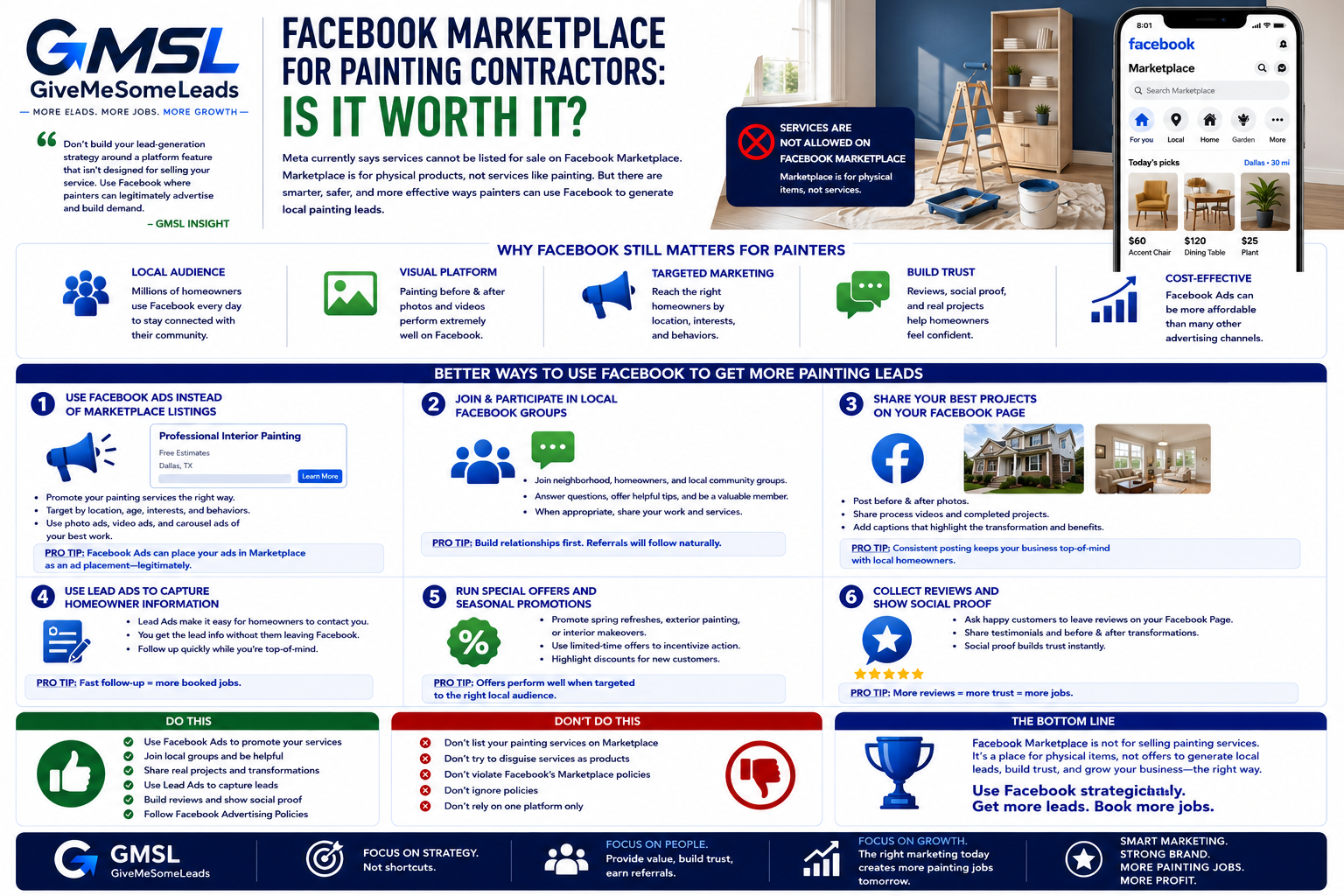
Facebook can be useful for painters, but Marketplace service listings are not the foundation. Use Facebook where your painting company can legitimately advertise, show proof, and create demand.
A painting contractor sees another painter posting House Painting, 1 dollar on Marketplace and getting attention.
So they copy the idea.
The listing gets a few messages, but then it disappears or gets flagged. Now the contractor has wasted time building a strategy around something that may not even be allowed.
Another painting contractor uses Facebook Ads with real before and after photos, a clear estimate offer, and proper local targeting.
That second contractor is building a channel they can actually test, track, and improve.
Can Painting Contractors Advertise Services on Facebook Marketplace?
For ordinary Facebook Marketplace listings, the answer is generally no.
Marketplace is designed around buying and selling items in the community. Meta’s rules say listings should represent physical products, and services are not allowed as normal Marketplace listings.
This is where many painting contractors get confused.
They may see cleaners, landscapers, painters, handymen, or other service businesses posting anyway. But seeing other businesses do something does not mean it is allowed or smart.
A listing may stay visible temporarily.
It may also be rejected, removed, reported, or stop showing to other users.
That is why painting contractors should be careful. A few free messages are not worth risking a marketing channel or building a strategy that can disappear at any time.
The better move is to use Facebook tools that are actually made for business promotion.
If the platform says services are not allowed in Marketplace listings, do not try to disguise your service as a product. Use Facebook Ads, local groups, your business page, and customer recommendations instead.
Seeing competitors do something on Facebook does not automatically mean it is a good marketing strategy.
A painter lists Paint Bucket, 1 dollar but uses the description to advertise whole home painting.
Maybe the listing gets a few clicks.
But the business is not really selling a paint bucket. It is trying to advertise a service through a product listing.
That creates a weak foundation.
A better strategy is to show a real exterior repaint, run a proper ad, target the actual service area, and send homeowners to a lead form or landing page.
Why Facebook Marketplace Still Looks Attractive to Painters
The appeal is understandable.
Painting is local.
Painting is local and highly visual. The opportunity is getting real projects in front of nearby homeowners through the right Facebook tools.
Marketplace is local.
Homeowners are already scrolling there.
Painting is also visual, which makes it easier to catch attention. A dark, outdated room transformed into a bright modern space can stop someone from scrolling. A faded exterior repainted with a clean new color scheme can create interest quickly.
So the marketing idea behind Marketplace is not bad.
The idea is to show local homeowners your work.
The problem is using the wrong Facebook feature to do it.
Instead of trying to advertise painting services through Marketplace listings, painters should use Facebook in ways that make more sense. That can include paid ads, lead ads, business page content, local groups where allowed, retargeting, Messenger follow up, and customer recommendations.
The goal is still the same.
Get your painting work in front of local homeowners.
Just do it through channels that are built for business marketing.
The real opportunity is not Marketplace. The real opportunity is using Facebook’s local attention to show real painting transformations.
Painters do not need to force Marketplace to work. They need to use the right Facebook tools for the right purpose.
A painter spends 10 hours posting and reposting Marketplace listings and gets 8 messages.
Out of those 8 messages, 3 are outside the service area, 2 are price shoppers, 2 never reply, and 1 turns into an estimate.
Another painter spends the same time building one strong Facebook ad campaign with real before and after photos, local targeting, and a simple estimate form.
That campaign produces 20 leads, 12 qualified opportunities, and 4 estimates.
The second approach is easier to measure and improve because it is built like a real marketing channel.
1. Use Facebook Ads Instead
Facebook Ads are a better alternative than trying to force painting services into Marketplace listings.
With Facebook Ads, painting contractors can promote interior painting, exterior painting, cabinet painting, whole home painting, commercial painting, and free estimate offers to homeowners in selected areas.
This is different from creating a fake Marketplace product listing.
Facebook Ads are designed for business promotion. You can choose your service area, show your creative, test different messages, collect leads, and track results.
For painting contractors, strong ad creative usually matters a lot.
Real project photos often work better than generic stock images. A homeowner wants to see what your company can actually do.
If you recently completed a dramatic exterior repaint, that can become an ad. If you transformed an outdated kitchen with cabinet painting, that can become an ad. If you refreshed a living room, that can become an ad.
Your completed projects are already marketing assets.
Start with your best visual projects. Use real before and after photos, a clear offer, and a simple call to action like Request a Painting Estimate.
Facebook Ads give painters a legitimate way to reach local homeowners without pretending a service is a product.
A painting company completes a strong exterior repaint.
Instead of posting Exterior Painting, 1 dollar on Marketplace, they create a Facebook ad showing the before photo, the finished result, and a clear message.
Thinking about repainting your home? Request a free estimate.
They target homeowners inside their real service area and send leads into a simple follow up process.
That is a real campaign, not a workaround.
2. Use Before and After Creative
Painting has a natural advantage on Facebook because the result is easy to see.
A strong transformation can explain the value of your work faster than a long paragraph.
Shows the category, but gives the homeowner little proof about your actual work.
Shows the problem, transformation, and finished result from work your company actually completed.
Compare two types of ads.
One ad uses a stock photo of a painter holding a roller.
The other ad shows a real local home that went from faded beige to a fresh modern color scheme.
The second ad usually tells a stronger story because it feels real.
Homeowners can imagine the same kind of improvement happening in their own home.
Use interior transformations, exterior repaints, cabinet painting projects, accent walls, commercial projects, detailed trim work, and finished rooms.
You do not need to overcomplicate the creative.
The project is the creative.
Take photos from the same angle before and after the work. The easier the transformation is to understand, the stronger the creative becomes.
Contractors often try too hard to invent advertising content. Your completed projects already contain most of what you need.
A homeowner scrolls Facebook and sees two painting ads.
The first ad has a generic photo that could belong to any company.
The second ad shows a real kitchen cabinet painting transformation with the old cabinets, the prep work, and the finished result.
The second ad feels more believable because it shows proof instead of only making a claim.
A painting contractor tests two Facebook ads.
Ad A uses a stock image and gets 40 leads at 45 dollars per lead.
Ad B uses a real before and after project and gets 35 leads at 52 dollars per lead.
At first, Ad A looks cheaper.
But if Ad B creates more qualified estimates because the project proof is stronger, it may be the better ad even with a higher cost per lead.
That is why painters should judge ads by customers and revenue, not only lead cost.
3. Use Facebook Lead Ads
Facebook Lead Ads allow homeowners to show interest without leaving Facebook.
Someone clicks the ad, opens a form, and submits their contact information directly inside the platform.
For a painting contractor, this can reduce friction.
But the form still needs to collect enough information to qualify the opportunity.
You might ask what type of painting they need, such as interior, exterior, cabinets, commercial, or other.
You can also ask where the property is located and when they are hoping to start.
Then collect the basics, name, phone number, and email.
The goal is not to build the longest possible form.
The goal is to collect enough information to understand whether the lead is worth following up with.
If the form is too easy, you may get more leads but lower quality.
If the form is too difficult, you may lose good opportunities.
The right balance depends on your business.
Ask only the questions needed to qualify the lead. Service type, location, timeline, name, phone, and email are often enough to start.
Facebook Lead Ads can create volume, but the quality depends on targeting, creative, form questions, and follow up.
A painting company runs a Facebook Lead Ad for cabinet painting.
The form asks:
- What would you like painted?
- What city is the property in?
- When are you hoping to start?
- What is your phone number?
This gives the office enough information to respond properly instead of treating every lead the same way.
4. Do Not Optimize Only for Cheap Facebook Leads
Facebook can sometimes produce cheaper leads than Google Search campaigns.
But cheaper does not automatically mean better.
A 30 dollar painting lead is not valuable if it never answers the phone, has no budget, is outside the service area, or wants work your company does not provide.
A 90 dollar lead may be more valuable if the homeowner is serious, local, ready to book an estimate, and interested in a profitable project.
That is why contractors should track cost per customer, not only cost per lead.
A lead is only the beginning.
The real question is how many leads become qualified opportunities, estimates, customers, and revenue.
Do not celebrate cheap leads until you know what they turn into. Track the full path from ad spend to booked painting project.
A cheap painting lead is not valuable because it was cheap. It is valuable if it has a realistic chance of becoming profitable work.
Facebook produces 50 leads at 30 dollars per lead.
Total spend is 1,500 dollars.
Only 5 become customers.
Cost per customer is 300 dollars.
Google Ads produces 20 leads at 90 dollars per lead.
Total spend is 1,800 dollars.
6 become customers.
Cost per customer is also 300 dollars.
At first, Facebook looked much cheaper.
But once you compare customers, the difference changes.
Now imagine the Google Ads customers also bring larger projects.
The higher cost per lead may actually create better business.
💡 Related Insight
If you haven't read it yet, check out our guide: Google Ads for Painting Contractors: The Complete Guide . Learn how painting contractors can use targeted Google Ads campaigns, stronger landing pages, high intent keywords, accurate conversion tracking, and better campaign structure to generate more qualified painting leads and reduce wasted ad spend.
5. Understand Facebook Intent
Facebook leads behave differently from Google leads.
When someone searches interior painter near me, they are actively looking for a painter.
That is existing demand.
When someone is scrolling Facebook and sees your ad, they may not have been planning to contact a painter right away. But your ad can remind them of a project they have been thinking about.
They may think, we have actually been talking about repainting the living room.
That can still become a customer, but the buying journey is different.
Google often captures demand that already exists.
Facebook can create interest, remind people of a project, or move someone from thinking about painting to requesting an estimate.
Because of that, Facebook leads may need more qualification, faster response, stronger follow up, and more nurturing.
Do not judge Facebook leads the exact same way you judge Google Search leads.
They entered the funnel differently.
Treat Facebook leads as interest based leads. Respond quickly, qualify properly, and guide them into the next step.
Facebook can create opportunities, but your follow up process decides how many of those opportunities become real estimates.
A homeowner sees a Facebook ad showing a beautiful living room repaint.
They were not searching for a painter that day, but they had been thinking about repainting for months.
They submit the form.
If the painting company responds quickly, asks the right questions, and books a consultation, that interest can become a real project.
If the company waits two days, the lead may go cold.
📊 Click the diagram to view a larger version. After opening it, turn your phone sideways for the best viewing experience.
6. Use Facebook Groups Carefully
Local Facebook groups can sometimes create opportunities for painting contractors.
Homeowners often use neighborhood groups, community groups, local recommendation groups, and homeowner groups to ask for help. Someone may post that they are looking for a good painter, need an exterior repaint, want cabinets painted, or need someone to refresh a rental property.
Feels like spam and can conflict with group rules.
Answer naturally, show a relevant project, and make it easy to contact you.
That can be a real opportunity, but only if you use groups the right way.
Do not join every local group and spam the same promotional post every morning. That gets annoying fast and may also break group rules. Many groups do not allow direct advertising, and even when they do, people usually respond better to helpful and natural participation.
The better approach is to be useful.
When someone asks for a painter and self promotion is allowed, respond professionally. Share a relevant project, answer the question clearly, and make it easy for the homeowner to contact you.
Facebook groups work best when people see you as helpful, not desperate for work.
Before posting in any Facebook group, read the group rules. Some groups allow business recommendations only when someone asks. Others have specific days for promotions.
Local groups can help painting contractors, but they are not a place to spam. They work best when your company participates like a helpful local business.
A homeowner posts:
Does anyone know a good painter for exterior work?
Painter A replies with a long sales pitch, all caps, and a phone number.
Painter B replies with a simple message saying they handle exterior painting in the area, shares one relevant project photo, and offers to answer questions.
Painter B feels more professional because the response fits the conversation.
A painting company posts 30 random promotions in local groups and gets 6 messages.
Most of the messages are price shoppers or people outside the service area.
Another painting company only responds when homeowners ask for painter recommendations. They get fewer messages, maybe 4 in a month, but 3 are serious opportunities.
The second approach creates fewer conversations, but often better quality conversations.
7. Let Customers Recommend You in Local Groups
A customer recommendation is often stronger than promoting yourself.
If a homeowner asks for a painter and your business replies, that is advertising.
The homeowner knows the contractor is promoting their own business.
The recommendation carries more weight because it comes from real experience.
If a past customer replies and says your company did a great job, that is social proof.
People trust recommendations more when they come from someone with a real experience. That is why your customer experience, review strategy, and referral process all matter.
You cannot force authentic recommendations in local groups. You earn them by doing great work, staying memorable, and making your company easy to share.
When past customers remember your name and had a good experience, they are more likely to mention you when someone asks.
After a successful project, send a thank you message with your company name, website, phone number, and Google profile. This makes it easier for happy customers to recommend you later.
The strongest Facebook group promotion often does not come from the contractor. It comes from a satisfied customer.
A homeowner asks in a local group:
Can anyone recommend a good exterior painter?
The contractor comments:
We can help. Call us.
That may work, but it feels like advertising.
Now imagine a past customer comments:
They painted our house last summer. The crew was clean, professional, and the result looked great.
That carries more weight because it comes from someone who already hired the company.
8. Build a Strong Facebook Business Page
Even if Facebook Marketplace is not the right place to list painting services, your Facebook Business Page can still support trust.
A homeowner may discover your company through Google, a referral, a Facebook ad, or a local group. Then they may check your Facebook Page before contacting you.
The page should make your business look active and legitimate.
Make sure it includes accurate company information, phone number, website, service area, real project photos, customer testimonials where available, team photos, and before and after work.
You do not need to post every day.
But the page should not look abandoned.
If your last post is from years ago, it can create doubt. A homeowner may wonder if the company is still active or if the information is still accurate.
A strong Facebook Page supports the rest of your marketing. It can help confirm trust when people are already considering your company.
Post enough real project content to make the page feel alive. Even one or two useful updates per month can be better than leaving the page untouched for years.
Your Facebook Page does not need to be your main marketing channel, but it should support trust when homeowners check your company.
A homeowner gets your company name from a friend and searches for you on Facebook.
Company A has no recent posts, an old phone number, and no real project photos.
Company B has recent exterior painting photos, a clear website link, customer comments, and accurate contact information.
Company B feels easier to trust because the page confirms that the business is active.
9. Use Facebook as a Portfolio
Painting contractors rarely have a shortage of visual content.
Every project can create useful marketing assets.
A single painting job can produce before photos, preparation photos, progress photos, finished room photos, before and after comparisons, customer testimonials, and short videos.
That means you do not always need to invent new content ideas.
Your completed work is the content.
This is especially powerful for painters because the transformation is easy to understand visually. A homeowner can quickly see the difference between the old space and the finished result.
Build a simple process around each project.
Take photos before the work begins. Capture a few progress shots during preparation or painting. Take clean final photos after cleanup. If the customer is happy, ask for a review and save the project details.
Now Facebook content becomes part of your operation instead of something you rush to create later.
Create a folder for each completed project with the service type, city, before photos, progress photos, finished photos, and customer feedback.
Real project content is stronger than generic marketing because it proves your company actually does the work.
A painting company completes a cabinet painting project.
They take photos before the prep work, during the process, and after the final result.
That one project can become a Facebook post, a before and after carousel, a Google Business Profile update, a website project page, and proof for future cabinet painting ads.
The company did the work once, but the marketing value can last much longer.
A painter completes 60 projects in a year.
If they document only 10 of them, they have 10 pieces of strong project proof.
If they document 40 of them, they have enough content to support Facebook, Google Business Profile, service pages, ads, emails, and sales conversations for months.
The work was already completed.
The difference is whether the company captured it.
10. Retarget Website Visitors
Not every homeowner who visits your website will contact you right away.
Some are still comparing painters. Some are choosing colors. Some are waiting for the right season. Some are discussing the project with a spouse. Some are checking their budget.
That does not mean they are not interested.
Retargeting allows painting companies to stay visible to people who already interacted with their business online, when eligible and properly set up.
For example, someone may visit your exterior painting page but leave without requesting an estimate. Later, they see a Facebook ad showing a beautiful exterior before and after project with a message inviting them to request an estimate.
That ad continues the conversation.
Instead of hoping the homeowner remembers your company, retargeting gives you another chance to stay in front of them.
This works best when the retargeting ad is relevant. Do not show random content. Show proof, reviews, project photos, and a clear next step.
Retargeting works better when your website pages are specific. Someone who visited an exterior painting page should see exterior painting proof, not a generic ad about every service.
Retargeting helps painters stay visible after the first visit, but the ad still needs strong proof and a clear reason to take action.
A homeowner visits your cabinet painting page, looks at a few project photos, then leaves.
Two days later, they see a Facebook ad showing a cabinet painting transformation and a simple message:
Thinking about updating your kitchen cabinets? Request a painting estimate.
That ad matches what they already showed interest in, so it feels more relevant than a general promotion.
A painting website gets 1,000 visitors in a month.
Only 30 request an estimate on the first visit.
That does not mean the other 970 visitors were worthless. Some may still be interested but not ready yet.
A simple retargeting campaign can help bring some of those visitors back when they are closer to making a decision.
11. Use Messenger as Part of Lead Follow Up
Facebook naturally creates conversational leads.
Some homeowners do not want to call right away. They may prefer to send a quick message first, ask a question, or explain what they need before speaking on the phone.
That is not a bad thing.
Messenger can be a useful starting point, but it should not become the whole sales process.
Your goal is to move the conversation forward. Ask simple questions like what they need painted, where the property is located, and when they are hoping to start. Once the lead seems like a real opportunity, move them into your normal process.
For example, you can say:
Great, what is the best phone number to reach you so we can discuss the project and see if we are a good fit?
Do not spend 45 minutes trying to estimate an entire house through Messenger. Use Messenger to qualify interest, then move the homeowner toward a call, estimate, or appointment.
Keep Messenger conversations simple. Use them to confirm service type, location, timeline, and contact information.
Messenger can start the conversation, but your sales process still needs to turn that conversation into a real estimate opportunity.
A homeowner sends a message asking how much it costs to repaint a living room.
Instead of trying to give a full price with limited information, the painting company asks a few quick questions about the room size, location, timeline, and whether walls, trim, or ceilings are included.
Then they ask for the best phone number to discuss the project properly.
That keeps the conversation moving without guessing.
12. Respond Quickly
Facebook leads can go cold quickly.
Someone fills out your form or sends a message while they are still scrolling Facebook. A few minutes later, they may see another painting ad, message another contractor, or get distracted by something else.
That is why response speed matters.
If your advertising creates the opportunity, your follow up has to convert it.
A simple process can look like this.
When the lead arrives, call first. If there is no answer, send a text. If they still do not respond, follow up again later in a professional way.
The same applies to Messenger.
Do not leave someone waiting for two days after they asked about painting. By then, the interest may already be gone.
Fast response does not guarantee the sale, but slow response can easily lose it.
Set up notifications so new Facebook leads are seen quickly. The faster your team responds, the better chance you have of turning interest into a real conversation.
Facebook creates attention in the moment. Fast follow up helps turn that attention into action.
A painting company gets 30 Facebook leads in a month.
They respond to half of them within 10 minutes and the other half the next day.
The faster response group creates 6 estimates.
The slower response group creates only 2 estimates.
The lead source was the same.
The follow up speed changed the result.
13. Qualify Facebook Leads
If your Facebook campaign gets lots of inquiries but very few estimates, do not immediately assume Facebook does not work.
Look deeper first.
Some campaigns generate poor quality leads because the targeting is too broad, the offer is too vague, the form is too easy, or the follow up process is weak.
Ask whether the leads are inside your service area. Check if they actually need the services you provide. Look at whether the projects are large enough, whether people understand what they requested, and whether your team is responding quickly enough.
Sometimes Facebook does not need to be abandoned.
It needs better qualification.
For painters, this can mean asking about service type, property location, timeline, and project size before treating every inquiry as equal.
Add a few simple qualifying questions to your lead form. You do not need a long form, but you do need enough information to separate serious opportunities from weak inquiries.
More Facebook leads does not always mean more business. The goal is to generate leads that have a real chance of becoming profitable painting projects.
A painting contractor runs a broad ad that says:
Need painting? Get a free estimate.
The campaign gets many leads, but several are outside the service area or asking for tiny jobs the company does not want.
Then the contractor updates the form to ask what needs painting, where the property is located, and when the homeowner wants the work done.
Lead volume drops slightly, but the quality improves.
14. Track Customers, Not Messages
Facebook can generate likes, comments, messages, and form submissions.
Those numbers are useful, but they are not the final goal.
The goal is customers.
A post with many likes does not automatically create revenue. A campaign with many form submissions is not automatically profitable. A Messenger conversation is not a win unless it becomes a qualified opportunity, estimate, customer, or revenue.
Track the full path.
Facebook spend.
Leads.
Qualified leads.
Estimates.
Painting customers.
Revenue.
That is how you know whether Facebook is actually helping the business grow.
This is especially important because Facebook can sometimes look busy. You may see activity, comments, reactions, and messages, but the business still needs to know what turned into real jobs.
Connect Facebook leads to your CRM or tracking sheet. Do not stop measuring at the form submission.
Activity is not the same as customer acquisition. Track what turns into booked painting work.
Campaign A gets 100 leads.
Campaign B gets 40 leads.
At first, Campaign A looks better.
But Campaign A creates 4 customers, while Campaign B creates 10 customers.
Now the conclusion changes.
Campaign B produced fewer leads, but more business.
That is why painting contractors should track customers, not just messages or forms.
15. Compare Facebook Against Your Other Lead Sources
Facebook should not be judged in isolation.
Compare it with your other lead sources, including Google Ads, Google Maps, Local SEO, referrals, repeat customers, and professional partners.
Each channel behaves differently.
Google Ads may bring homeowners who are actively searching right now. Local SEO may create long term visibility. Referrals may close at a higher rate because trust already exists. Facebook may create interest from homeowners who were thinking about painting but had not searched yet.
The question is not which channel creates the most leads.
The better question is which channel creates profitable customers at a cost your business can sustain.
Track lead volume, qualified leads, estimates, customers, revenue, customer acquisition cost, and project value.
That gives you a much clearer picture.
Compare channels by customers and revenue, not only lead count. A smaller channel can be more valuable if the leads close better or produce larger projects.
Lead volume does not tell you which channel is best. Customer quality, close rate, project value, and profit tell the real story.
A painting company tracks four lead sources.
Facebook creates 50 leads and 6 customers.
Google Ads creates 25 leads and 8 customers.
Google Maps creates 20 leads and 7 customers.
Referrals create 12 leads and 8 customers.
Facebook created the most leads, but referrals and Google Ads produced stronger customer results.
That does not mean Facebook is bad.
It means the company needs to understand what each channel is best at and invest based on real business outcomes.
💡 Related Insight
If you haven't read it yet, check out our guide: Painting Contractor SEO: 15 Ways to Rank Higher on Google . Learn how painting contractors can improve search visibility, strengthen service pages, optimize local SEO, target valuable keywords, build stronger website authority, and generate more qualified leads from Google.
What Painting Contractors Should Not Do on Marketplace
This is important because some contractors try to get around Marketplace rules instead of building a real marketing strategy.
Avoid listing a fake product just to advertise your service.
For example, do not create a listing for Paint Bucket, 1 dollar if the real purpose of the listing is to promote whole home painting.
Also avoid listing the service itself as an item, such as House Painting, 1 dollar or Interior Painting, Free Estimate.
Even if you see other companies doing it, that does not make it a smart long term strategy. The listing may stay visible for a while, but it can also be rejected, removed, reported, or create problems with your account.
Repeatedly reposting removed listings is also not a real system. If the platform removes the listing because it does not follow the rules, creating the same listing again is not building a dependable lead generation channel.
A painting contractor should not risk their Facebook presence for a few free messages from people who may not even become customers.
Do not try to disguise a painting service as a product. Use Facebook Ads, local groups, customer recommendations, retargeting, and your business page instead.
Do not risk your Facebook presence trying to generate a handful of free leads through a loophole that is not really a loophole. Build legitimate customer acquisition channels instead.
A painter creates a Marketplace listing for Paint Supplies, 1 dollar, but the description is really advertising interior painting services.
The listing gets a few messages, then disappears.
Another painter uses real project photos, runs a proper Facebook ad, targets the right service area, and sends homeowners to a simple estimate form.
The second painter is building something that can be tested, tracked, and improved.
Facebook Marketplace vs Facebook Ads for Painters
For painting contractors, the difference between Marketplace listings and Facebook Ads is important.
Marketplace is designed mostly for buying and selling items.
Built mainly around items, difficult to scale predictably, and service listings can create policy problems.
Gives you more control over targeting, creative, budget, lead forms, retargeting, and measurement.
Facebook Ads are designed for business promotion.
Marketplace listings give you limited control, can be rejected, and are difficult to scale predictably. Facebook Ads give you more control over targeting, creative, budget, lead forms, retargeting, and campaign performance.
That does not mean Facebook Ads are automatically profitable.
It means they are the proper tool to test if you want to reach local homeowners on Facebook.
If your goal is to promote interior painting, exterior painting, cabinet painting, whole home painting, or commercial painting, it makes more sense to use the advertising tools built for that purpose.
Do not build your strategy around direct Marketplace service listings.
Use Facebook where it actually fits the job.
If you want predictable testing, use the tool that gives you control. Facebook Ads give you more control than organic Marketplace listings.
Marketplace may look free, but weak control, policy risk, and poor tracking can make it expensive in wasted time.
Facebook Marketplace is mainly built for items, has limited control, and can reject service listings.
Facebook Ads are built for promotion, allow better targeting, and can be tested with real tracking.
For painters, the better long term option is usually not trying to force Marketplace to work. It is using Facebook Ads and organic Facebook content the right way.
Is Facebook Worth It for Painting Contractors?
Facebook can be worth testing for painting contractors.
But Facebook Marketplace service listings are not the strategy we would recommend.
The better opportunities are paid ads, Facebook Lead Ads, before and after content, retargeting, Messenger follow up, local community groups where appropriate, customer recommendations, and an active Facebook Business Page.
Painting is visual, which gives contractors strong material for Facebook.
A clean exterior repaint, a cabinet painting transformation, a bright interior refresh, or a detailed trim project can all work well as visual proof.
But Facebook should still be judged by numbers.
Do not only ask whether the campaign generated leads.
Ask whether those leads became qualified opportunities, estimates, booked painting projects, and revenue.
Facebook does not need to produce the cheapest lead.
It needs to produce customers at a cost your business can sustain.
Test Facebook with a clear offer, real project proof, a focused service area, and fast follow up. Do not judge the platform based only on forms submitted.
Facebook can work for painters, but the campaign only matters if it creates real business results.
A painting contractor spends 2,000 dollars on Facebook Ads.
The campaign produces 50 leads at 40 dollars per lead.
That sounds good at first.
But the real evaluation starts after that.
Out of 50 leads, 30 are qualified, 18 become estimates, and 6 become customers.
That creates a customer acquisition cost of about 333 dollars.
If those 6 projects generate 42,000 dollars in revenue and the profit margins make sense, the campaign may be worth improving.
But if most leads never answer, are outside the service area, or want jobs that are too small, the campaign needs to be adjusted.
Never evaluate Facebook based only on lead volume.
A Better Facebook Strategy for Painters
Instead of trying to use Marketplace listings for painting services, build a better Facebook strategy around real proof and real follow up.
Start by documenting great projects.
Take before photos, preparation photos, progress photos, and finished photos. The better the transformation, the stronger the creative.
Then use those photos in Facebook Ads, Business Page posts, retargeting ads, and local content where appropriate.
Target your real service area. Do not advertise everywhere just because Facebook allows it. Focus on cities and neighborhoods where you can profitably serve customers.
Use a clear offer, such as Request a Painting Estimate or Get a Free Exterior Painting Quote.
Then qualify the lead by asking about the service needed, location, timeline, and contact information.
After that, follow up quickly. Call, text, and keep the conversation moving.
Finally, track through revenue. Do not stop at likes, comments, messages, or forms. Track which Facebook leads became estimates, customers, and profitable projects.
That is how Facebook becomes a real acquisition channel instead of a collection of Marketplace hacks.
Make the work the focus. Real painting transformations usually create stronger creative than generic stock images or vague promotions.
A better Facebook strategy starts with proof, uses proper advertising tools, follows up quickly, and tracks actual customers.
A painting company finishes a strong exterior repaint.
They save the before and after photos, write a simple caption, create a Facebook ad, target nearby homeowners, and use a lead form asking for service type, city, timeline, name, phone, and email.
When leads come in, the office calls quickly and follows up by text.
The company tracks which leads became estimates and which estimates became customers.
That is a real system.
Common Facebook Marketing Mistakes for Painters
Many painting contractors make the same mistakes with Facebook.
Some try to list painting services as Marketplace products. Others disguise services as 1 dollar items. Some use only stock photos instead of showing real work.
Another common mistake is optimizing only for cheap leads. A cheap lead is not automatically a good lead. If it does not become a qualified estimate or customer, it may not help the business.
Some painters target too large of an area, which creates leads they cannot serve profitably. Others ask no qualification questions, so every form looks the same even when the quality is completely different.
Slow response is another major mistake. Facebook leads can go cold quickly. Calling once and giving up also wastes opportunities.
Other common mistakes include posting only promotions, ignoring retargeting, measuring likes instead of customers, and having no CRM tracking.
Facebook does not need to generate your cheapest lead.
It needs to generate customers at economics your business can sustain.
Track the full path from Facebook spend to lead, qualified lead, estimate, customer, revenue, and profit.
Facebook marketing works best when it is treated like a business system, not just a place to post and hope.
Campaign A gets 100 leads and looks successful.
Campaign B gets 40 leads and looks smaller.
But if Campaign A creates 4 customers while Campaign B creates 10 customers, Campaign B is clearly stronger.
Lead volume does not tell the full story.
Customers and revenue do.
Frequently Asked Questions
1. Can painting contractors list painting services on Facebook Marketplace?
For standard Marketplace listings, painting contractors should not rely on Marketplace to list painting services directly. Meta describes Marketplace around items for sale and its guidance says services are not allowed as normal listings. View Meta Marketplace guidance.
2. Why do I still see painters advertising on Marketplace?
A listing being visible does not automatically mean it follows Marketplace rules. Listings can be rejected, removed, reported, or stop showing if they do not comply. View Meta listing guidance.
3. Can painting contractors advertise on Facebook?
Yes. Facebook advertising tools are designed for business promotion and give painters more control over targeting, creative, budget, lead forms, and measurement than an organic Marketplace listing. View Meta advertising guidance.
4. Are Facebook Ads good for painters?
They can be worth testing because painting is visual and real project transformations can create strong creative. The result still depends on targeting, lead qualification, response speed, follow up, project value, and customer acquisition cost.
5. Are Facebook leads better than Google Ads leads?
Not automatically. Google Search often captures homeowners who are already looking for a painter. Facebook can create or accelerate interest earlier in the buying journey. Compare qualified leads, estimates, customers, revenue, and customer acquisition cost instead of judging only by lead price.
6. Should painters use local Facebook groups?
They can be useful when the group rules allow business participation. The strongest approach is usually helpful participation and relevant responses when homeowners ask for recommendations, not repeated promotional posting.
7. What kind of Facebook content works well for painters?
Real project photos are usually the strongest starting point. Before and after transformations, preparation photos, finished rooms, exterior repaints, cabinet projects, customer feedback, and short project videos can all support trust.
8. How should painting companies measure Facebook marketing?
Track the complete path from spend to leads, qualified leads, estimates, customers, revenue, and profit. That shows whether Facebook is creating real business instead of only messages and form submissions.
Final Thoughts
Facebook Marketplace can look attractive because local homeowners are already there, but painting contractors should not build their marketing strategy around direct service listings.
The stronger opportunity is using Facebook as a legitimate marketing channel for visual proof, local advertising, lead forms, retargeting, Messenger conversations, community participation, and customer recommendations.
Use real painting projects as the creative. Focus on the locations you can serve profitably. Qualify the lead. Respond quickly. Then track which opportunities become estimates, customers, revenue, and profit.
From our experience, Facebook is very good for discovery. It is usually a little less targeted than channels like Google Ads, where leads often have higher intent, but it can still be very effective in your local area when you use the right targeting, creative, and follow up.
Facebook is useful when it helps put real painting proof in front of local homeowners and connects that attention to a measurable sales process.
Do not judge Facebook by likes or cheap leads. Judge it by the customers and profitable projects it creates.
Ready to Build a Better Lead Generation System for Your Painting Business?
GiveMeSomeLeads helps painting contractors combine Google Ads, Local SEO, Google Business Profile, project content, landing pages, and conversion tracking into one measurable customer acquisition system.