You can have excellent Google Ads targeting and still waste thousands of dollars if the page people land on does not convert.
Think about the journey.
A homeowner searches for kitchen remodeling contractor near me, clicks your ad, and arrives on your website.
If they are sent to a generic homepage filled with multiple services, navigation links, and no clear next step, you have created friction at the most important moment.
A better journey is:
Kitchen Remodeling Search → Relevant Ad → Kitchen Remodeling Landing Page → Estimate Request
Marketing Perspective: Marketing and the technical side of high-converting landing pages can feel overwhelming, especially if you're focused on running your business. That's one of the reasons we created these guides. Our goal is to explain everything in a practical, easy-to-understand way so you can start making improvements yourself or, at the very least, understand the fundamentals. If you decide to work with a marketing agency in the future, you'll be able to ask better questions, make more informed decisions, and better understand the strategy behind your marketing.
What Is a Google Ads Landing Page?
A Google Ads landing page is a dedicated webpage built specifically for visitors arriving from a Google Ads campaign.
Unlike your homepage, which often introduces your entire company, a landing page focuses on one objective:
If a homeowner searches kitchen remodeling contractor in Dallas, your advertisement and landing page should continue that exact conversation.
The page should immediately reassure the visitor that they are in the right place with a relevant headline, completed kitchen projects, customer reviews, local information, and a simple way to request an estimate.
The fewer distractions between the click and the estimate request, the easier it becomes for qualified homeowners to become customers.
Why It Matters
Every Google Ads click represents an investment.
A landing page is where that investment either turns into a qualified lead or becomes a missed opportunity.
Even a small improvement in conversion rate can significantly increase the return on your advertising budget because you are generating more leads from the same number of clicks.
Google also recommends closely matching your landing page to your advertisements and keywords to create a better user experience, which can contribute to stronger campaign performance over time.
Many contractors focus heavily on generating more clicks while overlooking what happens after someone arrives on the website.
We have found that improving the landing page often produces a bigger impact than simply increasing the advertising budget.
The objective is not just to generate more traffic. It is to convert more of the traffic you are already paying for.
Why Your Homepage May Not Be the Best Landing Page
Your homepage serves an important purpose.
It introduces your company, explains your services, showcases recent projects, links to educational content, and helps visitors explore your website.
That is exactly what a homepage is supposed to do.
A landing page has a completely different job.
Someone searching kitchen remodeling contractor Dallas should not have to navigate through bathroom remodeling, flooring, additions, careers, financing, blog articles, and multiple service pages before finding what they are looking for.
The landing page should immediately continue the conversation started by the search.
Generic Homepage
The advertisement sends homeowners to a generic homepage with multiple services, several navigation options, and no immediate kitchen remodeling focus.
Dedicated Landing Page
The advertisement leads to a dedicated kitchen remodeling landing page featuring:
- A relevant headline
- Completed kitchen remodeling projects
- Local service area information
- Customer reviews
- Before and after transformations
- A simple estimate request form
Both contractors may deliver outstanding craftsmanship.
One simply makes it much easier for homeowners to take the next step.
Why It Matters
When visitors have to search for information, compare multiple services, or figure out what to do next, many leave before contacting your business.
A focused landing page removes unnecessary decisions and keeps homeowners moving toward one clear objective.
Imagine searching for kitchen remodeling contractor near me.
The first website welcomes you with a generic company overview and asks you to browse through several different services.
The second immediately shows beautiful kitchen transformations, explains the remodeling process, highlights local reviews, and invites you to request a free estimate.
Which company feels more prepared to handle your project?
Ask yourself one simple question:
If the answer is no, continue simplifying the page.
One thing we have consistently seen is that homeowners do not click Google Ads because they want to browse websites.
They click because they are looking for a solution.
The best landing pages remove distractions, answer the most important questions quickly, and make the next step feel obvious.
Every section should help move the homeowner one step closer to requesting an estimate, not one step deeper into your navigation menu.
Match the Headline to the Search
Your headline is often the first thing homeowners see after clicking your advertisement.
Within a few seconds, they should immediately know they are in the right place.
A generic headline such as:
does very little for someone searching specifically for a kitchen remodeling contractor.
Instead, continue the exact conversation that started on Google.
The closer your headline matches the homeowner's search, the more confident they will feel about staying on the page.
Why It Matters
Google Ads is built around relevance.
Your keyword, advertisement, and landing page should all support the same message.
When homeowners immediately recognize they are exactly where they expected to be, they are far more likely to continue reading instead of returning to Google to click another contractor.
A homeowner searches:
One company welcomes them with:
The other immediately says:
The second page instantly answers the homeowner's biggest question:
Do not try to sound clever.
Try to sound relevant.
Simple headlines that clearly explain what you do and where you do it almost always outperform vague marketing slogans.
Many businesses spend hours improving their Google Ads while giving very little attention to the first thing visitors actually read.
If your headline does not immediately reassure homeowners they have found exactly what they are looking for, you have already made your advertising work harder than it needs to.
The headline is not just another piece of text. It is the bridge between the Google search and the estimate request.
Put Your Main Call to Action Above the Fold
Once homeowners know they are in the right place, they should not have to search for what to do next.
Your primary call to action should appear immediately near the top of the page.
Support that call to action with:
The easier you make the next step, the more likely homeowners are to take it.
Why It Matters
Every additional click, scroll, or decision creates friction.
Landing pages work best when they remove unnecessary obstacles and naturally guide visitors toward becoming qualified leads.
Two contractors receive the same amount of Google Ads traffic.
One hides the estimate form near the bottom of the page after several long sections.
The other displays a prominent estimate button and simple contact form immediately after the hero section.
Even with identical advertising budgets, the second contractor often generates more opportunities because homeowners do not have to search for how to get started.
Choose one primary objective for each landing page.
If visitors are presented with five different buttons, multiple offers, blog articles, social media links, and several contact options, many will not know which action to take.
One of the simplest ways to improve conversion rates is reducing unnecessary decisions.
The highest converting landing pages are not always the most creative. They are usually the easiest to understand.
When homeowners immediately know what to do next, more of them become qualified leads.
Show Real Kitchen Projects Immediately
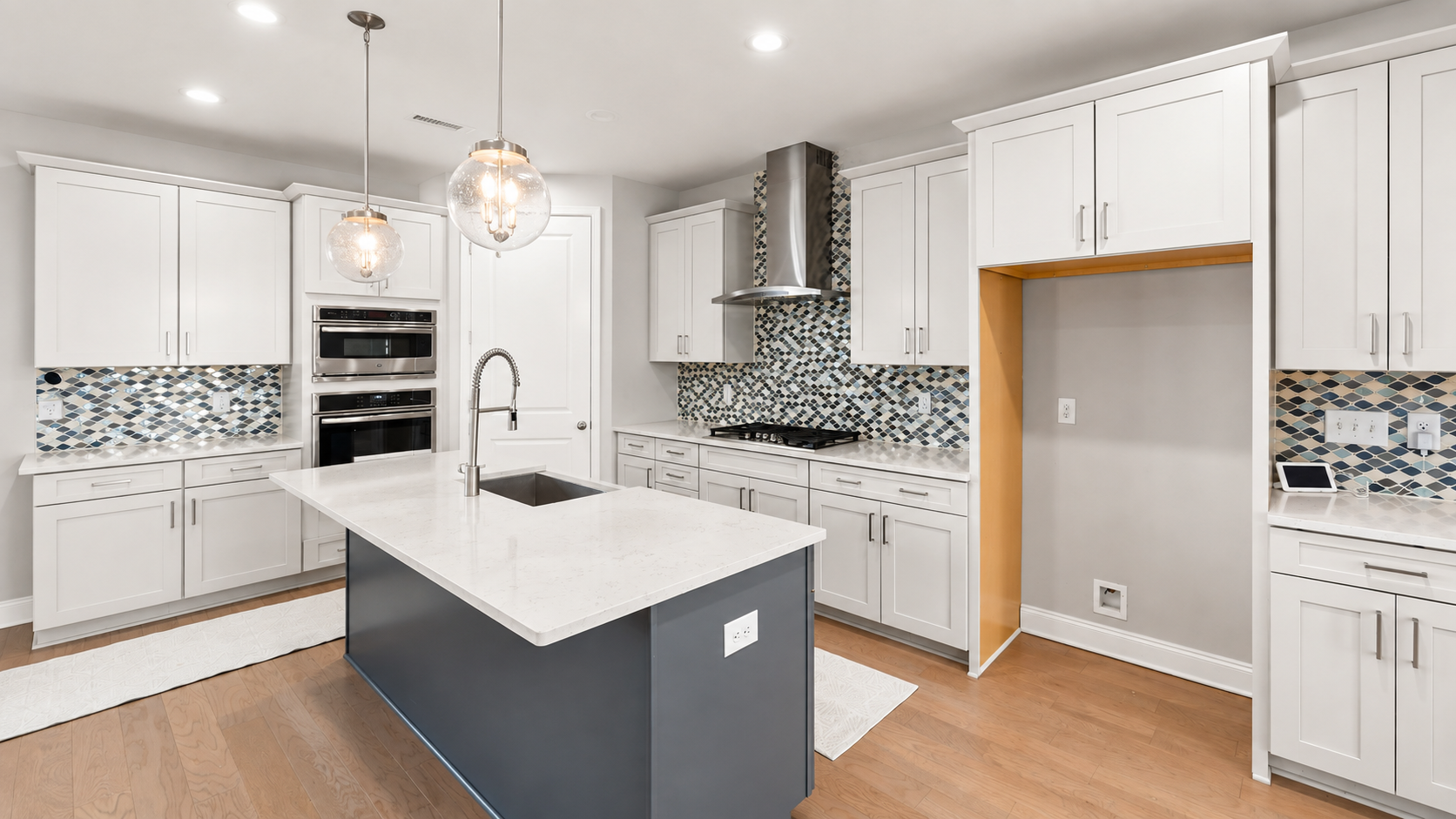
Kitchen remodeling is one of the most visual home improvement services.
Take advantage of that.
Instead of leading with a generic stock image that homeowners have seen hundreds of times, showcase your own completed projects.
Even better, highlight real transformations.
- Outdated cabinets
- Limited storage
- Worn countertops
- Poor lighting
- Closed off layout
- Custom cabinetry
- Large kitchen island
- Premium countertops
- Modern lighting
- Open functional design
Within seconds, homeowners should be able to picture the quality of work your company can deliver.
Why It Matters
Photos build trust much faster than paragraphs of text.
Homeowners want proof that you have completed projects similar to theirs, not just promises that you can.
A strong project gallery immediately demonstrates experience, craftsmanship, and attention to detail before they even read about your company.
Imagine visiting two kitchen remodeling websites.
The first opens with a beautiful stock image downloaded from the internet.
The second opens with an actual kitchen your team transformed, complete with before and after photos and a short description of the project.
Most homeowners will naturally place more confidence in the contractor showing real work.
Your best project should almost always appear near the top of the page.
Do not make homeowners scroll halfway down your website before seeing what your company is capable of delivering.
One completed kitchen should rarely produce just one marketing asset.
It can strengthen your landing page, Google Business Profile, website portfolio, social media, Local SEO, Google Ads, and future advertising campaigns.
Contractors who consistently document their work often build stronger marketing over time without needing to create entirely new content for every platform.
Build Trust Quickly
Kitchen remodeling is one of the largest investments many homeowners will make in their home.
Before requesting an estimate, they are asking themselves one important question:
Your landing page should answer that question as quickly as possible.
Do not simply tell homeowners you are a great contractor.
Show them why.
Why It Matters
Every visitor arrives with some uncertainty.
They do not know your company, your team, or the quality of your work.
The faster you replace uncertainty with proof, the more comfortable homeowners become requesting an estimate.
Two contractors charge similar prices.
One says they deliver exceptional craftsmanship.
The other displays over 150 Google reviews, dozens of completed kitchen remodels, detailed customer testimonials, warranty information, and photos of the team behind the work.
Even before speaking with anyone, many homeowners naturally feel more confident contacting the second company.
Do not place all of your trust signals in one section.
Spread them naturally throughout the page so homeowners continue building confidence as they scroll.
Trust is not built by one five star review or one beautiful project.
It is created through the combination of every positive signal homeowners see throughout your landing page.
Reviews, photos, testimonials, warranties, and real projects all work together to reduce uncertainty and make contacting your company feel like the safe decision.
Place Reviews Near Important Decisions
Customer reviews should not only appear at the bottom of your landing page.
Place them where they help homeowners feel more confident before making an important decision.
Look for reviews that mention:
Specific reviews build significantly more trust than short comments like:
Why It Matters
Homeowners naturally look for reassurance before submitting their information.
A well placed testimonial can answer concerns they have not even asked yet.
A homeowner finishes reading about your kitchen remodeling services but still feels unsure.
Right beside your estimate form, they read a review describing how your team communicated throughout the project, stayed on schedule, and exceeded expectations.
That extra reassurance may be exactly what encourages them to contact your business.
Choose testimonials that support the section they are displayed beside.
Reviews about communication fit well near your remodeling process, while reviews discussing craftsmanship belong beside your project gallery.
Many contractors treat testimonials like decorations.
We see them as sales tools.
The right review, placed at the right moment, can answer objections, build confidence, and encourage homeowners to take the next step without adding another word of sales copy.
Explain Your Remodeling Process
Homeowners are not only investing in a new kitchen.
They are investing in the experience of working with your company for several weeks or even months.
One of the biggest questions they have is:
Consultation
Discuss your goals, timeline, budget, and vision for the project.
Design and Planning
Finalize layouts, materials, finishes, and scheduling.
Construction
Your team completes the renovation while keeping the homeowner informed throughout the project.
Final Walkthrough
Review every detail together and make sure the homeowner is completely satisfied.
You can also explain:
The clearer your process becomes, the easier it is for homeowners to picture themselves working with your company.
Why It Matters
Kitchen remodeling can feel overwhelming for homeowners, especially if they have never completed a major renovation before.
A clear process removes uncertainty, builds confidence, and demonstrates that your company has a structured approach rather than simply figuring things out as the project progresses.
Two contractors submit similar estimates.
One simply emails a proposal.
The other walks the homeowner through every phase of the project, explains how communication works, outlines realistic timelines, and answers common questions before work even begins.
Even before construction starts, the second contractor feels more organized and professional.
Do not just explain what you do.
Explain what the homeowner should expect.
Helping visitors visualize the journey makes the project feel much less intimidating.
Many homeowners are not comparing kitchens. They are comparing confidence.
A clear remodeling process demonstrates professionalism, reduces uncertainty, and reassures homeowners that your company has successfully guided other families through the same journey.
Sometimes the process you explain is just as valuable as the finished project you deliver.
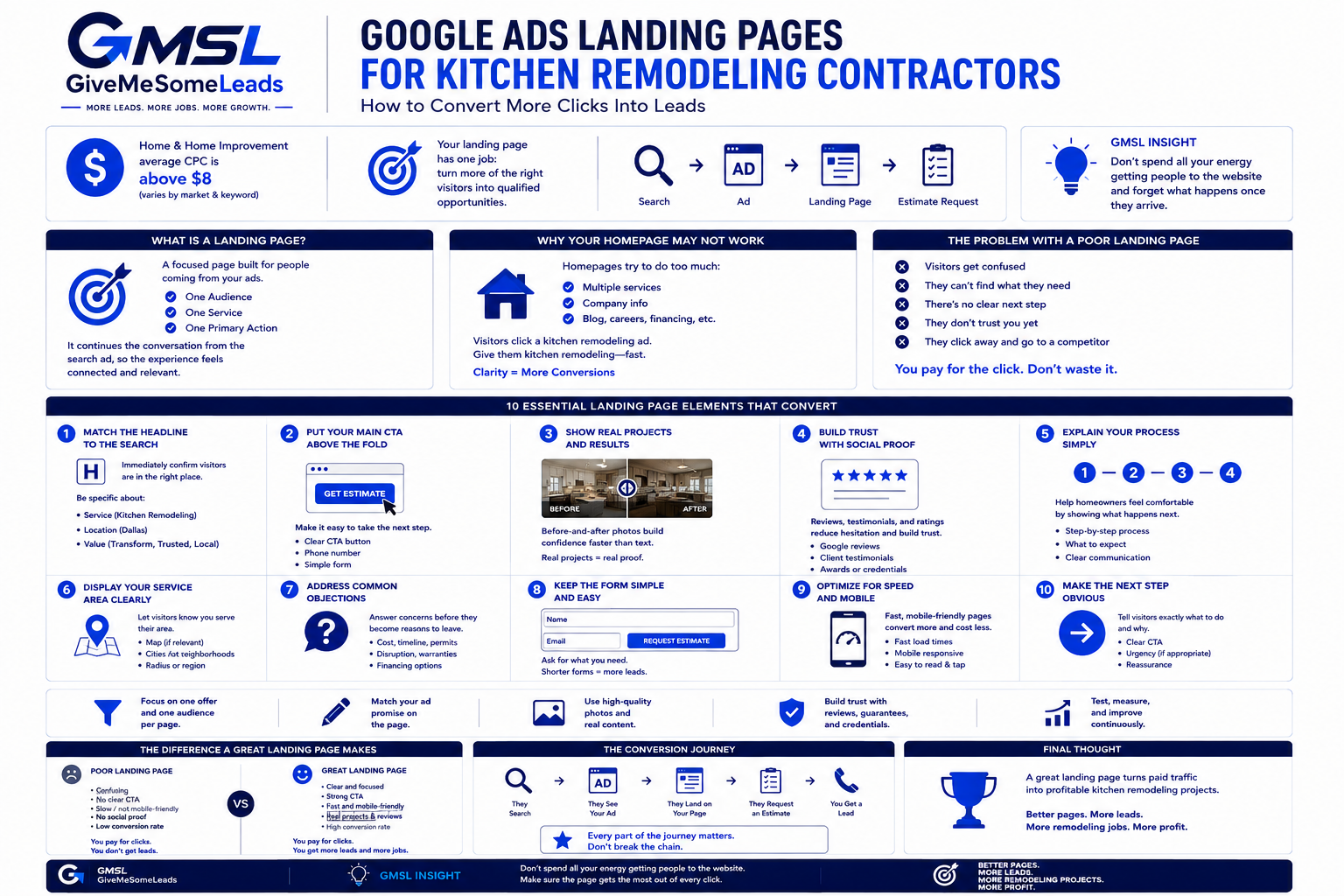
📊 Click the diagram to view a larger version. After opening it, turn your phone sideways for the best viewing experience.
Make Your Form Easy to Complete
Your contact form is often the final step before a visitor becomes a lead.
It should feel quick, simple, and effortless.
Every additional field creates another decision.
A basic estimate request form might include:
If you specialize in larger kitchen remodeling projects, a few qualification questions can also help.
When would you like to start?
What investment range are you considering?
The objective is not to collect every possible detail.
It is to start the conversation.
Why It Matters
A complicated form discourages good homeowners from contacting your business.
Most additional information can be gathered during the qualification call after you have already captured the lead.
One contractor asks visitors to complete a 15 field application before requesting an estimate.
Another asks only for the essential information and follows up with a short phone conversation.
Although both collect the same information eventually, the second contractor often generates significantly more inquiries because getting started feels much easier.
Review every field on your form and ask yourself one question:
If the answer is no, consider removing it.
Our approach has always been to reduce friction wherever possible.
We have consistently seen cleaner, simpler forms outperform longer ones because homeowners appreciate experiences that feel fast, natural, and straightforward.
The easier it is to request an estimate, the more opportunities your landing page has to convert qualified visitors into real conversations.
Consider Showing Pricing Context
Pricing is not appropriate for every landing page, but for many kitchen remodeling contractors it can be an effective way to improve lead quality.
Setting realistic expectations early helps homeowners determine whether your services align with their project before either of you invests time in a consultation.
Final investment depends on the size, scope, materials, and complexity of the renovation.
You may generate fewer inquiries.
That is not necessarily a bad thing.
The homeowners who contact you are often better informed and more aligned with the type of projects you want to build.
Why It Matters
Not every visitor is your ideal customer.
A landing page should help homeowners decide whether your company is the right fit just as much as it helps you identify qualified opportunities.
Two contractors receive the same amount of Google Ads traffic.
One hides all pricing information and schedules consultations with homeowners whose budgets range from $5,000 to $100,000.
The other explains that complete kitchen remodels typically begin around $40,000.
Although the second contractor receives fewer form submissions, the majority of those leads are already qualified for the services they provide.
You do not have to list exact prices.
Providing a realistic starting point or typical investment range is often enough to set expectations while still encouraging homeowners to contact you for a personalized estimate.
The goal of a landing page is not to convince every visitor to submit a form.
It is to encourage the right homeowners to reach out while naturally filtering out projects that are not a good fit.
Better qualified leads often create a healthier sales pipeline than simply generating more inquiries.
Create Separate Landing Pages for Different Campaigns
Not every homeowner is searching for the same type of remodeling project.
Someone searching for:
has different expectations depending on the search.
Sending every advertisement to the same landing page forces visitors to sort through information that may not be relevant to their specific project.
Instead, build dedicated landing pages whenever it makes sense.
Each page can focus on the services, projects, messaging, and customer concerns most relevant to that audience.
Why It Matters
The more closely your landing page matches the homeowner's search, the more relevant the experience becomes.
Relevance builds confidence, improves conversion rates, and often leads to better campaign performance.
A contractor runs separate Google Ads campaigns for complete kitchen remodels and luxury custom kitchens.
Instead of sending both audiences to the same generic page, each campaign directs homeowners to a landing page specifically built around that service.
The messaging, images, projects, and testimonials all match the visitor's expectations, creating a much stronger experience.
Think of your landing pages as extensions of your advertisements.
Every campaign should continue the same conversation from the keyword to the advertisement to the landing page.
One landing page rarely performs equally well for every service you advertise.
The more relevant you make each page to the homeowner's original search, the easier it becomes to build trust and generate qualified leads.
Consistency throughout the entire customer journey is often what separates average campaigns from exceptional ones.
Optimize for Mobile
A large percentage of homeowners will visit your landing page on a mobile device.
If your page is difficult to read, slow to load, or frustrating to navigate, many visitors will leave before ever contacting your business.
Your mobile experience should make requesting an estimate feel simple.
A homeowner should be able to understand your services and contact your company without zooming, pinching, or hunting for information.
Why It Matters
Google Ads generates traffic, but your website determines whether that traffic becomes qualified leads.
Even a beautifully designed desktop page can lose opportunities if the mobile experience feels slow or confusing.
Two contractors advertise the same kitchen remodeling service.
One landing page looks great on a desktop but requires constant zooming and scrolling on a phone.
The other is designed with mobile users in mind, making it easy to browse projects, read reviews, and request an estimate in just a few taps.
The second contractor creates a much smoother experience for today's homeowners.
Complete your own estimate request using your phone.
If anything feels confusing, slow, or unnecessary, there is a good chance your visitors feel the same way.
Many contractors evaluate their website on a large computer monitor even though many of their visitors arrive from a smartphone.
A landing page should be designed around the customer's experience, not the business owner's.
The easier your page is to use on mobile, the more opportunities you create to turn advertising clicks into qualified conversations.
Page Speed Matters
A beautiful landing page loses much of its value if homeowners leave before it finishes loading.
Every additional second creates another opportunity for someone to return to Google and contact another contractor instead.
Kitchen remodeling websites often contain large, high quality project photos, but those images should be optimized so they do not slow down the experience.
The goal is to deliver a professional looking website without sacrificing speed.
Why It Matters
Fast websites create a better first impression, improve user experience, and keep homeowners engaged long enough to explore your services and request an estimate.
Imagine clicking two Google Ads.
One website takes several seconds before anything useful appears.
The second loads almost instantly and immediately displays completed kitchen projects with a clear estimate button.
Most homeowners will not wait very long for the first website to catch up.
Large project photos are often the biggest cause of slow landing pages.
Compress images without noticeably reducing quality so homeowners enjoy beautiful visuals without long loading times.
We have found that speed is not just a technical metric.
It is part of the customer experience.
Every improvement that reduces waiting, removes frustration, or helps homeowners find information faster increases the likelihood they will continue exploring your business instead of returning to the search results.
Remove Unnecessary Distractions
Every landing page should have one clear objective.
Anything that does not support that objective deserves careful consideration.
Every section should help answer one important question:
If a section does not help answer that question, it may not belong on the landing page.
Why It Matters
The more decisions homeowners have to make, the more likely they are to postpone taking action altogether.
Simplicity helps visitors stay focused on the reason they clicked your advertisement.
One landing page includes dozens of navigation links, multiple service categories, blog articles, career opportunities, financing pages, and social media buttons.
Another keeps the visitor focused on kitchen remodeling, showcases completed projects, answers common questions, builds trust, and finishes with a simple estimate request.
The second page naturally guides homeowners toward becoming a lead.
Review your landing page section by section and ask yourself:
If not, consider removing or relocating it elsewhere on your website.
One thing we have consistently noticed is that higher converting landing pages often contain less, not more.
Removing unnecessary distractions allows the most important content to stand out and makes the path to becoming a customer feel much more natural.
Use Local Proof
One of the biggest advantages local contractors have is the ability to show real work completed in the communities they serve.
Instead of simply saying:
show homeowners exactly where that experience comes from.
Support those projects with:
When homeowners recognize neighborhoods or cities near their own, your business immediately feels more established and relevant.
Why It Matters
Homeowners naturally feel more comfortable hiring contractors who regularly work in their area.
Local proof reassures them that you are familiar with their community and have successfully completed similar projects nearby.
A homeowner living in Plano lands on your website.
Instead of only seeing generic kitchen photos, they discover a recently completed renovation only a few miles away, complete with project photos and a review from another Plano homeowner.
That project instantly feels more relatable than a gallery with no location or story behind it.
Whenever possible, connect your completed projects to the communities you serve.
One local project can strengthen your landing page, location pages, Google Business Profile, and Local SEO all at the same time.
The strongest proof is not always the biggest project.
It is often the most relatable one.
Homeowners want to know you have successfully completed projects for people just like them, in neighborhoods just like theirs.
Local proof helps transform your company from another contractor into a trusted part of the community.
Track Every Important Conversion
Generating clicks is only the beginning.
To understand whether your Google Ads campaigns are actually producing business, you need to track what happens after someone lands on your website.
Do not stop at measuring clicks or website visits.
Every stage provides valuable information about where your marketing can improve.
Why It Matters
Without accurate tracking, you are making decisions based on assumptions instead of data.
A campaign generating fewer leads may actually produce significantly more customers if those leads are higher quality.
2 Customers
6 Customers
At first glance, Campaign A appears more successful.
After reviewing your CRM, Campaign B clearly produced more business.
That is why tracking should not stop at the contact form.
Connect your website, call tracking, CRM, and advertising platforms whenever possible.
The more complete your data becomes, the easier it is to identify what is truly driving revenue.
Our philosophy has always been simple: marketing should be measured by customers, not clicks.
Every optimization becomes more valuable when you can trace it all the way from the first Google search to signed projects and revenue.
Measure Conversion Rate
Your landing page should continuously improve over time.
One of the easiest ways to measure that improvement is by tracking your conversion rate.
25 Leads
5% Conversion Rate50 Leads
10% Conversion RateAssume your Google Ads budget generated the same 500 visitors for both pages.
25 Leads
$200 Cost Per Lead50 Leads
$100 Cost Per LeadWhy It Matters
Small improvements in conversion rate can dramatically reduce your cost per lead without increasing your advertising budget.
Optimizing what happens after the click is often one of the fastest ways to improve campaign profitability.
Imagine increasing your landing page conversion rate from 6% to 9%.
Without generating a single additional visitor, your business begins producing significantly more estimate requests every month from the exact same advertising budget.
That is the power of continuous optimization.
Monitor conversion rates regularly, but always compare them alongside lead quality.
A page producing fewer but better qualified homeowners may ultimately generate much higher revenue.
The contractors who achieve the best long term results rarely build a landing page once and forget about it.
They continuously test, measure, learn, and improve.
Small improvements made consistently often outperform one major redesign because optimization is an ongoing process, not a one time event.
Do Not Optimize Conversion Rate Alone
A higher conversion rate does not automatically mean a better landing page.
The quality of the leads matters just as much as the quantity.
5 Customers
8 Customers
At first glance, Landing Page A appears to perform better because it generated more leads.
But after reviewing the results, Landing Page B produced significantly more paying customers.
Why?
The point is simple.
Why It Matters
Your ultimate goal is not to lower your cost per lead.
It is to increase your return on investment.
That means measuring the entire customer journey instead of stopping at the contact form.
15 Estimates
2 Customers20 Estimates
6 CustomersMost dashboards would celebrate Contractor A because they generated nearly twice as many leads.
The business owner would celebrate Contractor B because they generated three times as many customers.
That is the metric that actually pays the bills.
Review your landing page performance alongside your CRM or sales data whenever possible.
A page that produces fewer but better qualified opportunities is often far more valuable than one generating large amounts of unqualified traffic.
One thing we have learned from working with contractors is that lead generation is only the beginning.
A successful landing page should help attract homeowners who are genuinely interested in your services and are more likely to become profitable customers.
We believe marketing should always be optimized for business growth, not vanity metrics.
Test One Major Element at a Time
No landing page is ever truly finished.
The best performing pages continue improving through testing, learning, and ongoing optimization.
Rather than redesigning everything at once, focus on testing one meaningful change at a time.
Making one improvement at a time allows you to understand what actually influenced performance.
Why It Matters
If you change five different elements at once and your conversion rate improves, you will not know which change made the difference.
Small, controlled improvements produce much more reliable long term results.
A contractor changes only the headline on their landing page.
After several weeks, conversion rates improve by 18%.
Now they know the headline contributed to the improvement.
Next, they test a shorter estimate request form.
Then they test adding a recent kitchen renovation above the fold.
Over time, each improvement builds on the previous one, creating a landing page that consistently performs better than the original.
Do not make decisions based on opinions.
Let homeowner behavior guide your improvements.
Sometimes the smallest adjustment can produce a surprisingly large impact.
We do not believe there is such a thing as the perfect landing page.
Homeowner behavior changes, competitors improve, markets evolve, and businesses grow.
Our goal is continuous optimization, making small data driven improvements that gradually increase the number of qualified homeowners who become customers.
Those incremental gains often create a much bigger impact than one major redesign every few years.
A High Converting Kitchen Remodeling Landing Page Structure
Introduce the service, location, value proposition, and primary call to action.
Build confidence with reviews, ratings, certifications, and years of experience.
Showcase real kitchen transformations that demonstrate your craftsmanship.
Explain exactly what you offer and who you help.
Highlight what makes your business different from other contractors.
Help homeowners understand what to expect after contacting you.
Reinforce trust with real homeowner experiences.
Demonstrate your experience in the communities you serve.
Answer common concerns before they become objections.
Make requesting an estimate simple and obvious.
A high converting landing page is not necessarily the longest or the most visually impressive.
It is the one that answers the homeowner's questions, builds trust, removes uncertainty, and makes taking the next step feel easy.
Every section should have a purpose.
If it does not build trust, answer a question, remove an objection, or move the homeowner closer to requesting an estimate, it probably does not belong on the page.
Simplicity, relevance, and continuous improvement are often the biggest factors behind landing pages that consistently generate qualified remodeling opportunities.
Common Landing Page Mistakes
Any one of these issues can reduce the effectiveness of an otherwise well managed Google Ads campaign.
Why It Matters
A landing page does not have to be perfect to perform well, but removing obvious friction gives homeowners fewer reasons to leave without contacting your business.
Sometimes improving one weak area can generate more qualified leads without increasing your advertising budget.
Imagine two contractors investing the same amount in Google Ads.
One continually reviews their landing page, improves headlines, updates project photos, simplifies the estimate form, and adds new customer reviews.
The other launches a page once and never touches it again.
Several months later, the first contractor has a landing page that is significantly better at converting visitors into qualified opportunities, even though both businesses are spending the same amount on advertising.
Review your landing page regularly as if you were a homeowner visiting it for the first time.
Small improvements made consistently often outperform large redesigns completed once every few years.
The highest performing landing pages are rarely created in a single day.
They evolve over time as contractors learn more about their customers, review campaign data, answer common questions, and continue refining the experience.
We believe every landing page can be improved, and the goal is not perfection. It is continuous optimization that generates more qualified homeowners month after month.
A Better Google Ads Landing Page System
Every successful remodeling project creates another opportunity to strengthen your marketing.
That new kitchen can become:
Instead of treating your landing page as something you build once, think of it as a marketing asset that grows alongside your business.
A landing page is not just designed to generate today's estimate requests.
It should become smarter and stronger with every project you complete.
Every homeowner you help creates new proof that can improve your marketing, increase trust, and help future visitors feel confident choosing your company.
That is why we view landing pages as living marketing assets that continuously evolve rather than static webpages that remain unchanged for years.
Frequently Asked Questions
Do kitchen remodeling contractors need a separate Google Ads landing page?
Not always, but a dedicated landing page can create a more focused experience than a general homepage, especially when the ad targets a specific service or market.
What should be on a kitchen remodeling landing page?
Include a clear headline, real projects, reviews, trust signals, service information, remodeling process, service area, contact form, phone number, and strong CTA.
Should I remove the navigation menu?
For dedicated paid landing pages, reducing unnecessary navigation can help maintain focus. The right approach depends on your website and campaign.
Should I show kitchen remodeling prices?
Pricing ranges or starting prices can help qualify homeowners when they accurately represent your typical projects. Pricing varies significantly between contractors and project scopes.
How long should the landing page be?
Long enough to answer the questions a serious homeowner needs answered. A high-value kitchen renovation often requires more trust and explanation than a low-cost service.
Should I use stock photos?
Real project photography is generally much stronger because it demonstrates your actual work. Stock photos can make it harder for homeowners to evaluate your experience.
How many form fields should I use?
Ask only for information that helps you contact or qualify the homeowner. More fields may reduce submissions, but strategic qualification can sometimes improve lead quality.
What conversion rate should my landing page have?
There is no universal ideal. Conversion rate varies by traffic source, keyword intent, offer, market, project value, and qualification. Compare your own performance over time and measure qualified leads and customers as well.
How do I know if my landing page is working?
Track Traffic → Leads → Qualified Leads → Estimates → Customers → Revenue. The page producing the most profitable customers is more valuable than the page producing the most form submissions.
Final Thoughts
Google Ads gets homeowners to your door. Your landing page determines what they see when they arrive.
Make the experience relevant.
If they searched for kitchen remodeling, show kitchen remodeling. If they searched in Dallas, make your local relevance clear.
Show real projects. Show reviews. Explain your process. Make contacting you easy. Track what happens after the form is submitted.
The biggest mistake is thinking your Google Ads campaign ends when someone clicks.
The click is only the beginning.
Your keyword creates the opportunity. Your ad earns the click. Your landing page builds confidence. Your follow-up creates the conversation. Your sales process wins the project.
Final Thought: At GiveMeSomeLeads, we believe the highest converting landing pages are often the simplest. Every unnecessary section, form field, or distraction creates more friction and gives homeowners another reason to leave. A clear message, a straightforward call to action, and an easy way to request an estimate will almost always outperform a page that tries to explain everything or convince everyone. The goal isn't to impress visitors with complexity. The goal is to make contacting your business feel fast, natural, and effortless.
Before increasing your Google Ads budget, make sure your landing page is giving every qualified click a strong chance to become a profitable kitchen remodeling project.
Ready to Convert More Google Ads Traffic Into Kitchen Remodeling Leads?
GiveMeSomeLeads helps kitchen remodeling contractors improve Google Ads performance through high-intent campaigns, focused landing pages, conversion tracking, lead qualification, and customer-focused optimization.
- Google Ads landing page strategy
- Conversion optimization and qualification
- Lead, estimate, and customer tracking