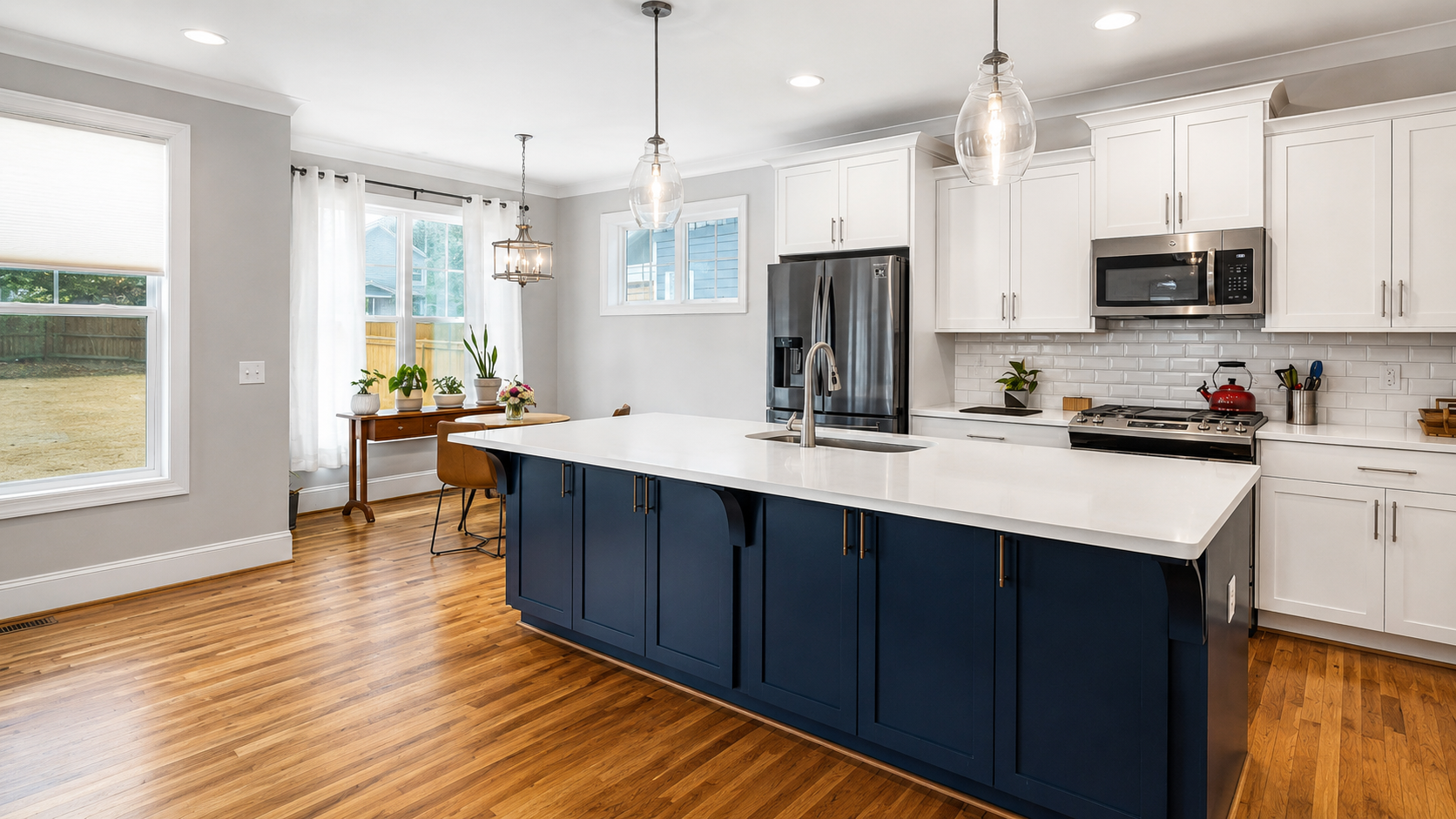
Kitchen remodeling is almost made for social media.
A dated kitchen can become a bright, modern space in seconds through a before-and-after video.
That is exactly what makes Facebook and Instagram interesting for kitchen remodeling companies.
Unlike Google Ads, where homeowners are actively searching for a contractor, Facebook Lead Ads can reach homeowners before they have started searching.
A homeowner sees your project, likes the transformation, becomes curious about their own kitchen, clicks the ad, and requests more information.
The opportunity is significant. There is one important catch.
Generating Facebook leads is relatively easy. Generating qualified remodeling opportunities is much harder. Facebook is primarily a discovery platform rather than a high intent search platform, which means many homeowners are introduced to your company before they are actively looking for a contractor. That does not make Facebook less valuable. Every business needs to be seen before it can be chosen. As we have mentioned before in other articles, our philosophy is to diversify your marketing across multiple channels. Combining Facebook Ads, Google Ads, Local SEO, referrals, and other lead sources helps create a more consistent flow of qualified opportunities while reducing the risk of relying on a single source for new customers.
What Are Facebook Lead Ads?
Facebook Lead Ads allow home improvement contractors to collect information from potential customers directly through Facebook and Instagram without requiring them to visit a website first.
Instead of asking homeowners to click through multiple pages, Facebook displays a lead form immediately after they interact with your advertisement, making it faster and easier to request information.
For a kitchen remodeling company, the process typically looks like this:
Why It Matters
Many homeowners spend time on Facebook and Instagram long before they begin searching Google for a remodeling contractor.
Facebook Lead Ads allow you to introduce your company earlier in that decision making process while making it simple for interested homeowners to contact you.
Meta reports that Lead Ads reduce friction by allowing people to submit their information without leaving Facebook or Instagram, helping businesses generate leads directly within the platform.
A homeowner scrolling Instagram notices a dramatic before and after kitchen transformation.
Curious about the renovation, they tap Learn More.
Within seconds they submit a consultation request without ever leaving Instagram.
Your team receives the lead immediately and contacts the homeowner while the project is still fresh in their mind.
Facebook Lead Ads should make requesting information easier, not replace your sales process.
The goal is simply to begin the conversation with qualified homeowners.
One important thing to remember is that Facebook should not be treated exactly like Google Ads.
Google captures existing demand. Facebook helps create and influence demand before homeowners begin actively comparing contractors.
Understanding that difference changes how you build campaigns, qualify leads, and measure success.
Why Facebook Lead Ads Can Work for Kitchen Remodeling
Kitchen remodeling is naturally one of the strongest services to advertise on Facebook because homeowners can immediately see the transformation.
Strong creative may include:
Why It Matters
People do not visit Facebook looking for a contractor.
They are looking for entertainment, inspiration, and ideas.
Your creative needs to interrupt that experience naturally by showing something worth stopping for.
Professional Kitchen Remodeling Services
A stock image and generic messaging provide very little visual proof.
Real Kitchen Transformation
An outdated kitchen transforms into a bright custom space with a large island and modern cabinetry.
Most homeowners stop scrolling for the second advertisement because it immediately demonstrates the final result.
Document every project from beginning to end.
Every completed kitchen becomes future advertising material.
One of our core philosophies is that contractors already create their best advertising every day.
Every completed project can generate photos, videos, reviews, case studies, website content, social media posts, and future Facebook campaigns.
The companies that consistently document their work build stronger marketing assets over time.
Facebook Leads vs Google Leads
Although both platforms can generate kitchen remodeling leads, they work very differently.
Existing Demand
The homeowner is already searching for a contractor.
Earlier Discovery
A homeowner may simply be scrolling through Facebook or Instagram when they see one of your completed kitchen projects.
Because of this, Facebook leads are often earlier in the buying journey.
They may need more education, stronger trust signals, additional follow up, and more time before making a decision.
Why It Matters
Many contractors become frustrated because they expect Facebook leads to behave exactly like Google leads.
They should not.
Google captures existing demand. Facebook helps create demand and introduces your business before homeowners begin actively comparing contractors.
One homeowner searches Google for a kitchen remodeling contractor and requests an estimate the same afternoon.
Another sees a beautiful kitchen transformation on Instagram and continues seeing projects and testimonials over the next several weeks before finally requesting a consultation.
Both become customers. They simply followed different buying journeys.
Judge Facebook campaigns using qualified leads, consultations, customers, and revenue instead of expecting the same buying behavior you typically see from Google Ads.
One of our biggest philosophies is that every marketing platform has a different role inside a customer acquisition system.
Google captures homeowners who are actively searching today.
Facebook introduces your business earlier in the decision making process so that when homeowners are finally ready, your company is already familiar.
Your Creative Is the First Qualification Layer
Unlike Google Ads, where keywords determine much of who sees your advertisements, Facebook relies heavily on your creative to attract the right homeowners.
The projects, videos, messaging, and images you choose immediately influence the type of leads your campaigns generate.
Showing premium work naturally attracts homeowners looking for similar projects while discouraging people searching for small repairs or inexpensive cosmetic updates.
Why It Matters
Great creative does more than generate attention.
It helps homeowners decide whether your company is the right fit before they ever submit a lead form.
One remodeling company advertises beautiful custom kitchens with large islands, premium cabinetry, and luxury finishes.
Another advertises generic remodeling images without showing any actual projects.
The first company immediately communicates the type of work they specialize in, helping attract homeowners interested in similar renovations.
Use your own completed projects whenever possible.
Real kitchens create far more trust than stock photography because homeowners can immediately see the quality of your craftsmanship.
One of our core philosophies is that every advertisement should qualify prospects before they ever contact your business.
Strong creative does not just generate more leads. It generates better leads by attracting homeowners who already appreciate the type of remodeling work you want more of.
Before and After Ads
Few advertising formats are more effective for kitchen remodeling than before and after transformations.
A dramatic visual comparison immediately shows homeowners what is possible without requiring a lengthy explanation.
A simple call to action might be:
Why It Matters
Homeowners do not just want to hear that you are experienced. They want to see the results you deliver.
Before and after projects remove uncertainty by showing real transformations completed by your company.
One advertisement shows a company logo with several paragraphs describing kitchen remodeling services.
Another shows an outdated kitchen transformed into a bright modern space with new cabinetry, countertops, and lighting.
Most homeowners stop scrolling for the transformation because it immediately communicates the value of the renovation.
Capture every project from multiple angles before demolition begins and again after completion.
Building a library of real transformations gives you months of advertising content.
One thing we've consistently seen is that your completed projects are your strongest sales tool.
Every finished kitchen should continue generating value long after construction ends by helping attract the next qualified homeowner.
Video Can Show the Entire Transformation
Video allows homeowners to experience the remodeling journey instead of only seeing the finished result.
Even a simple 15 to 30 second video can show:
Professional production is not always necessary.
Many homeowners respond well to authentic project footage because it feels genuine and believable.
Why It Matters
Video helps homeowners visualize what working with your company looks like.
Seeing the process builds confidence while demonstrating the quality of your craftsmanship.
Instead of posting only the finished kitchen, a remodeling company records short clips throughout the project.
The final advertisement shows the complete transformation from demolition to completion in under 30 seconds.
Homeowners do not just see the result. They experience the journey.
Your crews do not need expensive cameras.
Modern smartphones can capture excellent footage that becomes valuable advertising content when recorded consistently throughout each project.
One of our core philosophies is that documenting projects should become part of your remodeling process.
Every kitchen creates photos, videos, reviews, project pages, social media content, and future advertisements.
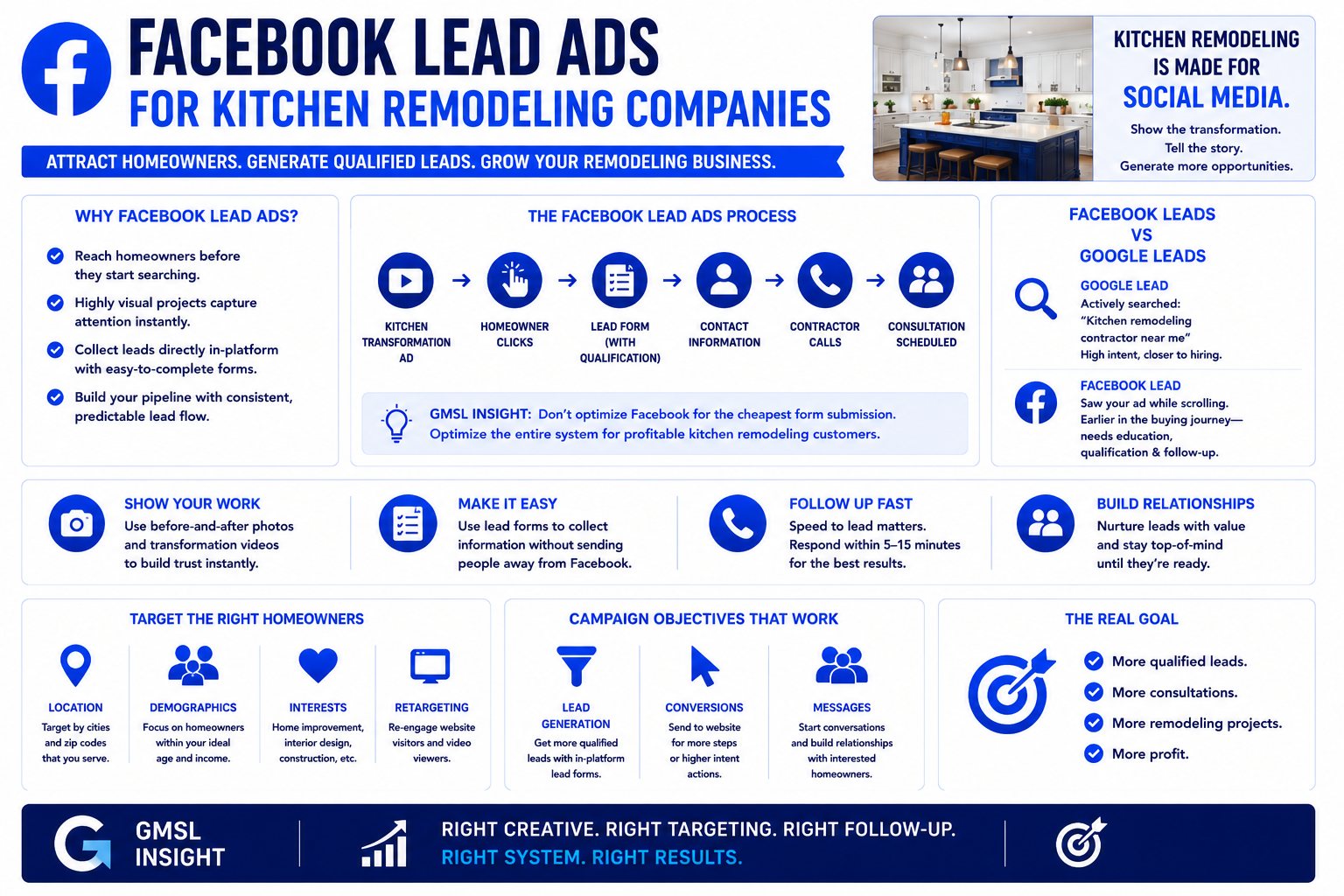
📊 Click the diagram to view a larger version. After opening it, turn your phone sideways for the best viewing experience.
Build a Better Lead Form
Generating more leads is not always the goal.
One of the biggest mistakes contractors make with Facebook Lead Ads is creating forms that are too simple.
A form asking only for a name, phone number, and email address may increase submissions, but it provides very little information about the homeowner or the project.
What Type of Project Are You Considering?
When Would You Like to Begin?
What Investment Range Are You Considering?
Location
Ask for the homeowner's ZIP code so your team immediately knows whether the project falls within your service area.
Why It Matters
Qualification begins before your first phone call.
Collecting a small amount of useful information allows your team to prepare for the conversation while helping identify homeowners who are more likely to become qualified consultations.
Two remodeling companies spend the same amount on Facebook advertising.
The first asks only for a name and phone number.
The second also asks about project type, desired timeline, investment range, and ZIP code.
Although the second company generates fewer submissions, its sales team spends significantly less time contacting homeowners who are outside the service area or looking for projects they do not offer.
Every question should have a purpose.
If the answer is no, it probably does not belong on the form.
Our perspective is simple: lead quality always matters more than lead quantity.
We would rather generate fewer homeowners who are genuinely interested in moving forward than a large number of submissions that never become consultations.
Do Not Over Qualify Either
While qualification is important, asking too many questions can reduce conversions.
A long form may discourage legitimate homeowners from completing it simply because the process feels complicated.
Why It Matters
Every additional question creates a small amount of friction.
Some questions improve lead quality. Others simply reduce the number of people willing to complete the form.
A remodeling company tests two Lead Forms.
The first asks only three questions. The second asks fifteen.
The longer form generates fewer submissions and does not significantly improve customer quality because many of the extra questions are discussed during the consultation anyway.
Start with a shorter form and allow your sales process to handle the remaining qualification.
Your goal is to begin the conversation, not complete the entire sales process before making the first phone call.
One of our core philosophies is to keep everything as simple as possible.
The easier you make it for qualified homeowners to contact your business, the more opportunities you will have to build relationships and guide them through the remodeling process.
Use Pricing to Set Expectations
Pricing can become one of the simplest ways to improve lead quality.
If your company specializes in larger kitchen remodeling projects, giving homeowners some pricing context helps them understand the type of investment your services typically require.
Some homeowners may decide your services are not the right fit.
That is okay.
Why It Matters
Many poor quality leads result from mismatched expectations rather than poor advertising.
Providing realistic pricing guidance allows homeowners to self qualify before contacting your company.
A homeowner planning a complete kitchen renovation sees your advertisement.
After reading that most full remodels begin around $35,000, they understand the level of investment involved before requesting a consultation.
Instead of creating surprise during the sales call, your pricing has already helped establish realistic expectations.
You do not need to publish exact prices.
Providing typical project ranges or starting prices is often enough to help homeowners understand whether your company is the right fit.
One principle we follow is that transparency improves lead quality.
When homeowners understand your services and pricing expectations before contacting you, conversations become more productive and estimates become more qualified.
What Should the Offer Be?
Free Estimate is one of the most common offers used by kitchen remodeling companies, but it is not the only option.
The important part is making sure your offer accurately reflects what happens next.
Why It Matters
Your offer influences both the number of leads you generate and the quality of those leads.
An offer that matches your actual sales process attracts homeowners with realistic expectations.
Free Estimate
Schedule Your Kitchen Remodeling Consultation
The second offer immediately tells homeowners they are beginning a conversation with a remodeling professional rather than receiving an instant price over the phone.
Choose one primary offer and use it consistently throughout your advertisements, landing pages, and website.
One important thing to remember is that marketing should reduce confusion, not create it.
Clear offers attract better homeowners because they understand exactly what to expect before they contact your company.
Target the Right Geographic Area
Even the best lead is not valuable if the project falls outside your service area.
As you collect more data, you will begin identifying which locations consistently produce your best customers.
Why It Matters
Every mile outside your ideal service area increases travel time, estimating costs, scheduling complexity, and overall project expenses.
A remodeling company initially advertises across an entire metropolitan area.
After several months they discover that homeowners within a 20 mile radius consistently generate larger projects and higher close rates than leads farther away.
They shift more of their budget toward the locations producing the strongest business results.
Review your completed projects every few months.
You may discover neighborhoods or cities that consistently generate larger remodeling projects and healthier profit margins.
One of our core philosophies is that your marketing should follow your business data.
Instead of guessing where your best customers live, let your completed projects, revenue, and close rates guide future advertising decisions.
Speed to Lead Matters
Facebook leads can become cold surprisingly quickly.
Many homeowners submit a lead form while casually scrolling Facebook or Instagram.
Only minutes later they may already be focused on something completely different.
The first conversation should remind homeowners why you are contacting them because they may not immediately remember your company or the advertisement they interacted with.
Why It Matters
The sooner you begin the conversation, the more likely the homeowner is to remember your advertisement and remain engaged.
Fast responses also demonstrate professionalism and improve the overall customer experience.
Two remodeling companies receive identical Facebook leads.
One waits until the following morning.
The other responds within fifteen minutes using a phone call followed by a friendly text message.
The second company begins the conversation while the homeowner still remembers submitting the form.
Automate lead notifications whenever possible so your team knows immediately when a new consultation request arrives.
The way we look at it is simple: marketing does not stop when someone submits a form.
Generating the lead creates the opportunity. Fast, professional follow up is what turns that opportunity into a real consultation and eventually a new customer.
Do Not Stop After One Call
Not every qualified homeowner answers the phone the first time.
They may be working, driving, helping their family, or simply unavailable when you call.
Use a professional follow up process that includes a combination of phone calls, text messages, and email while giving homeowners multiple opportunities to continue the conversation.
Why It Matters
Kitchen remodeling is a major investment, and homeowners rarely make decisions immediately.
A consistent follow up process helps prevent qualified opportunities from disappearing simply because the first call went unanswered.
A homeowner requests a kitchen remodeling consultation during lunch.
Your team calls fifteen minutes later, but they are in a meeting.
Instead of marking the lead as lost, your team sends a friendly text message, follows up with an email later that day, and calls again the following afternoon.
The homeowner answers the second call and schedules an estimate.
Create a simple follow up process that every team member follows consistently.
A repeatable system produces more predictable results than relying on memory.
From what we've observed is that many businesses do not actually have a lead generation problem.
They have a follow up problem.
Great marketing creates opportunities, but consistent follow up is what turns those opportunities into conversations and eventually into customers.
Connect Your CRM and Lead Data
Generating leads is only the beginning.
To understand whether your Facebook campaigns are actually working, you need to know what happens after each homeowner submits a form.
The more information you collect, the easier it becomes to identify which campaigns generate real business instead of simply producing form submissions.
Why It Matters
If leads remain inside Facebook without being tracked, it becomes almost impossible to know which campaigns deserve more investment.
Following the complete customer journey allows you to make better marketing decisions based on real business results.
A remodeling company discovers two campaigns generating the same number of Facebook leads.
After reviewing their CRM, they realize one campaign consistently produces qualified consultations while the other generates very little actual business.
They adjust their advertising budget based on customer data instead of lead volume alone.
Keep your CRM stages simple.
The easier they are to update, the more likely your team will use them consistently.
One of our core philosophies is that every lead should continue telling its story after the form is submitted.
The closer your marketing data gets to actual customers and revenue, the easier it becomes to optimize your campaigns with confidence rather than assumptions.
Measure Qualified Leads, Not Just CPL
Cost Per Lead is one of the most commonly tracked Facebook advertising metrics.
It is also one of the most misunderstood.
| Metric | Campaign A | Campaign B |
|---|---|---|
| Ad Spend | $2,000 | $2,000 |
| Leads | 50 | 25 |
| Cost Per Lead | $40 | $80 |
| Qualified Leads | 10 | 15 |
| Estimates | 4 | 9 |
| Customers | 1 | 3 |
Why It Matters
Lead volume does not pay the bills.
Qualified consultations, completed projects, and profitable customers do.
A remodeling company almost pauses one of its Facebook campaigns because the Cost Per Lead is nearly double the others.
After reviewing its CRM, the company discovers those leads consistently become larger kitchen remodeling projects with significantly higher close rates.
Instead of reducing the budget, the company increases it because the campaign is producing better business results.
Track your marketing through the complete customer journey.
The closer your reporting gets to actual revenue, the better your marketing decisions become.
From our experience working with contractors is that marketing should never be measured by lead volume alone.
Our goal is not to generate the most leads. It is to generate the most qualified leads because those are the homeowners who actually schedule consultations, approve estimates, and become profitable customers.
Test Your Creative
Even great advertisements eventually lose effectiveness.
Homeowners become familiar with your content, trends change, and different projects naturally attract different audiences.
The goal is not to change everything at once.
Instead, test one element at a time so you clearly understand what influenced performance.
Why It Matters
Consistent testing helps improve your campaigns over time while preventing advertising fatigue.
Small improvements made regularly often produce much larger long term gains than making dramatic changes all at once.
A remodeling company runs two nearly identical advertisements.
The only difference is the featured kitchen.
One advertisement generates twice as many qualified consultations because homeowners respond more positively to the larger transformation.
Document the results of every test.
After several months you will begin identifying patterns that help you build stronger campaigns faster.
One of our core philosophies is that marketing is a continuous optimization process.
There is no perfect advertisement because homeowner preferences, competition, and market conditions constantly change.
Retarget Interested Homeowners
Not every homeowner who sees your Facebook ad is ready to request a consultation immediately.
Some may visit your website, view your projects, or watch one of your videos before continuing with their day.
That does not mean they are not interested.
Each advertisement answers another question the homeowner may have before they are ready to contact your company.
Why It Matters
Kitchen remodeling is rarely an impulse purchase.
Homeowners often spend weeks or months researching ideas, comparing contractors, discussing budgets, and planning their projects.
Remaining visible throughout that process increases the likelihood they will remember your company when it is time to request an estimate.
A homeowner watches one of your kitchen transformation videos but does not submit the lead form.
A few days later they see another advertisement featuring a customer testimonial.
Later that week they see a completed kitchen project in their neighborhood.
After visiting your website again, they finally schedule a consultation.
Show different content at each stage of the customer journey.
Instead of repeating the same advertisement, gradually build confidence by introducing projects, reviews, testimonials, and your remodeling process.
One lesson we've learned is that trust is built through repeated positive interactions.
Retargeting is not about reminding homeowners that you exist. It is about continuously providing the proof they need to feel confident choosing your company.
Turn Completed Projects Into Future Leads
Every completed kitchen has the potential to generate future business.
Why It Matters
Your marketing becomes stronger every time you complete another successful project.
Instead of constantly searching for new content ideas, your business naturally creates its own marketing assets through the work you are already doing.
A contractor finishes a beautiful kitchen renovation.
One project supports months of marketing across multiple platforms.
Create a simple photo and video checklist for every crew.
Consistently documenting projects is much easier than trying to recreate them after construction has finished.
One of our core philosophies is that marketing should compound over time.
Every completed kitchen should make it easier to generate the next one.
Common Facebook Lead Ad Mistakes
More leads do not automatically mean a better campaign. Weak targeting, poor qualification, slow follow up, and incomplete tracking can make even inexpensive leads unprofitable.
A Simple Facebook Lead Ads System
Successful Facebook advertising is not just about creating attractive advertisements.
It is about building a complete customer acquisition system that guides homeowners from their first interaction all the way to becoming a satisfied customer.
Each completed project strengthens the next campaign, creating a marketing system that improves over time instead of starting from scratch.
Why It Matters
When every part of your marketing works together, Facebook becomes much more than a source of random form submissions.
It becomes a more predictable system for generating qualified homeowners while continuously building trust and strengthening your brand.
A remodeling company consistently documents projects, collects reviews, updates its portfolio, follows up quickly, and tracks every consultation through its CRM.
Over time, each completed kitchen improves the next advertising campaign because the business has more proof, more testimonials, and better data to optimize future marketing.
Build your marketing as one connected system rather than a collection of separate tactics.
Every advertisement, consultation, completed project, review, and testimonial should strengthen the next opportunity.
One principle we follow is that Facebook Lead Ads are only one piece of a much larger marketing system.
Long term success comes from connecting advertising, qualification, follow up, customer experience, reviews, project documentation, and continuous optimization.
Businesses that treat marketing as an ongoing system instead of individual campaigns are usually the ones that generate the highest quality customers and continue growing year after year.
Frequently Asked Questions
Do Facebook Lead Ads work for kitchen remodeling companies?
They can. Kitchen remodeling is highly visual, which makes before-and-after photos and transformation videos particularly suitable for Facebook and Instagram. Performance depends heavily on creative, qualification, targeting, and follow-up.
Are Facebook leads lower quality than Google leads?
Not necessarily, but they often begin earlier in the buying journey. Google Search captures active search intent, while Facebook may introduce your company before someone starts actively looking for contractors.
Should I use an instant form or send people to my website?
Both approaches can work. Instant forms reduce friction, while a website or landing page gives you more room to educate and build trust. Judge them by qualified leads and customers rather than form volume alone.
Should I ask for budget on the form?
For higher-value remodeling projects, a budget-range question can help set expectations and qualify opportunities.
What creative works best for kitchen remodeling?
Real before-and-after projects, transformation videos, walkthroughs, testimonials, and project stories are strong starting points.
How quickly should Facebook leads be contacted?
As quickly as reasonably possible. Social leads can lose momentum quickly, so a reliable notification and follow-up system is important.
What should I do when a lead does not answer?
Use a reasonable combination of calls, texts, and emails. One unanswered call does not necessarily mean the homeowner is not interested.
What is a good cost per Facebook lead?
There is no universal number. A profitable CPL depends on lead quality, estimate rate, close rate, project value, margins, and customer acquisition cost.
How should I measure Facebook Lead Ads?
Track Spend → Leads → Qualified Leads → Estimates → Customers → Revenue. Cost per customer and profitability matter more than cost per lead.
Final Thoughts
Facebook Lead Ads can be a powerful tool for kitchen remodeling companies.
But the strategy is not Run Ad → Get Cheap Leads.
It is:
Show Great Work → Capture Interest → Qualify → Respond → Follow Up → Estimate → Customer
Kitchen remodelers have an advantage because their finished work naturally creates compelling advertising.
Use real transformations, set realistic expectations, ask enough questions to identify good opportunities, respond quickly, and track what happens after every lead.
The lead form starts the conversation. What happens afterward determines whether it becomes a kitchen remodel.
Ready to Generate More Qualified Leads?
GiveMeSomeLeads helps kitchen remodeling contractors generate more qualified leads by building marketing systems that can be measured, improved, and scaled using real performance data instead of guesswork.
- Marketing strategies focused on qualified leads
- Landing pages designed to convert more homeowners
- Lead tracking and performance analysis to improve ROI